Fewer than 5,000 wild Torrey pines are thought to exist, confined to a handful of groves on the Southern California coast and a single Channel Island. That scarcity makes Pinus torreyana one of the rarest pine species on Earth despite its familiarity as a garden and street tree across San Diego.
The Torrey pine is a conifer in the family Pinaceae, endemic to the California coastal sage and chaparral ecoregion, and is currently listed as Critically Endangered. Its twisted, bonsai-like form along the bluffs of Del Mar and Torrey Pines State Natural Reserve has made it a defining image of the San Diego coastline, and its precarious survival gives its story an urgency beyond its striking looks.
Identification and Appearance
The clearest field mark is the needle count: Torrey pine is the only pine in its range with five needles per fascicle, and those needles are unusually long, running 25 to 30 centimeters (9.8 to 11.8 inches). This sets it apart at a glance from other regional conifers.
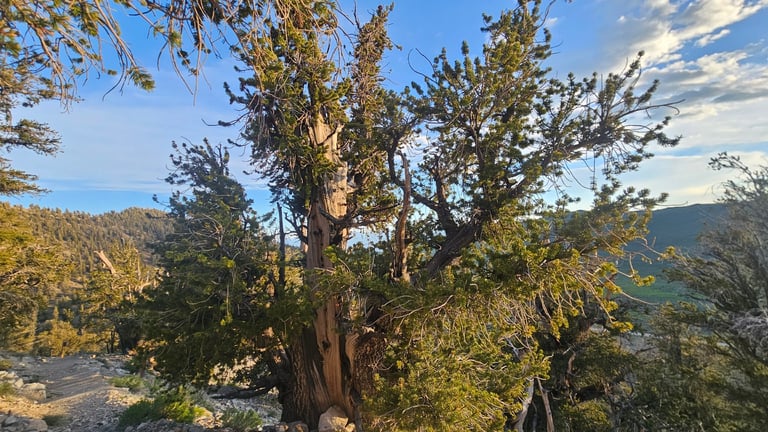
Mature trees grow 8 to 17 meters (26 to 56 feet) tall in the wild, with a broad, open, irregular crown rather than a neat conical shape typical of many pines. Coastal specimens exposed to constant onshore wind are often twisted into sculptural, bonsai-like forms, while trees growing further inland or in cultivation tend to be taller and more upright.
Cones are stout and heavy, 8 to 15 centimeters (3.1 to 5.9 inches) long and about as wide, and hold large, hard-shelled seeds that are edible. Like all pines, Torrey pine produces small flower-like structures called strobili: the male strobilus looks like a yellow bud, while the female strobilus resembles a small red cone.
Some trees develop a dense, tangled cluster of needles known as witch's broom or
Distribution and Habitat
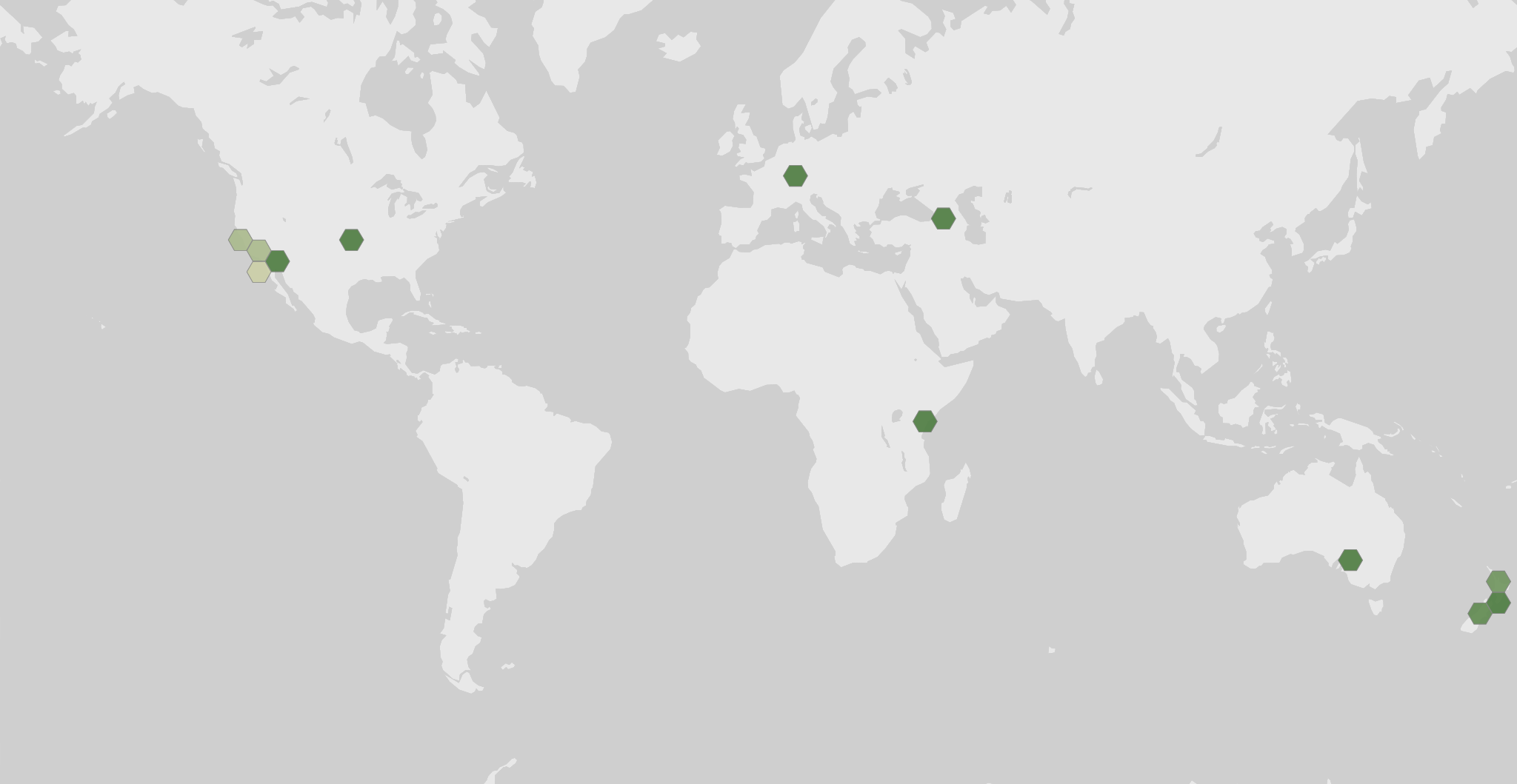
Torrey pine survives in only three places: a narrow coastal strip in San Diego County, two groves on Santa Rosa Island off the Santa Barbara coast, and a stand of old, massive trees around Pacific Grove on the Monterey County coast. The Santa Rosa Island and Monterey trees belong to the variety Pinus torreyana var. insularis.
Within its range the species grows on ridgetops, slopes, gullies, canyons, and coastal mesas at elevations of about 60 to 150 meters (200 to 500 feet), rooted in open, shallow, humus-poor sandy soils. It forms the Torrey pine forest, the only southern California coastal pine forest, part of the broader California closed-cone pine forests that grade into coastal sage scrub, chaparral, dune scrub, and salt marsh. On Santa Rosa Island it forms a distinct Torrey pine woodland, ranging from nearly pure stands with a litter understory to more open mixed stands with California scrub oak.
The climate across its range is maritime, with low winter rainfall and frequent fog that supplies the moisture the trees need to survive through dry summers. Monthly observation counts peak in April at 467 sightings and stay lowest around November at 185, a pattern that likely reflects when people visit and record the trees rather than any true seasonal change in the population, since these are presence records, not counts of abundance.
Associated plants across its range include chamise, California sagebrush, toyon, lemonadeberry, California scrub oak, California buckwheat, and several ceanothus and manzanita species, reflecting its close ties to coastal sage scrub and chaparral communities.
Ecology and Relationships
Torrey pine anchors itself in poor, sandy soil with an unusually extensive root system: a young seedling can push a taproot 60 centimeters (24 inches) down within its first season, and a mature tree's roots may extend as far as 75 meters (246 feet) in search of water and nutrients. This root architecture lets the species persist on ridgetops and mesas where little else can establish.
The tree depends entirely on animals to spread its seeds. Unlike most pines, its seed wings are papery, break off easily, and are functionally useless, so effective dispersal falls to birds and rodents. The California scrub jay is the single most important disperser on the mainland, and jays and squirrels are thought to be carrying seeds from garden trees into nearby parklands around San Diego. Cold, moist stratification of the seeds also encourages germination in the wild.
The caterpillars of the moth Gloveria arizonensis are confirmed to feed on Torrey pine in the wild, giving the species a documented, if narrow, role in the local food web.
Uses and Human Relationships
Despite its rarity in the wild, Torrey pine is a popular ornamental tree across San Diego, coastal and inland Southern California, and even parts of the Central Valley, and is sold by at least ten California nurseries as of 2020. Cultivated trees can grow far larger and faster than their wild counterparts: a single tree planted in a San Diego suburb in the 1940s or 1950s reached 108 feet (33 meters), and the Shipley Nature Center states the species can reach 148 feet (45 meters) in cultivation.
The species has also been trialed as a plantation forestry tree outside the United States, including in Australia, New Zealand, and Kenya.
In San Diego County the tree is a genuine local icon, lending its name to Torrey Pines State Natural Reserve, Torrey Pines State Beach, Torrey Pines Golf Course, Torrey Pines High School, Torrey Pines Gliderport, and numerous local roads, parks, and businesses.
Conservation and Threats
Torrey pine is listed as Critically Endangered, and its wild population is counted only within Torrey Pines State Natural Reserve and the groves on Santa Rosa Island, excluding the many ornamental trees planted around San Diego and elsewhere. Estimates vary: the population stood at roughly 9,000 individuals in the 1970s, had fallen to about 3,000 by 2016 according to the California Native Plant Society, and was put at 4,500 by Aljos Farjon's 2011 IUCN assessment, which also noted a slow ongoing decline, especially outside the reserve.
The main threats include forest fires, drought, repeated bark beetle infestations, and stress from air pollution; a fire that started on Santa Rosa Island on May 15, 2026 raised concern that it could reach the island's groves. These pressures follow a long decline from a low of only about a hundred surviving trees in the early 20th century.
The species receives some legal protection: the city of Del Mar, near the native habitat, protects Torrey pines under a tree ordinance that requires a permit before any tree can be removed.
Fun Facts
- Pine nuts from the Torrey pine were an important food source for the Kumeyaay tribe and the Chumash nations of Indigenous American people.
- The species is also known as the Del Mar Pine, after the Southern California coastal town where many wild trees grow.
- Beyond California, Torrey pine has been trialed as a plantation forestry species in Australia, New Zealand, and Kenya, far outside its native climate.
- Some trees develop witch's broom, a dense tangle of needles nicknamed a
Photos
Photographs from via iNaturalist, licensed under CC0 1.0., by Bruce Slater via iNaturalist, licensed under CC BY 4.0., by Matt Berger via iNaturalist, licensed under CC BY 4.0., by Gavin Skeen via iNaturalist, licensed under CC BY 4.0., by Konshau Duman via iNaturalist, licensed under CC BY 4.0., and by Skyler K via iNaturalist, licensed under CC BY 4.0., credited on each photo.
Ecology and classification
Classification
- Phylum
- Tracheophyta
- Class
- Pinopsida
- Order
- Pinales
- Family
- Pinaceae
- Genus
- Pinus
- Species
- Pinus torreyana
Sources
- GBIF Species names and classification
- iNaturalist Photos
- Wikidata Common names and conservation status
- Wikipedia Summary extract
- Encyclopedia of Life Habitat, diet and behavior traits