The largest recorded African bush elephant, shot in Angola in 1974, stood 3.96 meters at the shoulder and is estimated to have weighed 10.4 tonnes — heavier than two adult hippos combined. That single measurement captures why this animal holds the title of the largest living terrestrial species on Earth.
Loxodonta africana is a member of the family Elephantidae, native to sub-Saharan Africa, where it roams savannas, woodlands, forests, and even desert fringes. The IUCN lists it as Vulnerable, a status shaped by decades of ivory poaching and shrinking habitat. Beyond its sheer size, the species is worth knowing for its matriarchal societies, its rumbling infrasonic calls that carry for kilometers, and its outsized role in reshaping the landscapes it lives in.
Identification and Appearance
The single most reliable field mark is the ear: African bush elephants carry ears that can grow as large as 2 by 1.5 meters, pointed and triangular, covering the entire shoulder. Flapping these ears drives air currents across the blood vessels on their inner surface, a built-in cooling system for life under the African sun.
Size alone sets this species apart from almost every other land animal. Mature bulls average about 3.2 meters at the shoulder and 6 tonnes, with 90 percent of fully grown males falling between 3.04–3.36 meters and 5.2–6.9 tonnes. Cows are notably smaller, averaging 2.6 meters at the shoulder and 3 tonnes, with a typical range of 2.47–2.73 meters and 2.6–3.5 tonnes. Elephants keep growing until their long-bone joints fuse — around age 40 in males and 25 in females — which explains the wide size range seen among adults.
The body shape is distinctive: a markedly concave back, a forward-sloping occipital plane, and a long trunk ending in two finger-like tips capable of delicate manipulation. Both sexes bear curved, forward-pointing tusks that grow continuously throughout life, developing from small deciduous
Distribution and Habitat
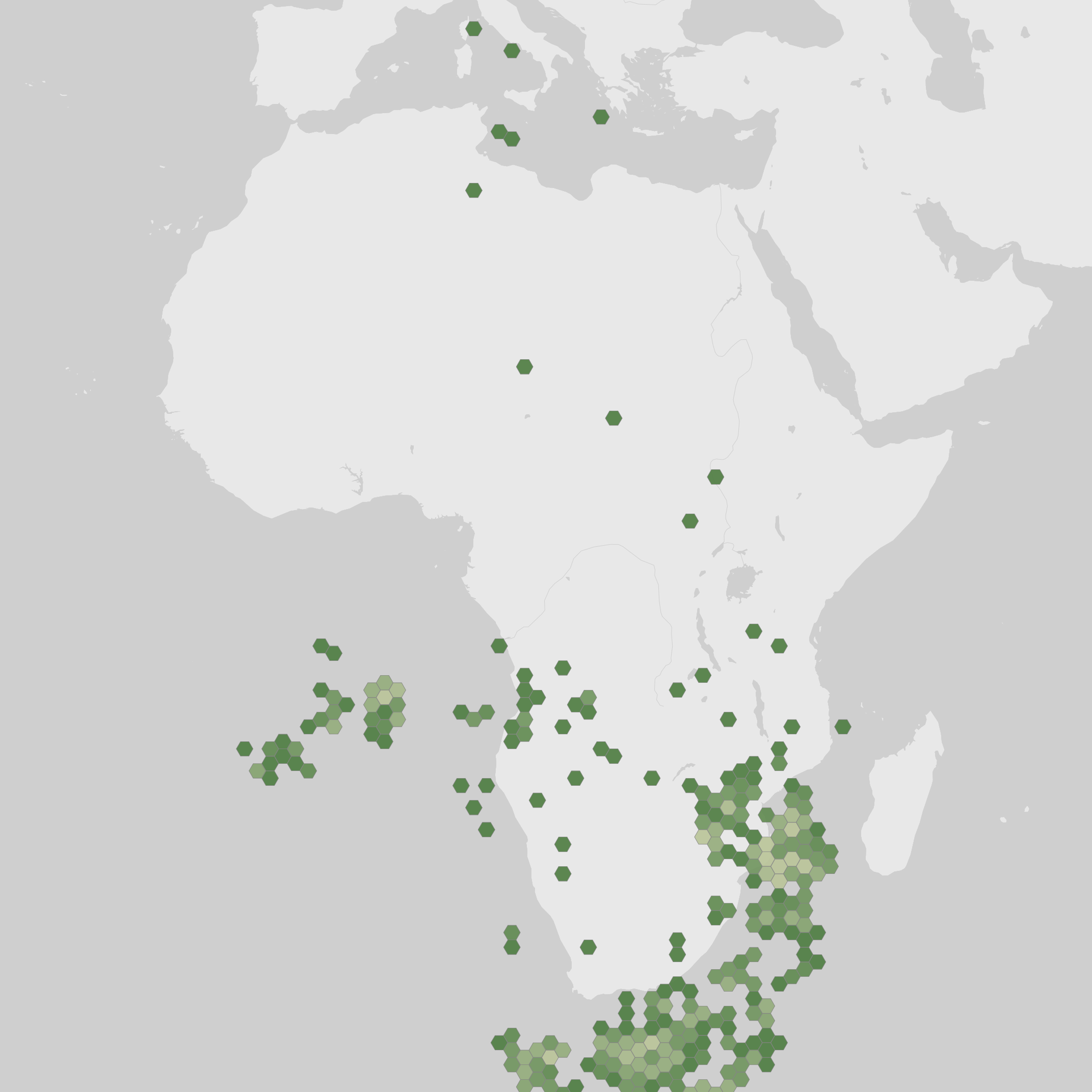
The African bush elephant ranges across sub-Saharan Africa, with populations recorded in Uganda, Kenya, Tanzania, Botswana, Zimbabwe, Namibia, Zambia, Angola, Malawi, Mali, Rwanda, Mozambique, and South Africa. It is a habitat generalist by necessity, moving between subtropical and temperate forests, seasonally flooded grasslands, woodlands, wetlands, savannas, and agricultural land, from sea level up to mountain slopes reaching 4,000 meters in elevation.
In Mali and Namibia, some populations have adapted to desert and semi-desert conditions, following scattered water sources across otherwise arid terrain. Elsewhere, the species favors areas combining reliable water with abundant forage, and increasingly this means protected reserves rather than open range, as unprotected land is converted to farming and infrastructure.
Monthly presence-observation data show a rise from roughly 1,900 sightings early in the year to a peak of over 3,150 around the eighth month, before tapering off toward year's end. This pattern likely reflects seasonal concentration near water and forage during drier stretches rather than any change in overall numbers, and should be read only as a presence signal, not as a population count.
Behavior and Lifestyle
African bush elephants organize their lives around the matriarchal family unit — several adult cows, their daughters, and young sons, sometimes joined into larger "kinship groups" cooperating on foraging, defense, and calf care. Group size shifts with season and habitat: aerial surveys in Uganda found average groups of 6.3 individuals in Rwenzori National Park versus 28.8 in Chambura Game Reserve, with elephants clustering more during the wet season.
Daily life follows a predictable rhythm. Elephants move at a steady 6 km/h, capable of bursts up to 24 km/h, and sleep only about four hours a day, split between an early-morning rest and a midday nap. The rest of the time is spent feeding, walking as little as 1.5 km a day when resources are plentiful or up to 40 km when they are scarce, and grooming by coating themselves in mud or water — a behavior that also aids hydration.
Young bulls leave the family unit between ages 10 and 19, ranging alone or in loose male groups. As they mature, they experience musth: swollen temporal glands, fluid secretion, and near-constant urine dribbling that signals heightened aggression and reproductive readiness. Older bulls endure musth for two to five months a year, compared to brief, sporadic bouts in males under 35.
Communication
Long-distance contact relies on infrasonic rumbles, mostly around 20 Hz and largely below human hearing, which can be detected by other elephants from more than 2 kilometers away. These calls help gather scattered herd members, signal mating readiness, or warn of danger, alongside trumpets, roars, barks, snorts, and grunts — the latter often signaling aggression, while a soft chirp indicates submission.
Visual and tactile signals fill in at closer range. Ear and trunk positions relay intent to herd mates, while a lower-ranking elephant greets a superior by inserting its trunk tip into the other's mouth. Mothers reassure calves through touches, embraces, and foot rubs, and use slaps to discipline them; courting pairs caress and intertwine trunks, and rivals wrestle with them during fights.
Scent marking adds a chemical channel used mainly by males in musth, who rub tusks against trees and bushes or leave secretions and urine trails that females track to locate a mate.
Diet and Nutrition
African bush elephants are herbivores that feed almost continuously through the day on tree foliage, grasses, herbs, fruit, and wood, including roots, twigs, and bark. They combine browsing and grazing, switching between the two depending on season and location rather than sticking to one feeding style.
During wet seasons, they become more selective, favoring nutrient-rich grasses when they are abundant. When the dry season sets in and food grows scarce, elephants broaden their diet, taking whatever high-nutrient plant matter is available. To reach roots or bark, an elephant will overturn an entire tree rather than search for easier alternatives, and it chews bark mainly for fiber without digesting the wood itself.
Water intake is substantial: an adult needs roughly 50 gallons (about 190 liters) a day, drawn up with the trunk and shot into the mouth. This constant need for food and water ties the species closely to reliable water sources, shaping both its daily movements and its seasonal ranging patterns.
Reproduction and Raising Young
Mating is polygynandrous: a receptive cow may mate with several bulls during her estrus, which lasts two to six days, while bulls compete for access and mature males in musth are far more successful at securing opportunities. Courtship involves a bull stroking a female with his trunk, sometimes chasing her if she retreats, until she surrenders her hindquarters and mating occurs, with the bull thrusting for up to two minutes.
After mating, cows carry their calf for about 22 months, one of the longest gestation periods of any mammal, with duration shortened somewhat when conditions favor newborn survival. Births typically produce a single calf weighing 90–120 kilograms, though twins occur rarely. Birth intervals vary by region, from 3.9–4.7 years in Hwange National Park to about 5 years in Amboseli, and can shorten under heavy hunting pressure. A birth observed in Tsavo East National Park showed the calf standing within 30 minutes and walking 20 minutes later, while the mother buried the placenta soon after delivery.
Calves depend entirely on their mother's milk until weaning around four months but may continue nursing occasionally for up to three years; lactation itself can last close to 4.8 years. Other family members help raise the calf through allomothering, teaching it to forage and navigate obstacles. Full independence arrives around age eight, while sexual maturity comes much later — about 11 years for females and 20 for males.
Population and Ecological Role
Population trends diverge sharply by region. Botswana holds the largest national population at roughly 130,000 elephants, and Kruger National Park in South Africa recorded 4.2 percent annual growth between 2003 and 2015, reaching an estimated 17,000 animals in its vicinity after culling ended in the mid-1990s. East Africa, by contrast, held about 137,000 elephants across six countries but saw a 62 percent decline between 2006 and 2013 driven by poaching, with Tanzania losing the most and Somalia's population going locally extinct; Ethiopia's numbers fell from 6,000–10,000 in the 1970s to just 1,900–2,151 by 2015, a roughly 90 percent collapse.
Ecologically, the species acts as a keystone bioengineer: by toppling and altering trees, it creates three-dimensional habitat structure that boosts diversity among reptiles and amphibians. It also hosts a wide range of parasites, including flukes, ticks, roundworms, lice, and botflies, while forming a mutualistic bond with white egrets that feed on its skin parasites.
Adult elephants face almost no predation, but calves under two are vulnerable to lions and spotted hyenas, especially during drought. In Botswana's Chobe National Park, lion prides exceeding 27 individuals killed 74 elephants between 1993 and 1996, mostly at night. Disease and environmental hazards also take a toll: anthrax outbreaks killed over 100 elephants in Botswana in 2019, and in 2020 more than 400 elephants died in the Okavango Delta after drinking water contaminated with neurotoxin-producing cyanobacteria.
Conservation and Threats
The IUCN Red List classifies the African bush elephant as Vulnerable, and it is split across CITES appendices: populations in Botswana, Namibia, South Africa, and Zimbabwe sit in Appendix II, meaning trade is restricted but not fully banned, while all other range countries fall under Appendix I, reflecting a higher extinction risk and a full ban on international trade.
Poaching for ivory remains the most severe threat. Between 2003 and 2015, rangers across 29 range countries reported 14,606 illegal killings, and despite an international ivory trade ban since 1989, illegal trade in ivory doubled between 2007 and 2014. Poachers preferentially target tusked bulls, skewing sex ratios, and intense poaching pressure has driven a rise in congenitally tuskless females in heavily hunted populations such as Mozambique's Gorongosa National Park. Habitat loss and fragmentation from farming, mining, logging, and urban expansion compound the problem, pushing elephants into conflict with farmers and leaving about 70 percent of the species' current range unprotected.
Conservation responses include stronger law enforcement and higher penalties in transit countries like Chad, relocation of vulnerable herds to protected areas, and, where populations have rebounded strongly, contraception or trap-and-relocate programs to manage overabundance.
Cultural Significance
Elephants have held a prominent place in African culture since ancient times, valued above all for their ivory tusks as commercial goods. Among Kenya's Maasai people, elephants are called Arkanjowe — a being both large and powerful — and are regarded as akin to humans; one Maasai legend holds that a woman who turned back before reaching her wedding destination shape-shifted into an elephant.
Prehistoric rock art across North Africa depicts the species with striking realism, including a Pleistocene-era carving at Libya's Tadrart Acacus, a UNESCO World Heritage Site, dated to roughly 12,000–8,000 BC. Neolithic engravings in south Oran, Algeria, and a white elephant painting at Namibia's Phillip's Cave add to this record, while San rock art from South Africa's Cederberg Wilderness Area, dated to the Bovidian period around 3550–3070 BCE, suggests the San held a symbolic and possibly symbiotic relationship with elephant families going back thousands of years.
Human use of the species has also had a darker side: tusks have been carved into billiard balls, dice, and piano keys, while ears have been made into leather and feet into furniture — practices increasingly difficult to justify given the species' conservation status.
Fun Facts
- Bulls in extended musth dribble urine continuously, staining the penis and sheath green in a condition researchers named "green penis syndrome."
- African elephants have an unusually large and complex neocortex, a trait shared with humans, apes, and some dolphin species.
- A 2020 study found that old bulls play a critical role in guiding herds and ensuring their survival, raising concern that removing them through trophy hunting or poaching disrupts entire groups.
- While cows almost always give birth to a single calf, twins occur on rare occasions.
- Tusks grow far faster in bulls than in cows: by age 60, a bull's tusks average 109 kilograms compared to just 17.7 kilograms in a cow.
- A large share of wild elephants suffer tusk fractures at some point, which often lead to serious infection since the exposed pulp is vulnerable to the elements.
Photos
Photographs from by Patrick Jackson via iNaturalist, licensed under CC BY 4.0., via iNaturalist, licensed under CC0 1.0., by Cullen Hanks via iNaturalist, licensed under CC BY 4.0., by Cael Marquard via iNaturalist, licensed under CC BY 4.0., and by Alan Manson via iNaturalist, licensed under CC BY 4.0., credited on each photo.
Ecology and classification
Classification
- Phylum
- Chordata
- Class
- Mammalia
- Order
- Proboscidea
- Family
- Elephantidae
- Genus
- Loxodonta
- Species
- Loxodonta africana
Sources
- GBIF Species names and classification
- iNaturalist Photos
- Wikidata Common names and conservation status
- Wikipedia Summary extract
- Animal Diversity Web Animal habitat, behavior and diet
- AnAge Longevity