A century ago an estimated four million African penguins bred along the coasts of Namibia and South Africa. Today fewer than 10,000 breeding pairs remain, a collapse so steep that the species was reclassified as Critically Endangered in 2024.
The African penguin is the only penguin species that breeds on the African continent, nesting on rocky islands and a handful of mainland sites between Namibia and South Africa's Algoa Bay. It is a flightless seabird, built for swimming rather than flying, with wings stiffened into flippers and a body shaped for speed underwater.
What makes this bird worth knowing is not only its dramatic decline but its individuality: the black spots scattered across each bird's white chest form a pattern as unique as a human fingerprint, a small detail that hints at how closely this species has been studied as it edges toward extinction in the wild.
Identification and Appearance
The single most useful field mark is the black horseshoe-shaped band that runs across the white chest and down the flanks, paired with a black facial mask and a thin white line arching from behind the eye to under the chin. Adults stand 60 to 70 cm tall and weigh between 2.2 and 3.5 kg, with a beak measuring roughly 4.8 to 6.5 cm.
The upperparts are solid black, sharply cut off from the white underside in a pattern known as countershading: the dark back blends with the ocean when viewed from above, while the pale belly is hard to spot from below. Black feet and black chest spots, variable in size and shape from bird to bird, complete the look. The pink glands above each eye brighten with heat and are visible at close range.
Males and females look almost identical, though males are slightly larger and have proportionally longer bills. Juveniles lack the crisp adult pattern entirely: their upperparts range from greyish-blue to brown, and their pale underparts show neither spots nor the black band, making young birds easy to tell apart from breeding adults.
African penguins are easily confused with the related Magellanic penguin, which shares a similar chest bar, but the Magellanic carries two bars across the throat and chest while the African penguin has only one. Its bill is also more pointed than that of the Humboldt penguin, another close relative.
Distribution and Habitat
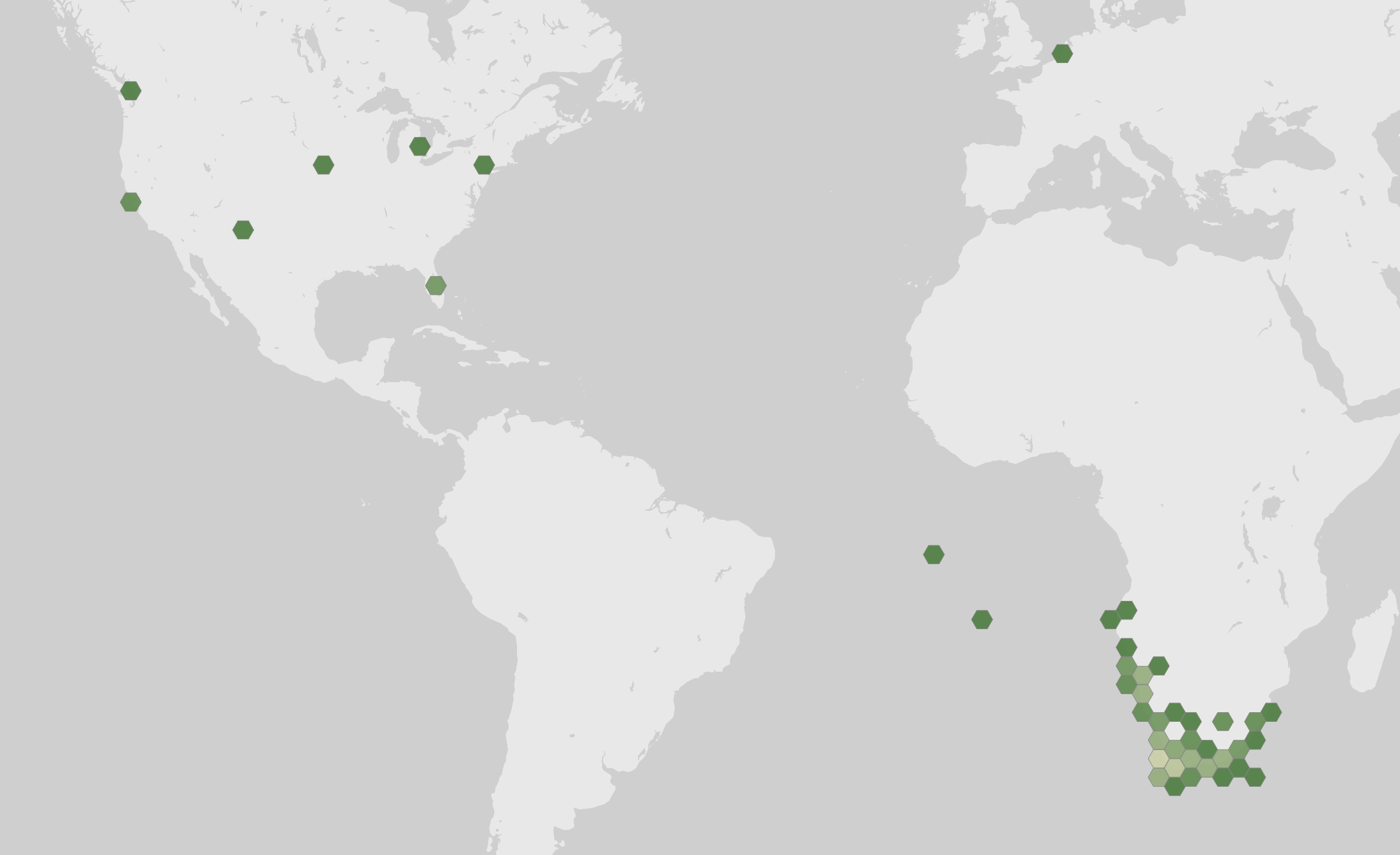
African penguins are confined to southern African waters and rarely range more than 40 km from the coast. Breeding colonies are spread across 27 islands between Namibia and Algoa Bay near Port Elizabeth, South Africa, a range that gave the offshore islands their name: the Penguin Islands.
Most colonies sit on predator-free islands, but two mainland colonies were established in the 1980s near Cape Town, at Boulders Beach in Simon's Town and at Stony Point in Betty's Bay, made possible by reduced numbers of land predators. A further mainland colony exists in Namibia, though its founding date is unrecorded. Even the mainland sites are not fully safe: the Betty's Bay colony has been attacked by leopards.
At sea, the birds forage over the Benguela and western Agulhas ecosystems, spending much of the day in the water and returning to shore each night to rest in large groups. Monthly observation counts peak from July through October, hinting at seasonal patterns in coastal presence, though these figures reflect where observers have recorded the birds rather than true population size.
No wild colonies exist outside this southwestern African coastline, though juvenile vagrants occasionally turn up beyond the normal range. Breeding populations are also maintained in zoos around the world, separate from any wild distribution.
Behavior and Lifestyle
African penguins are diurnal, social, and strongly colonial, gathering in large groups on shore at night and spending much of the day foraging at sea. They are also territorial around their nest sites, defending burrows and mates against other colony members.
Mutual care runs through colony life. Because penguins cannot easily reach their own heads and necks, pairs and colony mates engage in allopreening, cleaning each other's feathers and removing parasites such as ticks. Birds also bathe close to shore, shaking vigorously and preening with beak and feet, and will dive into the water on warm days simply to cool off.
Conflict does occur: fights involve wing-beating and biting, and penguins have been seen chasing rivals through the colony while gripping the other bird's back with their beak. Foraging trips vary by coast, ranging from 30 to 70 km on the west coast to an average of 110 km per trip on the south coast, reflecting how far the birds must travel to find shoaling fish.
Adults typically live 10 to 25 years in the wild and up to 34 in captivity, but mortality is shaped heavily by predators. At sea, sharks and fur seals take adult birds; on land, kelp gulls, Cape genets, mongooses, caracals, and domestic cats and dogs prey on chicks and nesting birds, with losses rising sharply when penguins are forced to nest in the open rather than in burrows.
Communication
African penguins earned the nickname 'jackass penguin' for their loud, braying, donkey-like calls, which come in three distinct forms. The yell, or contact call, is a territorial signal used to warn off other colony members approaching too closely.
The bray functions as a display call for attracting mates and maintaining the bond between partners within a colony, while the haw is used specifically between partners when one bird is on land and the other is out at sea. Alongside these vocal calls, penguins perform visual displays, including head-swinging and bowing, that establish nesting ownership and help partners and hatchlings recognize each other.
Communication in this species draws on visual, acoustic, and chemical channels together, combining calls and postures with scent cues to manage territory, courtship, and pair recognition within crowded, noisy colonies.
Hunting and Diet
African penguins hunt shoaling pelagic fish underwater, reaching top speeds of nearly 20 km/h as they chase prey through open water. Their streamlined bodies and flipper-like wings make them fast, agile swimmers built for pursuing fast-moving schools rather than ambushing still prey.
The core of the diet is small shoaling fish, particularly anchovies, pilchards, horse mackerel, and round herrings, supplemented by squid and crustaceans when fish are scarce. Because these prey species move in large, shifting schools, penguins must track them across variable distances.
How far a bird travels to find food changes by region and by season: shorter trips of 30 to 70 km are typical on the west coast, while foraging trips on the south coast can stretch much farther as prey schools shift location. This dependence on a narrow set of shoaling fish species leaves the penguins vulnerable whenever those fish populations decline or move away from traditional foraging grounds.
Nesting and Breeding
Courtship begins with the male performing visual and vocal displays to attract a mate, including head-swinging motions that signal ownership of a nest site and warn off rival males. A harsh vocal call with the neck and head extended upward follows, cementing the pair bond, before a final bowing display in which one or both birds duck their heads toward the nest or each other's feet.
African penguins are monogamous and return to the same nest site with the same partner year after year, gathering in colonies called rookeries. Nesting timing differs by country: it peaks in Namibia from November to December and in South Africa from March to May, coinciding with cooler temperatures that reduce the risk of eggs overheating in direct sun.
Pairs dig shallow burrows in sand, guano, or under rocks and vegetation, and lay a clutch of two eggs three to four times the size of a chicken egg. Both parents share incubation duties using a bare-skinned brood patch on the belly, over an incubation period of about 40 days. Guano removal by humans has eliminated much of the burrowing material once available, forcing many pairs to rely on open nests, sand burrows, or artificial nest boxes, which on Robben Island have been shown to improve chick survival over exposed nests.
After hatching, chicks are fed by regurgitation for about a month before joining a crèche with other chicks while both parents forage at sea. Chicks fledge at 60 to 130 days depending on food availability, then leave the colony to spend one to nearly two years at sea alone before returning to their birth colony to molt into adult plumage. Breeding success tracks prey abundance closely: at Robben Island, birds laid larger eggs, bred earlier, and raised more fledglings in years when food was plentiful.
Population and Ecological Role
Breeding numbers have collapsed at every measured interval: from roughly 1.5 million birds in 1910, to about 150,000-180,000 in 2000, to around 55,000 individuals in 2010, to under 10,000 breeding pairs by 2023. Individual colonies illustrate the same trend, with Dyer Island falling from 46,000 birds in the early 1970s to just 3,000 by 2008.
Ecologically, the species is a key predator of small shoaling fish such as anchovies and sardines, along with up to 18 species of crustaceans, linking it directly to the health of the Benguela and Agulhas fish stocks. The birds also carry several blood parasites, including four Plasmodium species and Leucocytozoon tawaki, which circulate within wild colonies.
Because African penguins depend so heavily on a narrow set of prey species, their population swings act as an indicator of broader shifts in southern African fish stocks and marine food webs, making their decline a signal of wider ecosystem stress rather than an isolated event.
Conservation and Threats
The African penguin is classified as Critically Endangered, a status reached in 2023 after the breeding population fell below 10,000 pairs; at the decline rate recorded between 2000 and 2010, experts warned the species could become functionally extinct by 2035 without intervention.
Historical threats included large-scale egg harvesting, which continued into the 1970s, and the stripping of guano deposits from islands for fertilizer, a practice that removed the burrowing material penguins need to shield eggs from overheating and predators. Today the dominant threats are competition with commercial fisheries for the same shoaling fish stocks and chronic and acute oil pollution, a hazard documented since the 1930s and driven home by disasters such as the 1948 sinking of the tanker Esso Wheeling, which killed thousands of birds at the Dyer Island colony.
Protections include listing on CITES Appendix II and endangered status under the US Federal List, alongside habitat measures such as artificial nest boxes that have improved chick survival on Robben Island. In March 2025, following litigation brought by SANCCOB, BirdLife South Africa, and the Biodiversity Law Centre, South Africa's government agreed to establish larger, full-time no-fishing zones around six key breeding areas after earlier partial closures proved ineffective.
Cultural Significance
African penguins were once a direct economic resource: their guano was excavated from rookeries and processed into fertilizer sold worldwide, and penguin skins were even used to make gloves. That guano trade, now banned, permanently altered the nesting habitat the species depends on by stripping away the soft burrowing material birds once used to shield their eggs.
Today the species' main human value is ecotourism rather than extraction. The colony at Boulders Beach in Simon's Town, South Africa, home to more than 2,000 penguins, draws visitors who can approach the birds within about a meter, making it one of the most accessible wildlife encounters of its kind. The species is also the most commonly kept penguin in zoos worldwide, favored for its manageable size and temperate climate needs.
Fun Facts
- The black spots scattered across each bird's chest form a pattern unique to that individual, much like a human fingerprint.
- The nickname 'jackass penguin' comes from its loud, donkey-like bray, one of three distinct calls the species uses.
- When molting, African penguins cannot swim because their new feathers are not yet waterproof, so they fast on land for about three weeks, losing roughly half their body weight in the process.
- Females remain fertile for about ten years, and in years with abundant food, colonies have produced more male chicks, which also grow faster and fledge heavier than females.
- African penguin eggs are three to four times larger than a chicken egg and were once collected commercially, with 12,000 taken from Dassen Island in a single 1953 harvest.
- The pink skin patches above each eye are cooling glands that visibly flush pinker as the bird's body temperature rises.
Photos
Photographs from by Jon Paul Rodríguez via iNaturalist, licensed under CC BY 4.0., via iNaturalist, licensed under CC0 1.0., by Cricket Raspet via iNaturalist, licensed under CC BY 4.0., by jk6000 via iNaturalist, licensed under CC BY 4.0., by chrisdt via iNaturalist, licensed under CC BY 4.0., and by Patrick Jackson via iNaturalist, licensed under CC BY 4.0., credited on each photo.
Ecology and classification
Classification
- Phylum
- Chordata
- Class
- Aves
- Order
- Sphenisciformes
- Family
- Spheniscidae
- Genus
- Spheniscus
- Species
- Spheniscus demersus
Sources
- GBIF Species names and classification
- iNaturalist Photos
- Wikidata Common names and conservation status
- Wikipedia Summary extract
- Encyclopedia of Life Habitat, diet and behavior traits
- Animal Diversity Web Animal habitat, behavior and diet
- AnAge Longevity