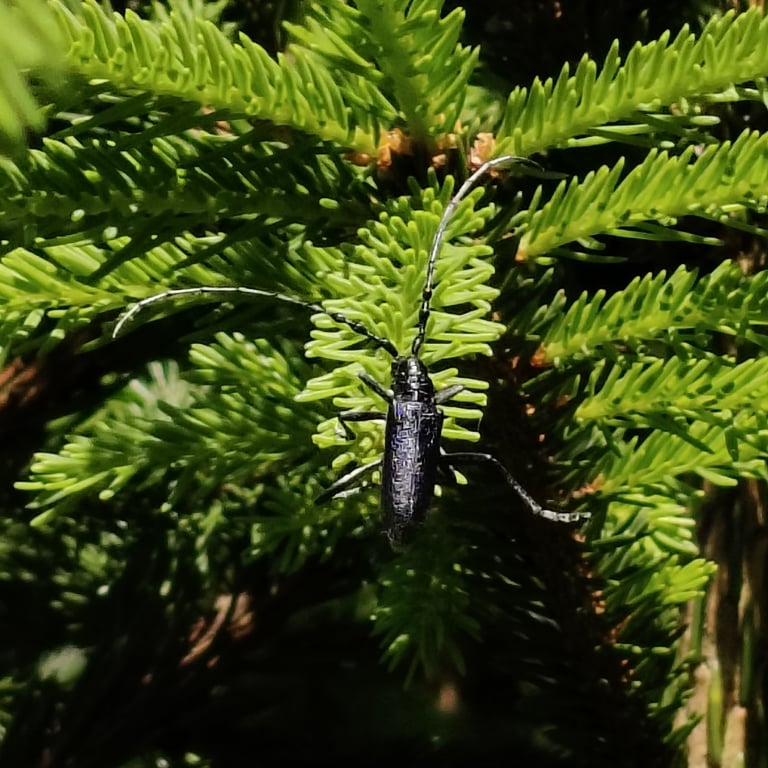
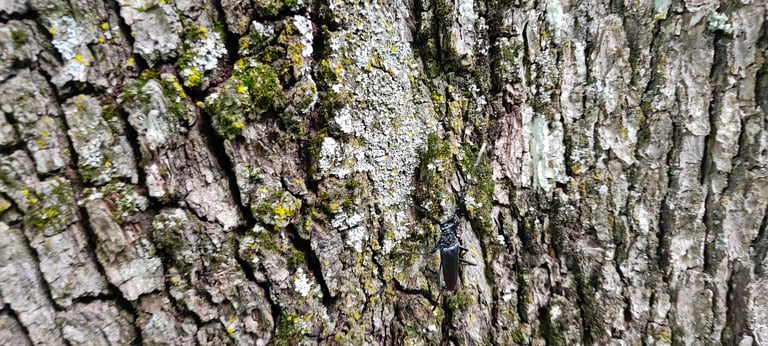
Agrilus biguttatus is a major driver of oak decline across Europe, boring beneath the bark of stressed trees until they die. Known by the common names oak splendour beetle, oak buprestid beetle, and two-spotted oak borer, it belongs to the jewel beetle family, Buprestidae, within the order Coleoptera.
The species is best known not for its own biology in isolation but for the outsized role it plays in the health of Europe's oak woodlands, making it a focus of forestry research wherever oak decline has been documented.
Identification and Appearance
The clearest clue to this beetle's presence is not the insect itself but the damage it leaves behind: emerging adults chew distinctive exit holes through oak bark, though detailed field marks of the beetle's own coloring and size are not well documented here. As a member of Buprestidae, the jewel beetle family, it shares the group's characteristic slender, elongate body form.
The common name "two-spotted oak borer" hints at a pair of markings used to distinguish it, though the exact placement and appearance of these spots are not detailed in the available record. Beyond this naming clue, specific measurements of body length, and differences between males and females, are not established in current sources.
Distribution and Habitat
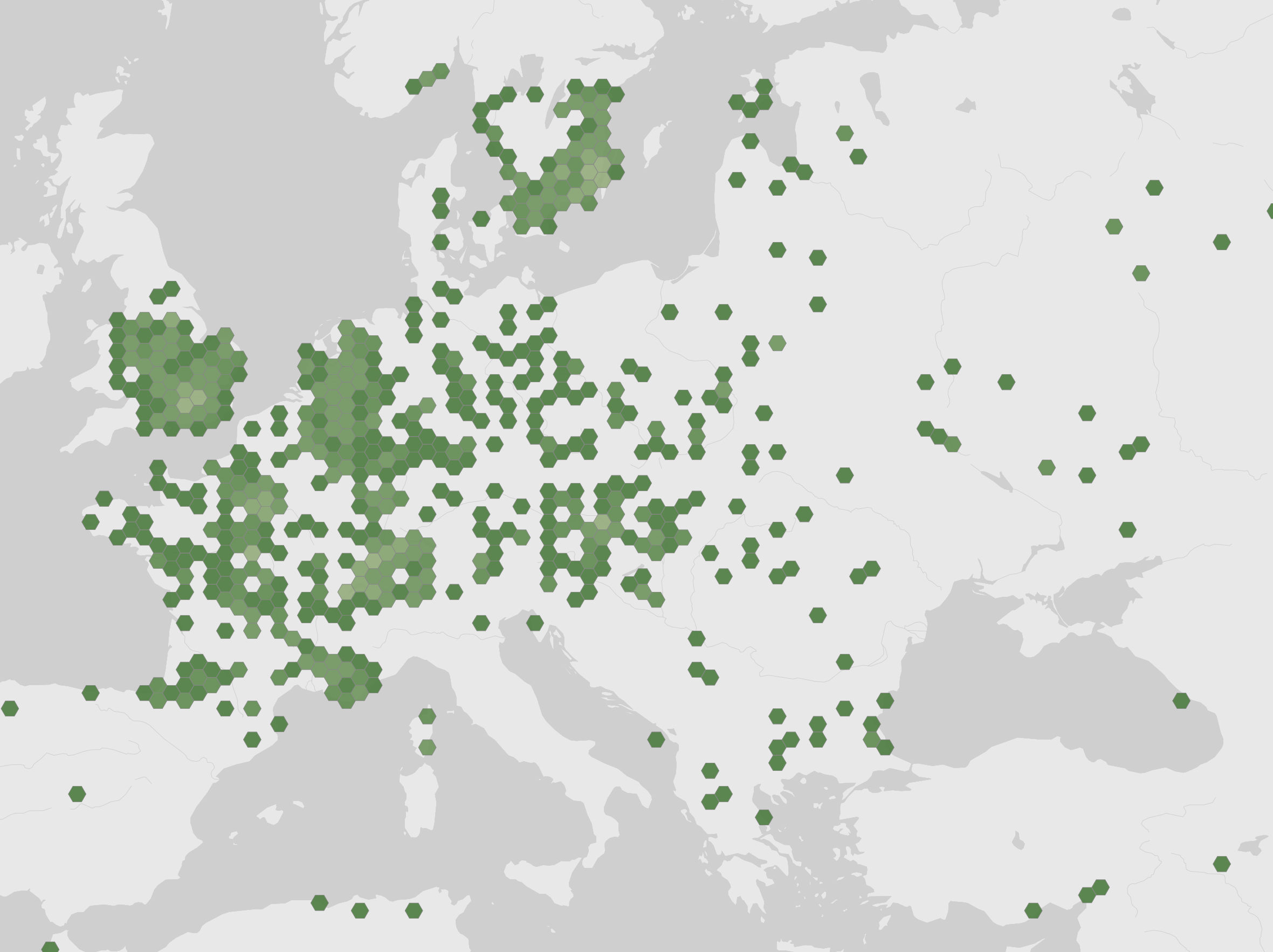
Agrilus biguttatus ranges widely across Europe, North Africa, and northern Asia, reaching as far north as southern Sweden and the United Kingdom. Adults can fly several kilometers, but cool temperatures ultimately limit how far north the species can persist. Considered rare in the UK before the 1970s, it began expanding from core populations in Denmark and the Netherlands during the mid-1990s, an expansion researchers have linked to warming temperatures favoring a species that prefers temperate conditions.
The beetle occupies a broad range of habitats, including deserts, xeric shrublands, Mediterranean scrub, mixed forests, and temperate coniferous forests, though its fortunes are tied above all to its host trees. Its principal hosts are oak species: English oak (Quercus robur), sessile oak (Q. petraea), downy oak (Q. pubescens), evergreen oak (Q. ilex), cork oak (Q. suber), and turkey oak (Q. cerris). It has also been recorded on European beech (Fagus sylvatica) and chestnut (Castanea sativa).
Monthly presence observations show a sharp spike in June, with counts rising from the low hundreds in April and May to a peak near 1,900 in June before tapering through July and August. This pattern lines up with the beetle's May-to-July emergence period, though these figures reflect presence records rather than true abundance or a complete map of the species' range.
The species has not yet been found in the United States, but its capacity to travel in wood shipments means introduction there could pose a significant risk to oak-dominated ecosystems.
Reproduction and Life Cycle
Adult beetles emerge from pupation between May and July and initially move up into the canopy of mature oaks to feed on foliage, along with leaves of sycamore and beech. Courtship begins in flight, where males select mates, aided by volatile pheromone cues that also help both sexes locate feeding and mating sites. Laboratory work has shown that the beetles' antennae detect specific compounds in oak leaf odor, including (Z)-3-hexenal, (Z)-3-hexen-1-ol, (E)-2-hexenal, and (Z)-3-hexenyl acetate, which they follow from fresh foliage back to a suitable host tree.
After mating, females use olfactory cues to descend from the canopy to the trunk, where they lay eggs in cracks and crevices in the bark, often tucking them between bark plates so larvae can tunnel easily toward the tree's vascular tissue. Females favor older oaks, typically 30 to 40 centimeters in trunk diameter, with an inner bark thickness of 10 to 13 millimeters.
Larval development depends heavily on moisture in the inner bark, so larvae feed downward toward the base of the tree, where water content is higher. New generations of eggs are sometimes laid directly beneath eggs from earlier generations on the same host. Females target trees already weakened by drought, since healthy oaks can generally resist infestation; the beetle has only a brief window to colonize a tree, between the point where drought lowers its defenses and the point where the tree's death cuts off the water supply larvae need.
Population and Ecological Role
Agrilus biguttatus is one of the principal insects behind acute oak decline (AOD), a syndrome marked by black fluid oozing from cracks in the bark that often kills affected trees within a few years. Oaks can recover from AOD if given time without renewed attack, but as a secondary pest the beetle strikes while trees are still weakened, invading before recovery can take hold and pushing already stressed individuals toward death. Symptomatic trees typically show D-shaped exit holes left by emerging adults.
Warmer climates and drought conditions, which favor both the beetle's growth and its ability to invade hosts, are believed to have intensified oak decline across the continent. Pest incidence linked to Agrilus species has been documented in Germany, France, Hungary, Poland, and England, contributing to rising oak mortality in these regions. No population count or trend figures for the beetle itself are established here, but its ecological weight is measured through the scale of oak decline it drives.
Cultural Significance
Available cultural references tied to this beetle's name largely trace back to Agrios, a giant from Greek mythology whose name shares a root meaning "wild" or "savage," rather than to any folklore built around the insect itself. No documented associations exist connecting Agrilus biguttatus to art, symbolism, or traditional use by people.
In practice, the beetle's most visible role in human affairs is as a forestry concern: it is studied and monitored by foresters and researchers because of its part in acute oak decline, rather than for any cultural or ornamental significance.
Fun Facts
- Male beetles choose mates in mid-flight, guided partly by scent cues rather than sight alone.
- The beetle's antennae can detect four specific chemical compounds released by fresh oak leaves, letting it home in on host trees from a distance.
- Females sometimes lay new eggs directly on top of eggs from a previous generation on the same tree.
- Infested oaks often reveal themselves through D-shaped exit holes left behind by emerging adults.
- Though absent from the United States today, the beetle could pose a serious risk to American oak forests if introduced through wood shipments.
- The species prefers oaks in a fairly narrow size range, trunks 30 to 40 centimeters across with inner bark 10 to 13 millimeters thick.
- It belongs to Buprestidae, the jewel beetle family, though its own coloring is not well documented in current records.
Ecology
Habitat
- Forest
- Shrubland
- Desert
Diet
- Herbivore