The seven-spot ladybird has earned a reputation as "one of the most successful aphidophagous insects" on the planet, according to entomologist Tatia Bauer, thanks to its knack for thriving almost anywhere aphids can be found.
Coccinella septempunctata, a carnivorous beetle in the order Coleoptera and family Coccinellidae, is native to Europe, most of Asia, and North Africa, and now inhabits temperate regions on several continents after being introduced to North America and elsewhere to fight aphid infestations. Its ability to settle into so many different habitats, and to hunt aphids so effectively, is what makes this small red beetle worth a closer look.
Identification and Appearance
The clearest field mark is the pattern that gives the species its name: seven black spots set against glossy orange-red elytra, with one spot always sitting next to the scutellum where the wing covers meet, flanked by two small white patches. The remaining six spots, three per elytron, vary slightly in size and position between individuals, though fused spots and all-black melanic forms are rare.
Adults measure 6.5 to 7.8 mm long and about 4 mm wide, with an oval, strongly convex body. The underside, pronotum, and legs are black, and two white spots sit on the front of the pronotum near the inner edge of each eye.
Telling males from females requires a close look: females are slightly larger and broader, and the shape of the seventh abdominal sternite differs reliably between the sexes. Males also carry an extra type of leg seta used for traction and a few more chemosensory sensilla on their labial palps than females, though these differences are microscopic.
Immature stages look nothing like the adult. Eggs are spindle-shaped, orange or yellow, and about 1 mm long. Larvae start out 1 to 2 mm long and dull black with a pale brown dorsal line, growing to roughly 8 mm by the fourth instar, which turns dark grey to black with orange lateral tubercles. Pupae, about 6 mm long, range from grey to pale orange with dark triangular markings before the adult emerges with soft, colorless elytra that darken over time as melanins and carotenes develop.
Distribution and Habitat
The seven-spot ladybird is a habitat generalist, turning up almost anywhere aphids are abundant: herbaceous plants, shrubs, and trees in open fields, grasslands, marshes, agricultural land, and suburban gardens and parks. It has been recorded from sea level up to 1,500 meters elevation.
For overwintering, the species seeks out open, south-facing sites with shelter, such as boulder fields, dense tussocks of grass, or hedgerows, where sunlight exposure is maximized during the colder months.
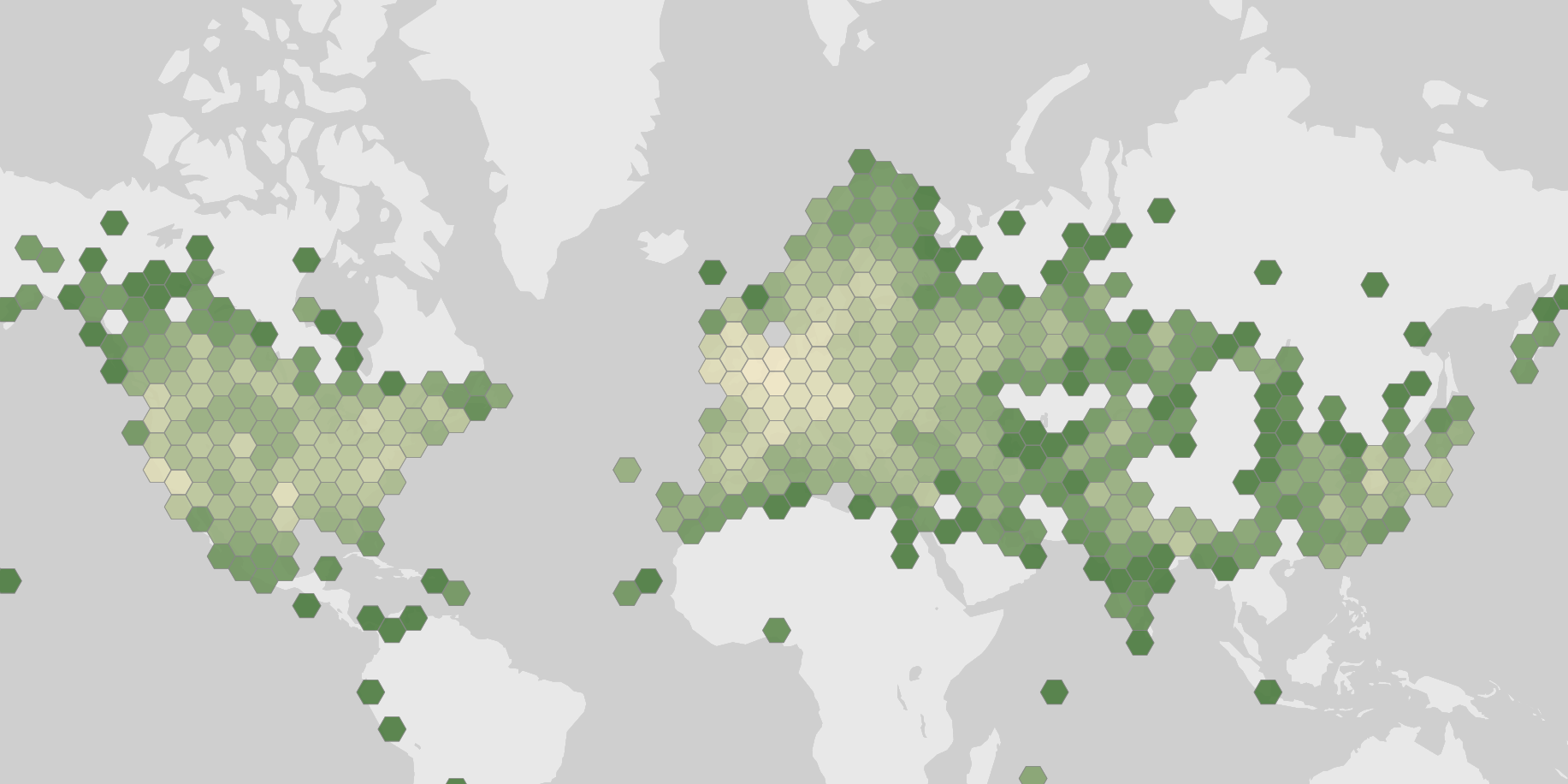
Monthly observation counts rise sharply from January through a peak in June, then taper off through autumn and winter. As presence records rather than a measure of abundance, this pattern most likely reflects when adults are most active and visible aboveground rather than true population size, but it does point to late spring and early summer as the season when the beetle is most conspicuous.
Behavior and Lifestyle
Coccinella septempunctata is active by day and dormant at night, flying readily between plants in search of prey. Its most distinctive seasonal behavior is overwintering in aggregations, typically groups of 10 to 15 individuals though clusters exceeding 200 have been documented, packed into dense grass foliage or wedged between boulders.
Before settling in for the winter, adults release the pheromone 2-isopropyl-3-methoxy-pyrazine to draw other ladybirds to the same shelter. Grouping this way conserves warmth, offers protection, and conveniently leaves each beetle with potential mates nearby once diapause ends in spring.
Outside the hibernation period, the beetle relies on chemical cues to find food: it detects the alarm pheromone aphids release when threatened, as well as volatile compounds that plants emit once aphid infestations take hold, and follows both toward a meal.
Communication
Chemical signaling dominates how the seven-spot ladybird interacts with its world, working alongside visual cues from its high-contrast coloring. Before winter, adults emit the pheromone 2-isopropyl-3-methoxy-pyrazine specifically to draw other ladybirds into a shared overwintering site, a signal that doubles as a way to guarantee mates will be nearby once diapause ends.
The same chemical sense drives foraging: the beetle detects the alarm pheromone aphids release from their cornicles when they sense a predator, and it also picks up on volatile compounds released by plants under aphid attack, using both as cues to locate infested vegetation.
Chemical signals also shape how the species avoids its own larvae eating each other. Because intraguild predation is common among coccinellid larvae, females are deterred from laying eggs near existing conspecific or heterospecific egg clusters, a response that lowers the odds of offspring being cannibalized before they even hatch.
Hunting and Diet
Locating prey starts with chemistry: Coccinella septempunctata homes in on the alarm pheromone aphids release when they detect a predator, and on volatile compounds that plants give off once an aphid infestation takes hold, following both signals to infested vegetation before settling in to feed.
Once there, the beetle is a polyphagous predator that mainly consumes aphids and similar scale insects, picking them off plant surfaces without needing to chase them down. When aphid numbers drop, adults switch to eating pollen to get by.
Pressure within its own guild shapes the diet further: adults will sometimes eat conspecific eggs or larvae, and the four larval instars, which normally hunt aphids on their own, will turn to eating other ladybird larvae when aphids are scarce. This intraguild predation and cannibalism are recurring features of life in the Coccinellidae.
Reproduction and Life Cycle
Courtship follows a five-step sequence initiated by the male: approach, watch, examine, mount, and copulatory attempt. A male comes within about a centimeter of a female and observes her before touching her antennae and mouth with his own; if she is receptive, he climbs onto her elytra from behind to attempt mating. Immature females, and those that have recently mated or are ready to lay eggs, resist these advances, while females ready to mate release their own volatile sex pheromones to draw males in.
The mating system is polygynandrous: an individual may mate four to six times in a single day, and females mate with many males across a season, which measurably raises egg fecundity, viability, and hatching success. Sexual maturity arrives quickly, at 8.5 to 9.3 days after emergence in males and 10.8 to 11.6 days in females, and breeding runs from spring through early summer, with some individuals continuing into autumn.
Fertilized females lay eggs in clusters of roughly 10 to 30 on leaves and stems, choosing spots without existing conspecific eggs by detecting olfactory cues left behind by earlier clutches. A female may lay 250 to 500 eggs, sometimes up to 1,000, over her lifetime, often more than the environment can support, a strategy that pays off when aphids are unusually abundant.
Eggs hatch after about four days, and the larvae begin by eating their own eggshells and any infertile eggs nearby before hunting aphids through four instars. After a final instar that stops feeding and fixes itself to a substrate, the pupal stage lasts around eight days before the adult emerges with soft, colorless elytra that darken as pigments develop. Neither parent provides any care beyond the female choosing a safe, food-rich site to lay her eggs.
Population and Ecological Role
As a voracious predator of aphids and scale insects, Coccinella septempunctata plays an outsized role in suppressing pests that damage plants, an ecological service that ripples through to every organism depending on that vegetation.
The beetle is itself prey for birds, small mammals, spiders, and other ladybird species, with its fourth larval instar especially vulnerable to being picked off. Adults fare better, protected by conspicuous black-and-orange coloring that warns predators and by reflex bleeding, a defense in which they release a foul-tasting alkaloid fluid containing coccinelline and precoccinelline from their leg joints when threatened.
Parasitism is a major pressure on the species. Larvae are attacked by parasitic wasps in the families Eulophidae and Braconidae and by flies in the family Phoridae, while the braconid wasps Perilitus coccinellae and Dinocampus coccinellae are especially significant: D. coccinellae lays eggs inside a female's body cavity, and its larva later pupates inside one of the host's legs before emerging as an adult roughly nine days afterward, an ordeal some ladybirds are reported to survive and recover from.
Conservation and Threats
Coccinella septempunctata has no special status on the IUCN Red List, under CITES, or on any national or state list, meaning it has simply never been formally assessed rather than confirmed as secure. Where it has been introduced, such as in North America, it is instead regarded as an invasive species in its own right.
The most pressing threat to native populations, particularly in Europe, comes from the harlequin ladybird, Harmonia axyridis. This more disease-resistant invasive species outcompetes C. septempunctata for food and even preys on it directly. After arriving on England's south coast in 2004, having previously been introduced to the Netherlands, Belgium, and France as a biocontrol agent, it spread rapidly; the UK Ladybird Survey has tracked its expansion and warned it could potentially wipe out native seven-spot ladybirds in affected regions.
Population swings can also be dramatic on their own. During England's 1976 heatwave, a warm spring first boosted aphid numbers, fueling a ladybird population boom before the heat dried out host plants and crashed aphid supplies; by late July, an estimated 23.65 billion seven-spot ladybirds swarmed the country's eastern and southern coasts in search of food, a event locals still call "the year of the ladybird."
Cultural Significance
European folklore ties the seven-spot ladybird closely to the Virgin Mary, with legends describing red, black-spotted beetles arriving to eat crop-destroying insects for medieval farmers who prayed for Mary's help; the beetle's red wings were said to echo her cloak, and its seven spots her seven joys and sorrows. Its names across European languages carry this history, often replacing older references to Freyja, the Norse fertility goddess, with the Virgin Mary instead.
Beyond folklore, the species carries formal symbolic status: it is the national insect of Finland and the official state insect of Massachusetts, New Hampshire, Delaware, Ohio, and Tennessee, and it appears on postage stamps issued by countries including Switzerland, Finland, Malta, Croatia, Algeria, Israel, Iraq, China, and India.
People also value the beetle practically. As one of the most effective aphid-eating insects known, it has been deployed widely, including across the United States, as a biological control agent to protect crops from aphids, which damage plants directly and spread disease as they feed.
Fun Facts
- The number seven carries symbolic weight in many cultures, and this beetle's seven spots have been likened to other sevens people find meaningful, such as the seven colors of the rainbow and the seven notes of the chromatic scale.
- In Sweden the beetle is called nyckelpiga, or "key maiden," from a belief that its seven spots stood for seven virtues and held the keys to unlock heaven's gate for the Virgin Mary.
- Maltese speakers call it nannakola, a name that replaced the older word kola after a popular early 20th-century nursery rhyme.
- In Spanish it is mariquita or marieta, both names derived from Maria, again referencing the Virgin Mary.
- New York's official state ladybug is not this species but a relative, the nine-spotted ladybug, Coccinella novemnotata.
Ecology
Habitat
- Wetland
- Forest
- Grassland
- Urban
Behavior
- Predator
- Hibernating
- Social
- Diurnal
Diet
- Insectivore
Photos
SourcesGBIFiNaturalistWikidataWikipediaEncyclopedia of LifeAnimal Diversity Web