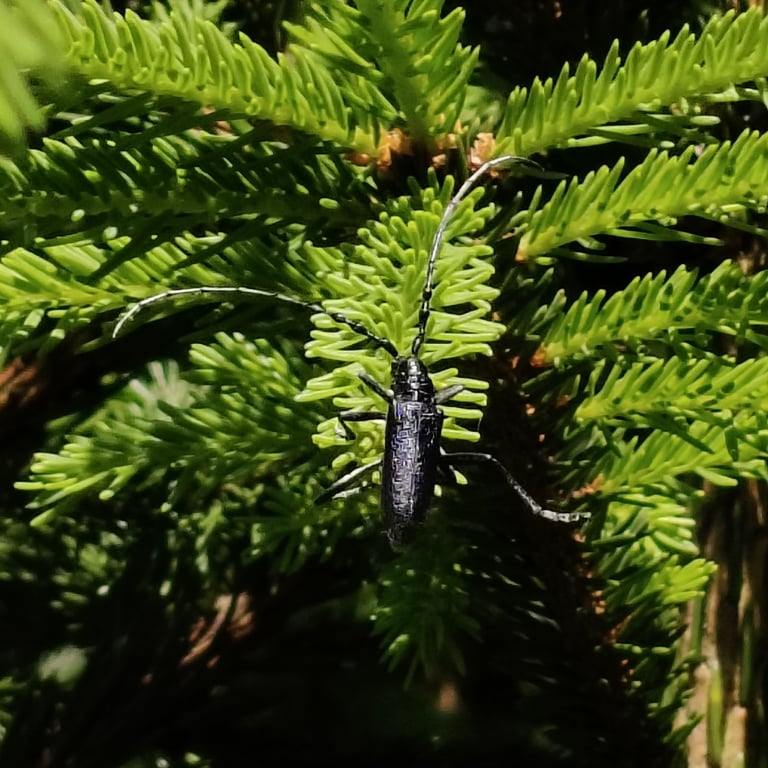
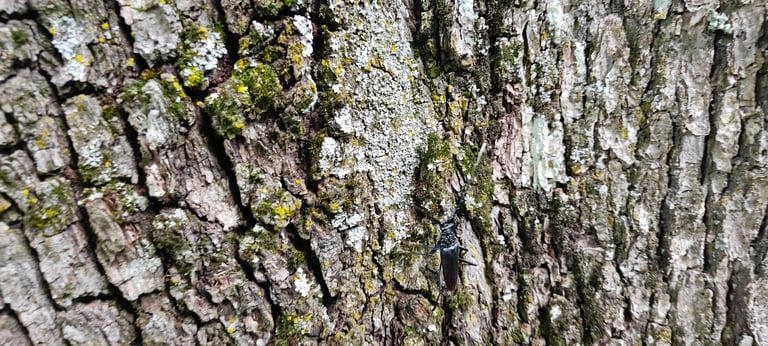
Male Cerambyx welensii carry antennae so long that the last three segments reach well past the tip of the elytra, a trait that immediately sets the sexes apart in this longhorn beetle.
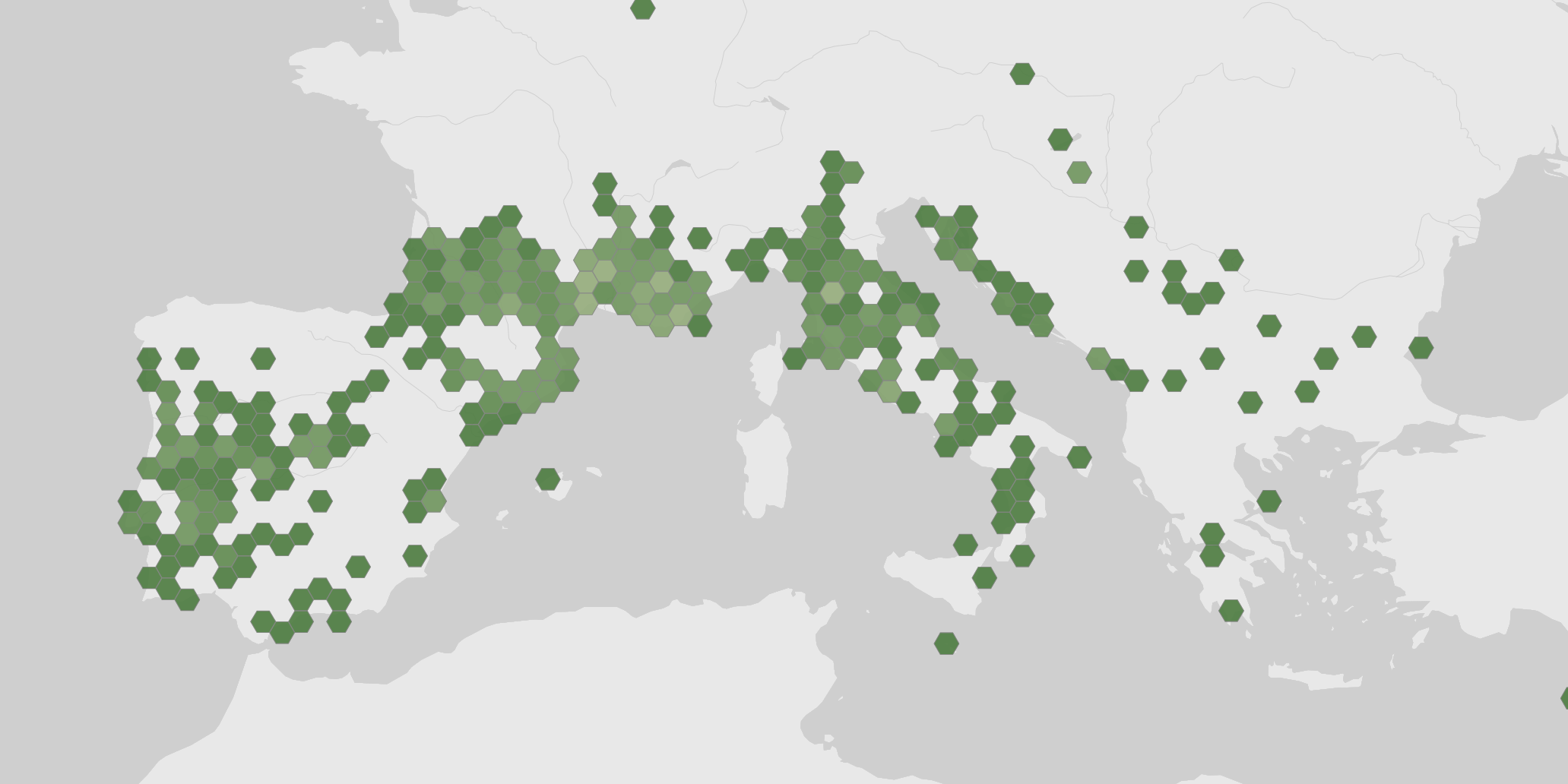
Cerambyx welensii belongs to the beetle family Cerambycidae, within the order Coleoptera. It ranges widely across Southern Europe, North Africa, and the Near East, from Mediterranean woodlands to drier scrublands further east. No conservation status is established for the species here, but its close resemblance to other Cerambyx beetles, including the protected Cerambyx cerdo, makes accurate identification worth the effort for anyone encountering it in the field.
Identification and Appearance
The clearest field mark is the elytra's covering: a thick layer of white-to-yellowish setae over a brownish body, with the apex of each elytron noticeably clearer and less hairy. This gives the beetle a two-toned, slightly frosted look rather than the uniform dark sheen seen in some relatives.
Adults measure 25 to 58 millimeters in length, with an elongated, cylindrical body typical of longhorn beetles. The pronotum bears a thorny tubercle on each side, a useful feature to check when confirming identification. The elytra themselves end in rounded apices rather than pointed or truncated tips.
Sexual dimorphism is pronounced: males have antennae that extend past the elytra by their last three segments, while females show comparatively shorter antennae relative to body size. This antennal length difference, combined with body size variation, is the most reliable way to distinguish males from females at a glance.
Cerambyx welensii is easily confused with Cerambyx carinatus and Cerambyx cerdo. The setae coverage on the elytra and the shape of the pronotal tubercles are the details worth checking closely when separating it from these lookalikes.
Distribution and Habitat
Cerambyx welensii has a broad distribution spanning Southern Europe, North Africa, and the Near East. Confirmed countries include Albania, Bosnia and Herzegovina, Bulgaria, Croatia, France, Greece, Hungary, Italy, Malta, Portugal, Romania, Slovakia, Slovenia, and Spain in Europe, along with Sicily; Morocco and Tunisia in North Africa; and Jordan, Lebanon, Syria, Israel, and Azerbaijan further east.
Monthly observation data show a sharp concentration of records in early summer, climbing from single digits in winter and spring months to 559 in June and peaking at 1,138 in July, before falling back to 221 in August and single digits by autumn. As presence observations rather than a measure of abundance, this pattern should be read cautiously, but it does point to a strong seasonal window of adult activity centered on midsummer across the species' range.
Fun Facts
- The species was originally described from the Peloponnese in Greece by Auguste Gaspard Brullé in 1832 under the name Cerambyx velutinus, a name used for almost 160 years before it was replaced because it had already been applied to another species.
- It is also known by the synonym Hammaticherus welensii Küster, 1845, reflecting an older genus classification still noted in taxonomic catalogues.
- Despite its Mediterranean reputation, the species' range extends as far east as Iran, making it a xerophilic beetle adapted to dry conditions across a very wide geographic span.
Photos
Photographs from via iNaturalist, licensed under CC0 1.0., by Antoine Guiguet via iNaturalist, licensed under CC BY 4.0., by wa_lu via iNaturalist, licensed under CC BY 4.0., by BIONNB via iNaturalist, licensed under CC BY 4.0., by Paolo Zucca via iNaturalist, licensed under CC BY 4.0., by mnauky via iNaturalist, licensed under CC BY 4.0., by Yokki via iNaturalist, licensed under CC BY 4.0., by lkatusic via iNaturalist, licensed under CC BY 4.0., by Adrien Nouailhane via iNaturalist, licensed under CC BY 4.0., by Hélio Suarez via iNaturalist, licensed under CC BY 4.0., and by Yves Bas via iNaturalist, licensed under CC BY 4.0., credited on each photo.
Ecology and classification
Classification
- Phylum
- Arthropoda
- Class
- Insecta
- Order
- Coleoptera
- Family
- Cerambycidae
- Genus
- Cerambyx
- Species
- Cerambyx welensii
Sources
- GBIF Species names and classification
- iNaturalist Photos
- Wikidata Common names and conservation status
- Wikipedia Summary extract