Few mushrooms are as instantly recognizable as Amanita muscaria, the fly agaric, whose bright red cap studded with white warts has become a universal symbol of fairy-tale forests. Beneath that familiar image lies real biological complexity: genetic studies show enough diversity within A. muscaria to suggest it is not one species but a whole species complex.
It is a basidiomycete fungus in the family Amanitaceae, native to temperate and boreal forests across the Northern Hemisphere and now naturalized in parts of the Southern Hemisphere as well. Beyond its striking looks, the fly agaric has shaped folklore, spiritual ritual, and even popular Christmas imagery, making it one of the most culturally significant fungi in the world.
Fruiting Body and Identification
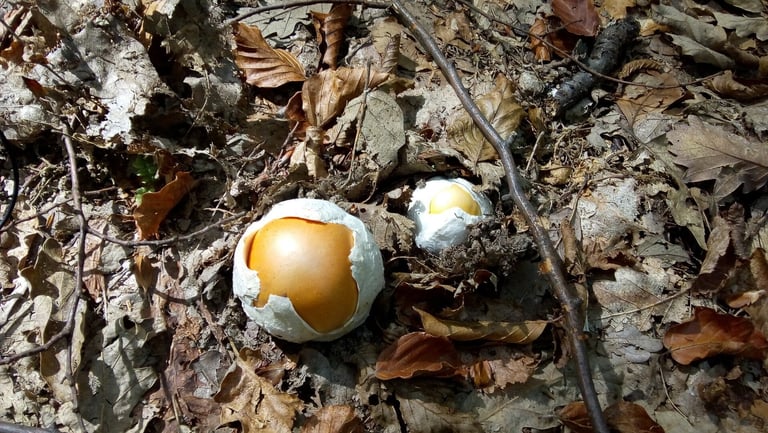
The clearest identifying feature of Amanita muscaria is its bright red cap, ranging from 5 to 30 centimeters across, scattered with small white to yellowish, pyramid-shaped warts left over from the universal veil that once enclosed the young mushroom. Fruiting bodies emerge from the soil looking like white eggs; as they expand, the veil breaks apart, the red color shows through, and the warts become relatively less prominent even though they do not change in size themselves. The cap shape shifts through development, from globose to hemispherical and finally flattening into a plate-like form in mature specimens. Rain or age can wash away the warts and fade the red color.
Beneath the cap, the free gills are pure white, matching the white spore print. The oval spores measure 9 to 13 by 6.5 to 9 micrometers and do not stain blue with iodine. The stipe stands 5 to 20 centimeters tall and 1 to 2 centimeters wide, with a slightly brittle, fibrous texture typical of large mushrooms. At its base is a bulb bearing two to four distinct rings or ruffs, remnants of the universal veil, while a white, sometimes flaccid ring higher up the stem marks where the partial veil once covered the gills. There is generally little smell beyond a mild earthiness.
Despite its distinctive look, A. muscaria has been confused with other yellow-to-red mushrooms, and immature "button" specimens can resemble puffballs.
Distribution and Habitat
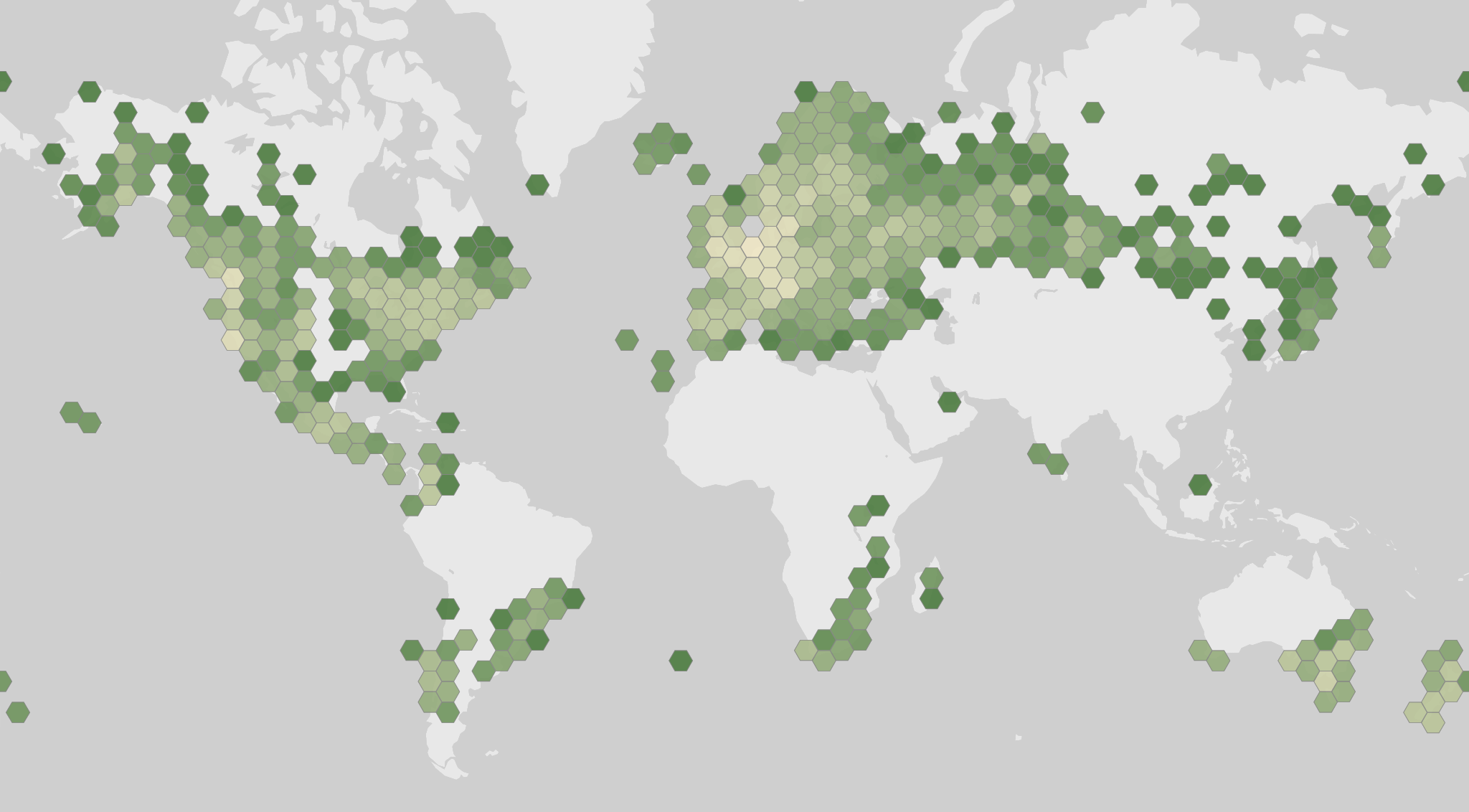
Amanita muscaria is native to conifer and deciduous woodlands across the temperate and boreal Northern Hemisphere, including higher elevations of warmer regions such as the Hindu Kush, the Mediterranean, and Central America. A molecular study proposes an ancestral origin in the Siberian–Beringian region during the Tertiary period, with later radiation across Asia, Europe, and North America. In North America it is native to parts of Alaska and grows alongside imported European trees near the West Coast.
As an ectomycorrhizal fungus, it forms symbiotic partnerships with a range of trees, including pine, oak, spruce, fir, birch, and cedar, and it is often found growing near Boletus edulis or in fairy rings. Carried alongside pine seedlings, it has spread into the Southern Hemisphere, including Australia, New Zealand, South Africa, and parts of Brazil such as Paraná, São Paulo, Minas Gerais, and Rio Grande do Sul. In New Zealand, Tasmania, and Victoria it behaves like a fungal weed, forming new partnerships with southern beech, and it appears to be invading and possibly displacing native species in an Australian rainforest, with reports of it spreading as far north as Port Macquarie on the New South Wales coast.
Fruiting season varies by climate: summer and autumn across most of North America, but later into autumn and early winter along the Pacific coast. Observation records show a strong seasonal peak, with reported sightings climbing sharply through late summer and reaching their highest point in October before tapering off by winter—consistent with a cool-season fruiting pattern, though these figures reflect presence records rather than true population size or abundance.
Uses and Cultural History
Amanita muscaria carries a long history of spiritual and ritual use, with records of ritual drinks dating back as far as 4,000 years. Indigenous peoples across Siberia, Scandinavia, Eastern Europe, and Russia regarded it as having medicinal properties, and in Eastern European folklore it is woven into tales of magic and fairy stories. Among the Koryak people of the Kamchatka Peninsula in Eastern Siberia, the mushroom is described in cultural folklore as a "divine offering" from an entity known as Big Raven. Some scholars have speculated that Soma, the ceremonial beverage referenced in the Hindu Vedas, may have been prepared from this mushroom, and its red-and-white form has been linked in popular culture to the Norse god Odin and to the origins of the modern Santa Claus image.
The mushroom's psychoactive effects come from compounds including muscimol and its precursor ibotenic acid, both of which are water-soluble; some traditional practices, such as boiling and discarding the cooking water, are described as partly detoxifying it, and drying is noted to increase potency by converting ibotenic acid into the more potent muscimol. Patrick Harding has described a Sami custom of processing fly agaric through reindeer. According to some sources, once detoxified in this way, the mushroom has been treated as edible, though the amount and ratio of its active compounds vary widely by region and season, with spring and summer specimens reported to contain up to ten times more ibotenic acid and muscimol than autumn ones.
Fun Facts
- Some scholars have speculated that the ceremonial Hindu beverage Soma, referenced in the Vedas, may have been prepared from Amanita muscaria.
- The Koryak people of Siberia's Kamchatka Peninsula describe the mushroom in folklore as a "divine offering" from the entity Big Raven.
- Its red-and-white form has been popularly linked to both the Norse god Odin and the modern image of Santa Claus.
- Records of ritual drinks made from the mushroom stretch back as far as 4,000 years.
- In Eastern European folklore, the fly agaric is a recurring figure in stories of magic and fairy tales.
Ecology
Habitat
- Forest
- Woodland
- Mountain