A single mushroom, weighing barely 30 grams, or about half a cap, is estimated to hold enough toxin to kill an adult human. That grim statistic belongs to Amanita phalloides, the death cap, the fungus responsible for the majority of fatal mushroom poisonings worldwide.
The death cap is a basidiomycete fungus in the family Amanitaceae, native to Europe, where it forms ectomycorrhizal partnerships with broadleaved trees. Since the late twentieth century it has spread to other continents, often carried unintentionally on the roots of imported oaks, chestnuts, and pines. Its large fruiting bodies emerge in summer and autumn, typically greenish with a white stipe and gills, though the cap color varies enough that it cannot be trusted as a safe identifying feature.
What makes this species worth attention is not just its lethality but its ordinariness: it looks unremarkable, smells faintly sweet, and has repeatedly been mistaken for prized edible mushrooms around the world, with tragic consequences.
Fruiting Body and Identification
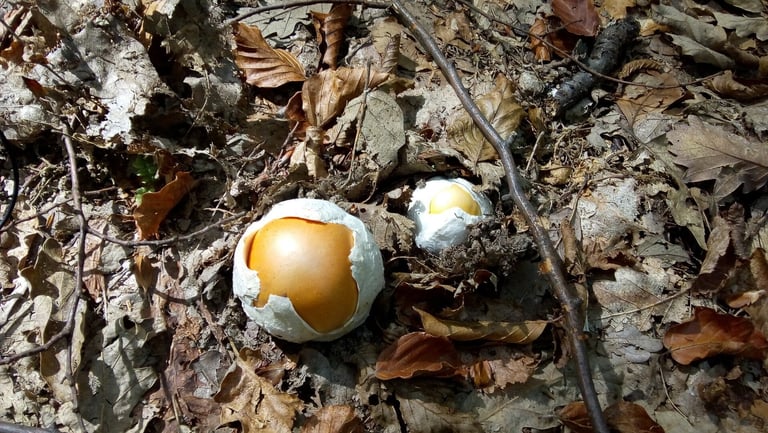
The most reliable identifying feature is not the cap but the base of the stipe: a swollen, ragged, sac-like white volva, often hidden beneath leaf litter, that must be excavated to be seen. Young specimens emerge from the ground looking like a white egg wrapped in a universal veil; as this veil ruptures, it leaves the volva behind as a diagnostic remnant.
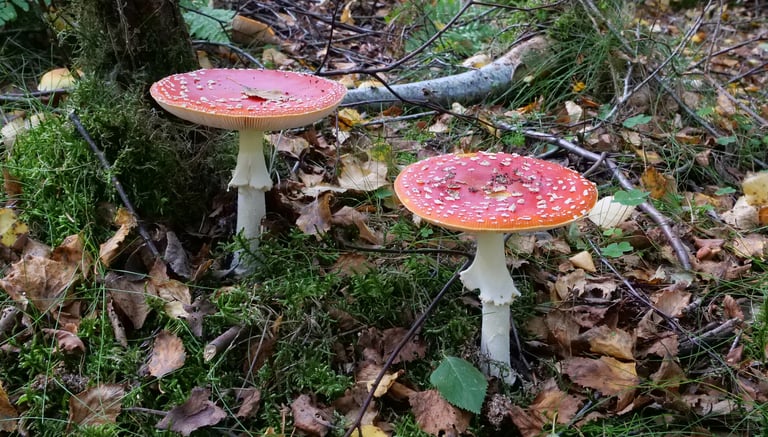
The cap spans 5 to 15 centimeters across, starting rounded and hemispherical before flattening with age. Color ranges from pale green, yellowish-green, and olive-green to bronze, or occasionally pure white, usually paler toward the margin and paler still after rain. The surface is sticky when wet and peels easily, a trait sometimes wrongly assumed to signal edibility. Beneath the cap, crowded white lamellae (gills) are free from the stipe, and a floppy, skirt-like annulus hangs about 1 to 1.5 centimeters below the cap edge. The stipe itself is white with scattered grayish-olive scales, 8 to 15 centimeters long and 1 to 2 centimeters thick.
The flesh carries a smell that starts faint and honey-sweet but grows overpowering and sickly as the mushroom ages. The spore print is white, smooth, and ellipsoid, with spores measuring roughly 7 to 12 by 6 to 9 micrometers that stain blue with iodine; the gills themselves stain pallid lilac or pink when treated with concentrated sulfuric acid.
Distribution and Habitat
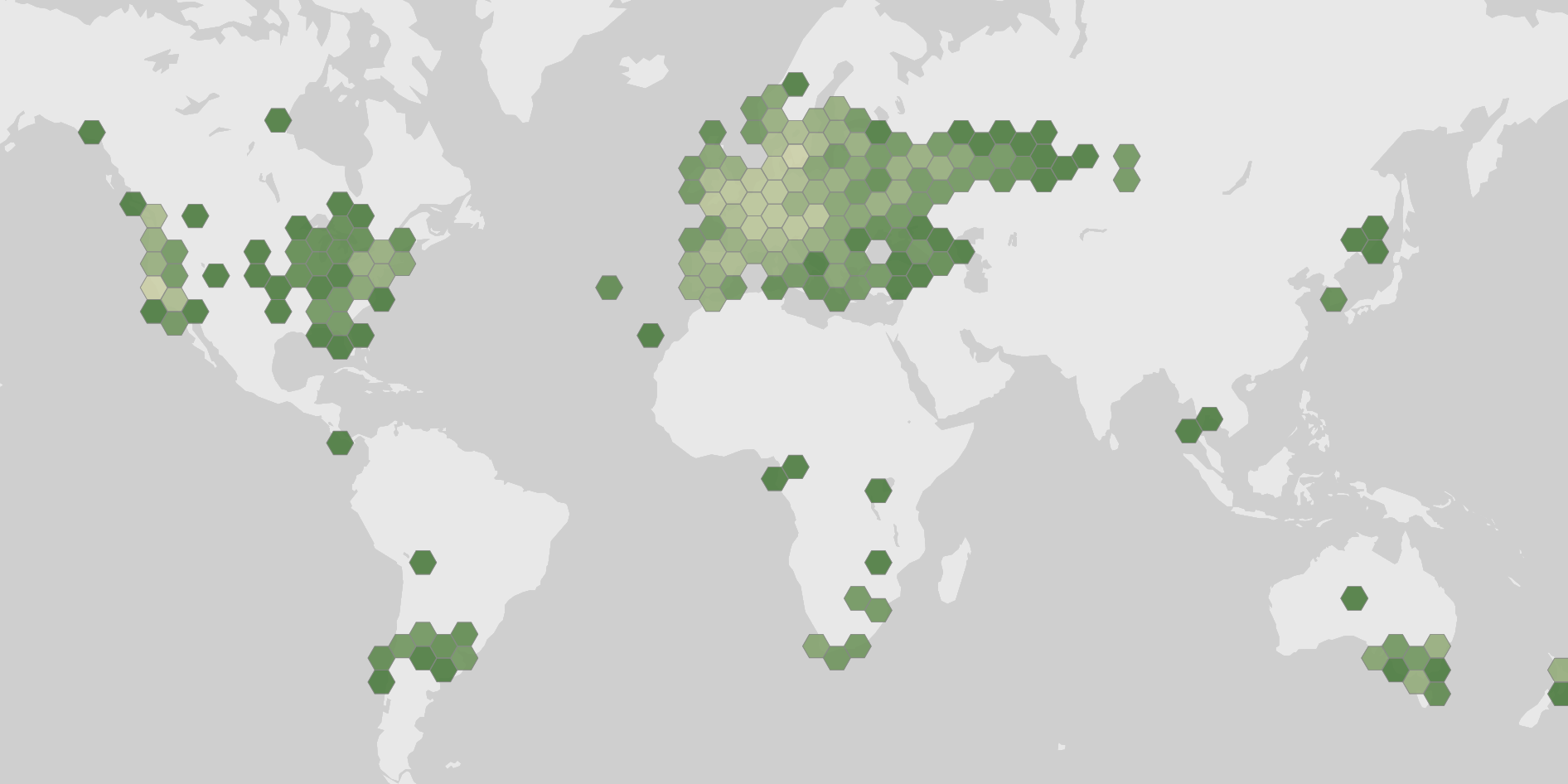
The death cap is native to Europe, where it is widespread, ranging from southern Scandinavia and Ireland in the north and west, east to Poland and western Russia, and south through the Balkans, Greece, Italy, Spain, and Portugal, with populations also in Morocco, Algeria, and the forests of northern Iran. It favors deciduous woodland, particularly under beech and oak, showing a slight preference for acidic soils, and in mountainous regions it also occurs in coniferous forest and in pastures at the edge of woodland.
Outside its native range, the species has been introduced repeatedly, most likely on the roots of imported oaks, chestnuts, and pines. It reached North America by the late nineteenth century, with East Coast populations probably arriving inadvertently alongside chestnut plantings and West Coast populations confirmed as introduced by genetic study in 2009; multiple separate introductions appear to have produced genotypes adapted to either oaks or conifers. In the Southern Hemisphere, introduced oaks carried it to Australia (recorded around Melbourne, Canberra, Adelaide, Beechworth, Sydney, and Albury) and to South America, while pine plantations are linked to its presence in Tanzania and South Africa, and oaks and poplars to populations in Chile and Uruguay.
Monthly observation counts show a pronounced late-summer and autumn peak, with figures climbing sharply from around 1,500 in July to over 10,900 in October before falling back below 4,000 by November. As presence records rather than measures of abundance, these figures cannot confirm population size, but the pattern is consistent with the death cap's known late-summer-to-autumn fruiting season.
Ecology and Relationships
The death cap lives as an ectomycorrhizal symbiont, wrapping its hyphae around the fine roots of host trees and exchanging soil nutrients for sugars produced by the tree. In Europe it partners most often with oaks, but also with beeches, chestnuts, horse-chestnuts, birches, filberts, hornbeams, pines, and spruces, while introduced populations tend to remain tied to whichever host trees were exotic to their new range, such as coast live oak in coastal California.
In some introduced regions the fungus has formed unexpected new partnerships, associating with hemlock and with members of the myrtle family, including Eucalyptus in Tanzania and Algeria and Leptospermum and Kunzea in New Zealand. These novel associations suggest the species may have invasive potential beyond the tree hosts it depends on in its native range.
Few animals appear to feed on it. It has been recorded once as food for the pleasing fungus beetle Rotitma sanguinipennis, though this record is considered likely to be a mix-up with a related beetle species that does feed on Amanita, and it has been found alongside adults of another beetle, Tritoma biguttata, without clear evidence that it forms a regular food source for them.
Uses and Cultural History
Human interaction with the death cap has been overwhelmingly one of harm rather than use: it is not eaten, but its notoriety has made it a cultural symbol of deceit and hidden danger, its innocuous, even pleasant appearance concealing a fatal outcome. Documented poisonings stretch back to the eighteenth century in Europe and beyond, cementing this reputation.
Most poisoning incidents trace back to mistaken identity rather than deliberate consumption. The death cap's resemblance to the edible paddy straw mushroom (Volvariella volvacea) has repeatedly endangered East and Southeast Asian immigrant communities in Australia and on the West Coast of the United States; in one Oregon case, four members of a Korean family required liver transplants after such confusion. Many North American cases involve Laotian and Hmong immigrants who mistake it for Amanita princeps ("white Caesar"), a popular edible species in their countries of origin, and of nine people poisoned in the Canberra region between 1988 and 2011, several were recent immigrants from Laos and China.
Beyond its grim record, the fungus has drawn sustained scientific interest: its biochemistry, particularly the amatoxins that inhibit RNA polymerase II, has been studied intensively for decades, and its genome has been sequenced.
Fun Facts
- The death cap's own RNA polymerase II is immune to the amatoxins it produces, so the fungus does not poison itself even though the toxin destroys human liver cells.
- Its genome has been fully sequenced, aiding decades of research into how its toxins work.
- The toxic phallotoxin phalloidin was isolated in 1937 by Feodor Lynen and Ulrich Wieland, and the more dangerous amatoxins were isolated in 1941 by Heinrich Wieland and Rudolf Hallermayer, all at LMU Munich.
- Before modern intensive care, mushroom poisoning mortality was around 60 to 70 percent; with modern medical treatment the death cap's mortality rate has fallen to an estimated 10 to 30 percent.
- A chemical screening method called the Meixner test can detect amatoxins in a suspected sample, but it also gives false positives for psilocybin and related tryptamine compounds.
- Death caps have been reported to taste pleasant, which, combined with a delay of six to twelve hours before symptoms appear, allows severe internal organ damage to occur before a victim realizes anything is wrong.
Ecology
Habitat
- Forest
- Woodland
- Grassland