The embryos of the spotted salamander host a symbiotic green alga, Chlorococcum amblystomatis, growing in and around the developing cells — the only documented case of a vertebrate hosting an endosymbiotic microbe this way.
Ambystoma maculatum is a mole salamander in the family Ambystomatidae, native to eastern North America, ranging from Nova Scotia to Lake Superior and south to Georgia and Texas. It spends most of its life hidden underground or beneath leaf litter in mature forests, and the IUCN currently lists it as Least Concern.
It also holds official status as the state amphibian of Ohio and South Carolina, a mark of how familiar its black-and-yellow pattern is across its range. Between its hidden underground habits, its decades-long lifespan, and its unusual biology, this is an amphibian that rewards a closer look.
Identification and Appearance
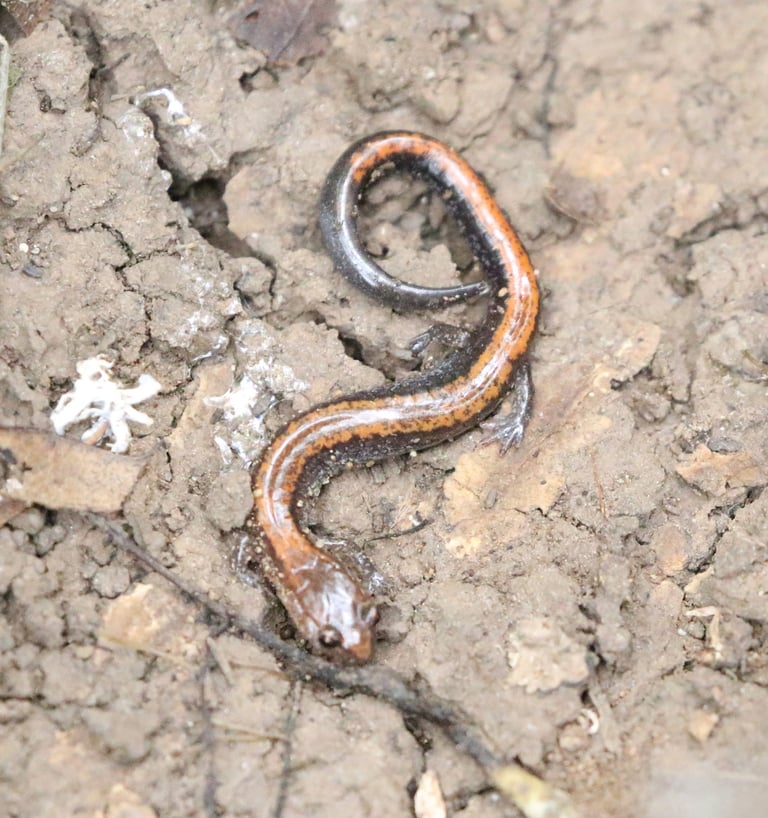
Two ragged rows of yellow-to-orange spots running from behind the eyes to the tip of the tail, set against a black or bluish-black body, are the clearest way to recognize this species. Adults measure roughly 15 to 25 centimeters (5.9 to 9.8 inches) including the tail, weigh around 12.8 grams, and show the stout build and wide snout typical of mole salamanders.
Body color ranges from black to dark gray, dark green, or dark brown. Spots near the top of the head tend to run more orange, while those along the rest of the body are more yellow. The underside is slate gray mottled with pink.
Sexual differences show up mainly in the spots rather than in size alone: larger females tend to carry brighter, higher-chroma spots, while males often have more of their back covered in spots that are duller overall. Body condition also correlates with spot brightness, with well-fed animals showing more vivid coloring.
The scientific name reflects the animal's build and pattern: Ambystoma draws on Greek roots for a blunt mouth, and maculatum is Latin for spotted. Individuals commonly live around 20 years, with some records reaching 30.
Distribution and Habitat
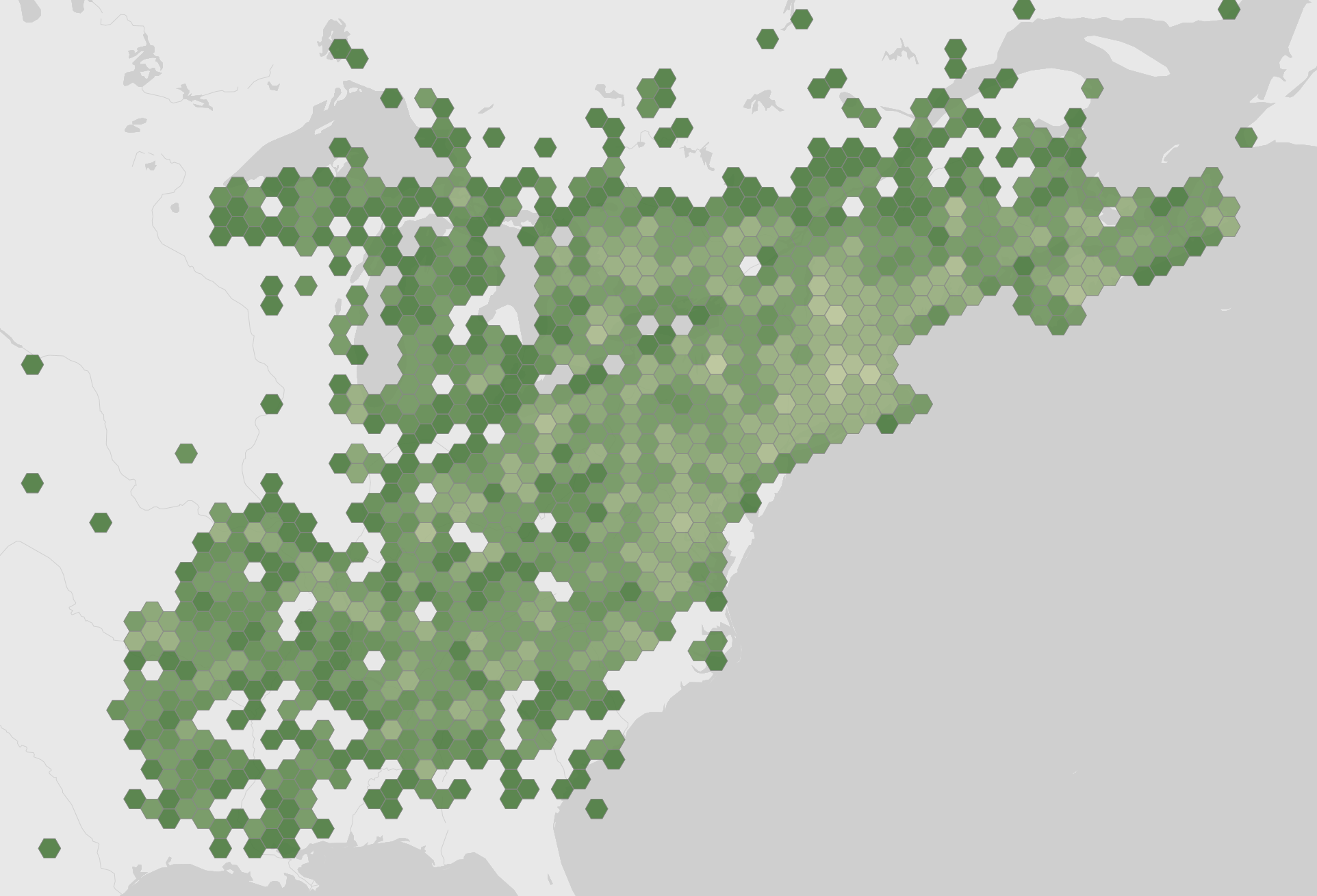
The spotted salamander occupies a broad swath of eastern North America, from Nova Scotia south through the Great Lakes region around Lake Superior, and down to southern Georgia and Texas.
Adults favor mature deciduous bottomland forests along rivers, though they also use upland mixed or coniferous forest where the climate stays damp and fishless breeding ponds are nearby. Breeding depends on temporary vernal pools that dry out often enough to exclude fish but hold water long enough for larvae to complete metamorphosis; larger pools tend to hold more egg masses and support better larval survival. Outside the breeding season, adults keep to forest with well-drained soils riddled with small-mammal burrows, and they are largely absent from areas with canopy cover below 30 percent.
Dispersal between ponds happens mainly through juveniles, which favor mature forest over young secondary growth or open fields and can detect a forest edge from about 10 meters away; early successional forest may even act as an ecological trap. Populations tied to different pools form genetically distinct metapopulations, with animals living within 4.8 kilometers of each other sharing notably more genes than those farther apart.
Monthly observation counts peak sharply in April, with over 13,900 records that month compared to a few hundred in the depths of summer and winter. That spike lines up with the species' spring breeding migration, though these are presence records only and say nothing about total population size.
Behavior and Lifestyle
Spotted salamanders are fossorial and nocturnal, spending nearly all their time hidden a few centimeters below the soil surface, in existing burrows and crevices, though individuals have been found as deep as 1.3 meters. They rarely dig their own tunnels, relying instead on burrows made by small mammals, and only surface on moist or rainy nights when underground food runs short. A home range of just 8 to 15 square meters is typical, and they defend it aggressively against other spotted salamanders they encounter.
Breeding draws them out in a dramatic seasonal shift. After the first rains following snowmelt, they migrate at night to their home pond, often traveling the same route and entering at the same spot every year, and they can find their natal pond again even if displaced hundreds of meters away, likely guided in part by chemical cues. In North Amherst, Massachusetts, this migration crosses a public road so reliably that officials built dedicated tunnels to protect the salamanders during the event locally known as the Big Night.
Larvae behave differently depending on threat level: they hide in bottom litter when predators are near but turn into aggressive hunters otherwise, sometimes learning visual landmarks associated with food sources. Adults defend themselves with autotomy of the tail, strong regenerative ability, and a toxic milky secretion released from glands along the back and neck when disturbed.
Communication
Chemical cues dominate this species' social life. Spotted salamanders appear to prefer the scent of their home pond over unfamiliar ponds, and females are drawn to chemical signals males release into the water during courtship.
Courtship itself layers touch onto scent: males nudge and rub against females, likely combining tactile and chemical signals to prompt mating. Vision also plays a role, particularly for detecting motion in low light, helping the salamanders locate prey and possibly navigate using landmarks near their burrows and breeding sites.
Hunting and Diet
Larvae hunt as soon as they hatch, starting on small insects and branchiopod crustaceans such as Daphnia and fairy shrimp before moving on to larger prey, including isopods, amphipods, bigger insects, frog tadpoles, and even other salamander larvae. When vernal pools begin to dry and crowding intensifies, larvae will turn cannibalistic and attack members of their own species.
Adults hunt on the forest floor using a sticky tongue to snatch prey, taking earthworms, snails, slugs, millipedes, centipedes, spiders, and a wide range of insects. They occasionally take smaller salamanders as well, including the red-backed salamander, Plethodon cinereus.
Reproduction and Life Cycle
Breeding begins with a rush to the pond: after the first thaw rains, males move faster than females and arrive first, often outnumbering them once the females show up. In the water, males swim vigorously, rubbing and nosing one another and producing up to 80 gelatinous sperm packets called spermatophores each, sometimes covering a rival's spermatophore with their own to gain an edge.
Females collect these spermatophores internally to fertilize their eggs, a mating system best described as polygynandrous, with each male potentially fertilizing several females and each female taking sperm from multiple males.
Each female then lays 100 to 370 eggs, averaging around 200, in several compact masses coated in clear or milky jelly and attached to submerged branches or aquatic plants. Eggs hatch in four to seven weeks, with timing depending on location: as early as late December in the southern part of the range, as late as May in Nova Scotia.
Sexual maturity takes two to three years in warmer parts of the range but can take males five to six years and females up to seven years farther north. Parental investment ends once the eggs are laid; males provide no care, and females contribute only the yolk provisioning and protective jelly layer before leaving the eggs to develop on their own.
Population and Ecological Role
Spotted salamanders shape the community of species that breed in vernal pools, influencing both the abundance and diversity of other amphibians sharing those waters. Gray treefrogs, Hyla chrysoscelis and Hyla versicolor, avoid breeding in ponds where spotted salamanders are present, and depending on timing and pool size, spotted salamanders can reduce populations of other Ambystoma species using the same pools.
The species also maintains a mutualistic relationship with a unicellular green alga, listed as Oophila amblystomatis, tying its reproductive success to a partner organism found nowhere else in vertebrate biology.
Conservation and Threats
The IUCN rates the spotted salamander as Least Concern, and it carries no special protection under the U.S. Endangered Species Act, CITES, or Michigan's state list. It remains a fairly common species overall, but its dependence on vernal pools for breeding makes local populations vulnerable even where the species as a whole is secure.
The leading threats are acidic precipitation, which harms developing embryos, and habitat destruction through deforestation, which isolates breeding populations from one another and can cut off the metapopulation connections that keep genetic diversity healthy.
Conservation status
- LC
- NT
- VU
- EN
- CR
Least Concern
Cultural Significance
The spotted salamander carries official recognition as the state amphibian of both Ohio and South Carolina, a status that reflects how familiar its yellow-spotted pattern is to people living within its range.
Beyond symbolism, the species offers a practical benefit to people: by preying on insects in and around its breeding ponds, including mosquitoes that develop there, it may help suppress pest insect populations nearby.
Fun Facts
- The scientific name blends Greek and Latin roots: Ambystoma refers to a blunt mouth, and maculatum means spotted.
- Spotted salamanders can learn to associate visual landmarks in their habitat with food sources, an ability documented through behavioral studies.
- Genetic studies show that populations breeding in ponds more than 4.8 kilometers apart share noticeably less genetic material than those closer together.
- Its regenerative powers extend well beyond limbs: it can regrow parts of its tail, legs, and even portions of its brain and internal organs after injury.
- Males consistently arrive at breeding ponds before females each spring, a pattern linked to differing temperature thresholds that trigger movement in each sex.
- Individuals can live for two to three decades in the wild, with some records reaching around 30 years of age.
Ecology
Diet
- Carnivore
Behavior
- Nocturnal
- Predator
- Burrowing
- Migratory
Habitat
- Forest
- Freshwater
Photos
SourcesGBIFiNaturalistWikidataWikipediaAnimal Diversity WebAnAge