The axolotl never grows up. Unlike almost every other salamander on Earth, it reaches full sexual maturity while still wearing the body of a larva, keeping its feathery external gills, its finned tail, and its fully aquatic lifestyle for its entire life instead of transforming onto land.
A member of the mole salamander family (Ambystomatidae) in the order Caudata, Ambystoma mexicanum is native to a single, shrinking corner of the world: the ancient canal system beneath Mexico City. The species is now listed as Critically Endangered, with wild populations reduced to fragments of their former range.
Few amphibians carry as much scientific and cultural weight. The axolotl's ability to regrow lost limbs, its sprawling genome, and its deep roots in Aztec mythology have made it one of the most studied and recognized salamanders in the world, even as its native lakes disappear around it.
Identification and Appearance
The single best field mark is the axolotl's retained larval anatomy: a wide, flattened head, lidless eyes, and three pairs of feathery external gill stalks projecting from behind the head, each lined with fine filaments that increase surface area for gas exchange. A finned tail runs from behind the head to the vent, and the limbs are underdeveloped, ending in long, thin digits.
Sexually mature adults measure 15 to 45 cm (6 to 18 in) at 18 to 27 months old, with most individuals settling around 23 cm (9 in); anything over 30 cm (12 in) is unusual. Beneath four hidden gill slits, gill rakers filter out food particles while allowing water to pass, and the mouth holds only barely visible vestigial teeth, since axolotls feed by suction rather than biting.
Males and females differ subtly: males develop a swollen cloaca lined with papillae, while females grow noticeably wider bodies when carrying eggs. The wild-type color is brown or tan with gold speckling over an olive undertone, and animals can shift this coloring slightly by adjusting their melanophores, likely for camouflage. Captive breeding has produced several common color morphs from four pigmentation genes: leucistic (pale pink body, black eyes), xanthic (grey body, black eyes), albinistic (pale pink or white body, red eyes), and melanistic (black or dark blue body with no gold flecking), along with piebald and double-homozygous combinations popular in the pet trade.
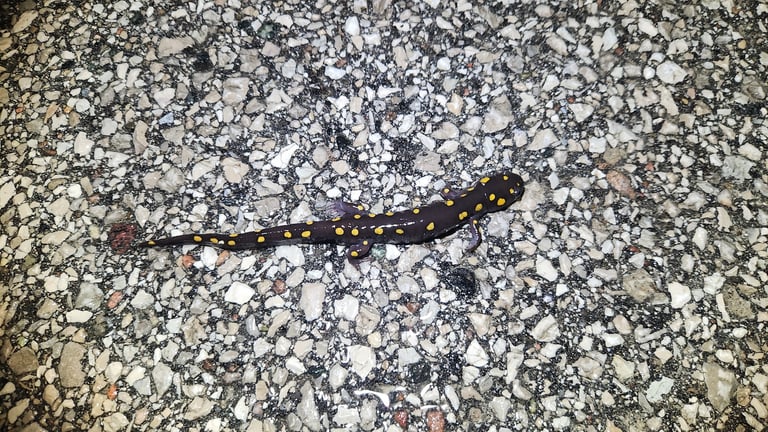
Because it never metamorphoses, the axolotl can be confused with the larvae of other neotenic mole salamanders, especially the tiger salamander, or with unrelated aquatic salamanders like mudpuppies, all of which share the external-gill, finned-tail body plan at this life stage.
Distribution and Habitat
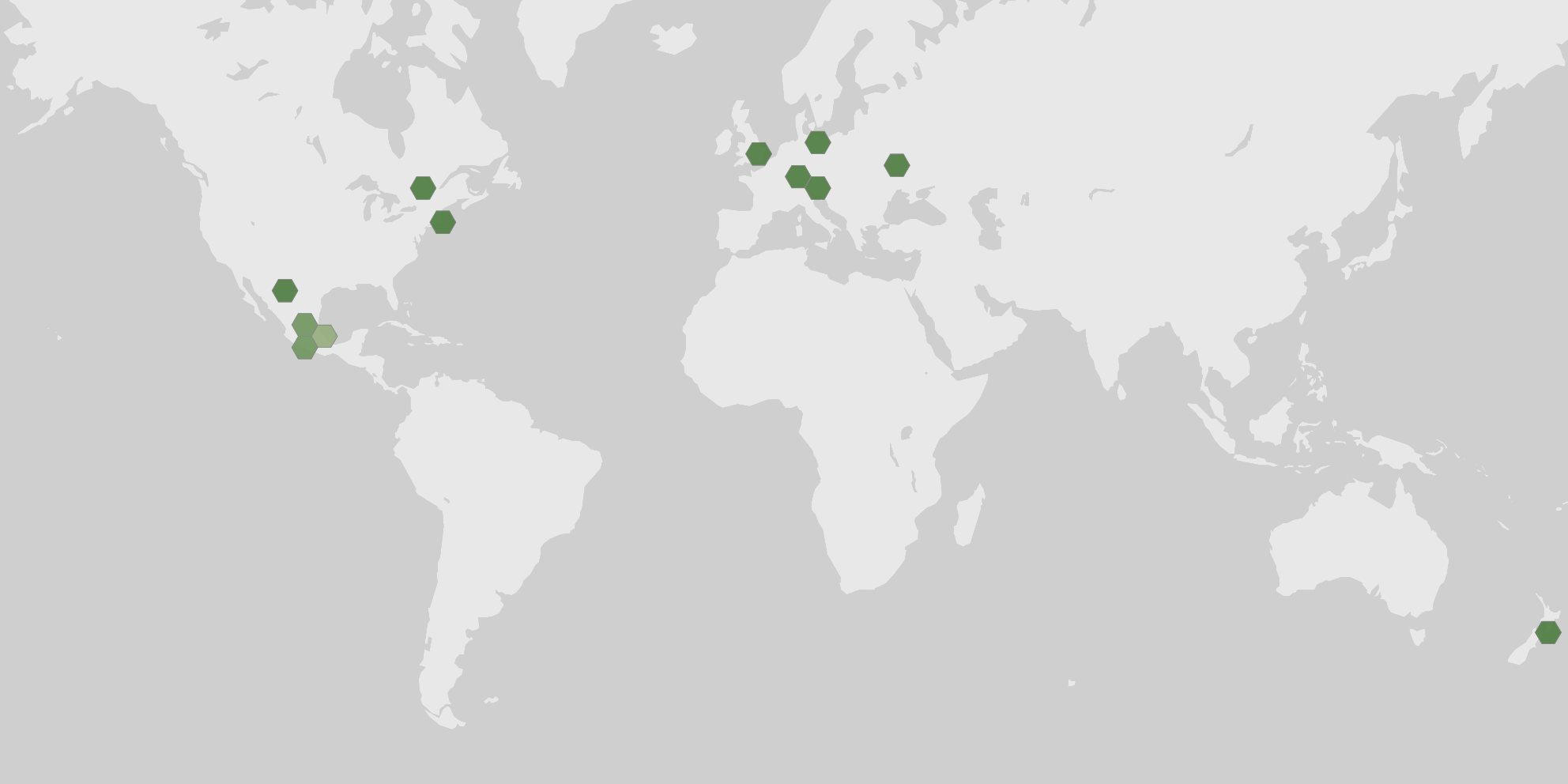
The axolotl's entire native range is confined to the high-altitude lake system of the Valley of Mexico, historically Lakes Chalco and Xochimilco near Mexico City. Lake Chalco has been completely drained, leaving Lake Xochimilco, at roughly 2,274 m elevation, as the species' last stronghold, now reduced mostly to a network of canals and wetland fragments rather than open lake.
Within this system the species favors deep, brackish water channels with abundant aquatic vegetation, conditions that support both cover from predators and the still, oxygen-rich water axolotls rely on. A population has also been confirmed in the artificial lake at Chapultepec, though the species' overall footprint remains tiny compared to its historical extent.
Monthly observation counts show a pronounced peak in January (74 records) with lower numbers through most of the year and a smaller secondary rise in September; because these figures reflect presence records rather than abundance or a complete range survey, they should be read only as a cautious hint of when observers most often encounter the species, not as a measure of population size.
Behavior and Lifestyle
Axolotls are solitary animals that can be active at almost any hour, showing both diurnal and nocturnal activity rather than keeping to a strict schedule. Described as natatorial, they are built for swimming and spend their entire lives in water, alternating between sedentary periods resting on the substrate and more motile bouts of active movement.
This flexible, largely undirected activity pattern fits an animal with few natural predators left in its remaining habitat and little need to defend territory, unlike many terrestrial salamander relatives.
Communication
Axolotls communicate mainly through visual and chemical signals, and these channels become important almost exclusively during mating, when pheromones and body movements guide the courtship exchange between male and female. Outside the breeding period, there is little to no communication between individuals.
To sense their surroundings and locate prey, axolotls rely on the same visual and chemical channels, supplemented by an unusual ability to detect electrical fields, a sense that helps them find food and navigate in the often murky water of their canal habitat.
Hunting and Diet
As the top predator in its native canals, the axolotl hunts by suction rather than pursuit: it locates prey largely by smell, then snaps its wide mouth open to create a vacuum that pulls the target straight into its stomach, while its gill rakers interlock to seal the gill slits during the strike.
This method lets it take a broad range of prey, including mollusks, aquatic insects and other arthropods such as crayfish, small fish, worms, zooplankton, and even other salamanders, including its own species. Effectively an opportunistic ambush feeder, the axolotl will eat anything it can catch and fit into its mouth.
Because it hunts by ambush and smell rather than active chase, its diet is shaped more by what drifts or crawls within striking range in the vegetation-choked canals than by seasonal migration of prey.
Reproduction and Life Cycle
Axolotls follow a polygynandrous, promiscuous mating system, with courtship following the typical Ambystoma pattern. Pairs begin by nudging each other's cloacal region before circling together in a shared "waltz." The male then moves ahead, undulating the rear of his body and tail in a display resembling a hula dance, drawing the female to follow.
The male deposits a cone-shaped, jelly-capped spermatophore on the substrate by shaking his tail vigorously for about thirty seconds, then moves forward; the female follows, positions herself over the spermatophore, and picks it up with her cloaca to complete internal fertilization.
In the wild, breeding occurs once a year, generally between March and June. Females lay 100 to 300 eggs, depositing them singly rather than in clumped masses, each wrapped in a protective jelly coat and attached individually to rocks or floating vegetation. Eggs hatch after 10 to 14 days, and the hatchlings are immediately independent, receiving no further parental care beyond the female's pre-hatching provisioning of the egg. Both sexes typically reach sexual maturity by the following breeding season, at around one year of age.
Population and Ecological Role
Historically, the axolotl held the role of top predator within its native lake and canal system, a position that let it shape the structure of the wider aquatic community by controlling the numbers of the invertebrates, fish, and amphibians it fed on.
With wild populations now reduced to isolated fragments of the former lake system, that ecological role has been greatly diminished across most of the species' original range, even as the axolotl remains one of the best-known amphibians in captivity and research collections worldwide.
Conservation and Threats
The axolotl is classified as Critically Endangered on the IUCN Red List and listed under CITES Appendix II, reflecting a wild population that has collapsed within living memory. Surveys in Lake Xochimilco found roughly 6,000 axolotls per square kilometer in 1998, dropping to 1,000 in 2003 and just 100 in 2008; a four-month search in 2013 found no surviving wild individuals at all, though two were spotted a month later in the canal network.
Habitat loss is the most severe threat: Lake Chalco was drained entirely for drinking water, and Lake Xochimilco survives only as a patchwork of canals and swamps squeezed by the growth of Mexico City. Water quality in the remaining habitat is poor, with a low nitrogen-to-phosphorus ratio and high chlorophyll a levels pointing to an oxygen-poor environment, worsened by partially treated wastewater from aquaculture and agriculture. Pesticide runoff entering the lake sharply raises mortality in axolotl embryos and larvae, and survivors often show morphological and behavioral abnormalities. Introduced predatory fish add further pressure by preying directly on axolotls and their eggs.
The steep population crash has also driven a significant loss of genetic diversity, with evidence of low gene flow between remaining groups and elevated genetic drift from repeated population bottlenecks, leaving surviving axolotls more inbred and less able to adapt to further environmental change.
Conservation status
- LC
- NT
- VU
- EN
- CR
Critically Endangered
Cultural Significance
In Aztec belief, the axolotl was sacred, tied to the myth of the god Xolotl, who transformed himself into an axolotl to escape being sacrificed by the other gods, an origin story reflected directly in the species' name (from atl, water, and Xolotl). Beyond myth, the animal was historically eaten as a delicacy, prepared in dishes such as tlapiques, and its fat was used in traditional medicine.
The axolotl remains deeply embedded in modern Mexican identity: it appears in Diego Rivera's 1951 mural Agua, el origen de la vida in Chapultepec Park, became the official emoji of Mexico City in 2017, and was featured on Mexico's redesigned 50-peso banknote in 2021, a note popular enough that tens of millions have reportedly been hoarded rather than spent.
Its reach extends well beyond Mexico. In Japan it is known as the "wooper looper" after a 1980s marketing campaign, an inspiration behind Pokémon characters such as Wooper and Mudkip, and it lent its look to Toothless in the How to Train Your Dragon films, to the game Axie Infinity, and to Minecraft, which added axolotls in 2020 as part of an effort to highlight endangered species. It also appears in Julio Cortázar's short story "Axolotl."
Fun Facts
- The axolotl genome, sequenced in 2018, spans about 32 billion base pairs, roughly ten times the size of the human genome, and was the largest animal genome completed at that time.
- Despite its enormous genome, the axolotl encodes about 23,251 proteins, only slightly more than the roughly 20,000 found in humans; the size gap comes mainly from repetitive DNA and unusually long introns.
- A star in the constellation Cetus was officially named Axólotl in 2019.
- In 2021, Mexico's new 50-peso banknote featuring an axolotl was named "Bank Note of the Year" by the International Bank Note Society.
Ecology
Habitat
- Wetland
- Mountain
- Freshwater
Diet
- Carnivore
Behavior
- Nocturnal
- Predator
- Solitary
- Aquatic
Photos
SourcesGBIFiNaturalistWikidataWikipediaEncyclopedia of LifeAnimal Diversity WebAnAge