A single female northern crested newt can live for up to 28 years, an exceptional lifespan for an amphibian barely 16 centimeters long.
Also known as the great crested newt or warty newt, Triturus cristatus is a large, dark-bodied newt native to Great Britain, northern and central continental Europe, and parts of Western Siberia. The IUCN lists it as Least Concern, though populations across its range are declining. What makes this species stand out is not just its size but the male's dramatic seasonal transformation: during the aquatic breeding season he grows a serrated crest along his back and tail, turning an otherwise drab woodland dweller into one of Europe's most striking amphibian displays.
Identification and Appearance
The clearest way to recognize a breeding male is the jagged crest running along its back and tail, reaching up to 1.5 centimeters high. The crest is heavily indented along the back but smoother toward the tail, and it is interrupted at the base of the tail. Females never develop this crest, but instead show a yellow line running along the lower edge of the tail.
This is a relatively large newt. Males typically reach a total length of 13.5 centimeters, while females grow larger, up to 16 centimeters, and rare individuals have been recorded at 20 centimeters. The species has 15 rib-bearing vertebrae, giving it a moderately slender build compared with other crested newts; only the Danube crested newt, with 16 to 17 vertebrae, is more elongated, while the remaining, stockier Triturus species have 14 or fewer.
Skin texture and color help confirm identification. The back and sides are dark brown and rough-textured, with black spots and heavy white stippling across the flanks. The throat is yellow and black with fine white speckling, and the belly is yellow to orange with irregular dark blotches, a pattern unique to each individual. During breeding season, males also develop a swollen cloaca and a blue-white flash running along the sides of the tail.
Where its range overlaps with the marbled newt in western France, or with other crested newt species along the borders of southeast Europe, body proportions and vertebral count offer the most reliable distinctions, since coloration alone can be similar across these closely related species.
Distribution and Habitat
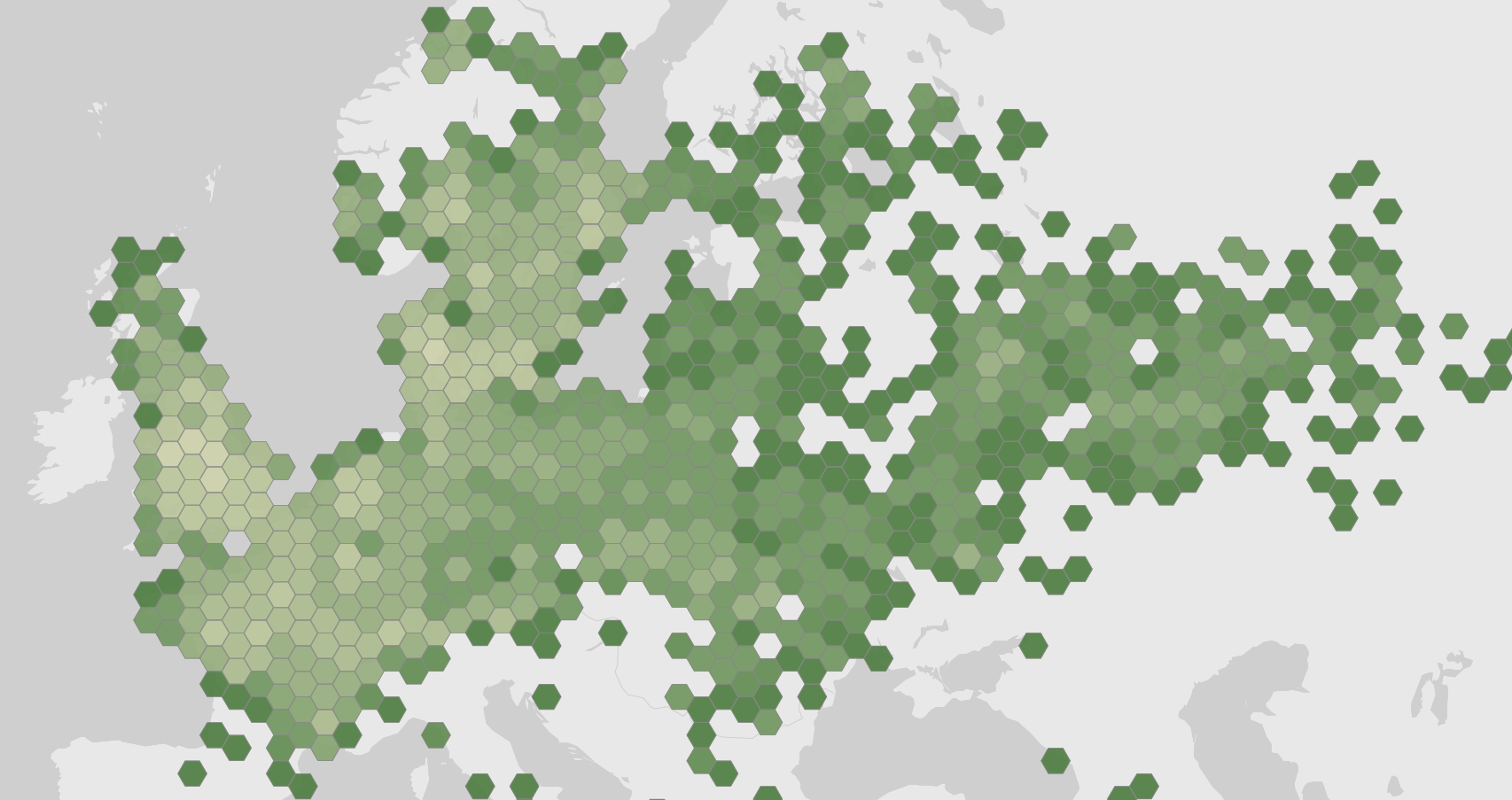
The northern crested newt is the most widespread and northerly of the crested newt species. Its range stretches from Great Britain through southern Fennoscandia to the Republic of Karelia in Russia in the north, with a southern margin running through central France, southwest Romania, Moldavia, and Ukraine before continuing into central Russia and the Ural Mountains. Its range extends further east into Western Siberia, from Perm Krai to Kurgan Oblast.
Outside the breeding season, the species is mainly a forest-dweller, favoring deciduous woodlands and groves, though conifer stands are also used, particularly at the northern and southern edges of its range. Where forests are absent, it makes use of other cover-rich habitats such as hedgerows, scrub, swampy meadows, or quarries. It also tolerates farmland, dunes, and industrial or brownfield sites, provided enough shelter and connected habitat patches remain available.
For breeding, it seeks out stagnant, mid- to large-sized ponds with abundant underwater vegetation and no fish, since fish prey heavily on the larvae. Many of the ponds used in the United Kingdom are human-made, and other suitable sites include ditches, channels, gravel pit lakes, and garden ponds. The species is generally a lowland animal but has been recorded up to 1,750 meters in the Alps.
Monthly observation counts show a sharp rise in spring, peaking in April and May before tapering off through summer and into a low winter baseline. This pattern most likely reflects when the newts are most visible and active at aquatic breeding sites, rather than a true measure of population size.
Hunting and Diet
Northern crested newts hunt differently depending on the season and habitat. On land, they forage among leaf litter and vegetation for earthworms and other annelids, insects and their larvae, woodlice, and snails and slugs. Once they enter the water to breed, their hunting shifts toward aquatic prey: small bivalves and other mollusks, microcrustaceans, and aquatic insects.
During the breeding season, adults also prey on tadpoles and juveniles of other amphibians, including the common frog and common toad, as well as smaller newts, and even their own species' young. Larvae are predators too, taking small invertebrates, tadpoles, and smaller larvae of their own kind once they are large enough.
The newts themselves face predation at every life stage. Larvae are eaten by carnivorous invertebrates, water birds, and especially predatory fish, which is why breeding ponds free of fish are so important to the species. Adults rely on a hidden lifestyle to avoid herons, grass snakes, shrews, badgers, and hedgehogs, but when threatened they roll into a defensive posture, display their bright warning-colored belly, and secrete a milky, toxic substance.
Reproduction and Life Cycle
Courtship begins with an elaborate display in which territorial males establish small patches of clear ground as leks, or courtship arenas, and attract females through specific body movements combined with released pheromones. If a female responds, the male guides her over a spermatophore he has deposited on the ground, which she picks up with her cloaca to achieve internal fertilization.
The female then lays her eggs individually, usually folding each one into the leaves of aquatic plants, a process that takes around five minutes per egg. She lays roughly 200 eggs in a season. Each embryo is light-colored, 1.8 to 2 millimeters across with a 6-millimeter jelly capsule, distinguishing them from the smaller, darker eggs of other newt species sharing the same ponds. A genetic quirk shared across the genus Triturus causes about half of these embryos to die before hatching.
Larvae hatch after two to five weeks depending on water temperature, developing their forelimbs first and their hindlimbs later, as in all salamanders. Unlike smaller newt species, crested newt larvae swim freely in open water rather than clinging to vegetation, and can reach 7 centimeters before resorbing their external gills and moving onto land. Metamorphosis into terrestrial efts takes another two to four months.
Survival is harsh at every stage: on average, only about 4 percent of larvae survive from hatching to metamorphosis. In unfavorable conditions some larvae delay development and overwinter in the water instead, though this strategy is less common than in smaller-bodied newt species.
Conservation and Threats
The northern crested newt is currently assessed as Least Concern by the IUCN, but this masks ongoing declines across much of its range, and the species is rare enough in some areas to appear on several national red lists.
Habitat destruction from urban and agricultural development is the primary driver of decline, affecting both breeding ponds and the surrounding terrestrial habitat the newts need outside the breeding season. Because the species disperses poorly between sites, habitat fragmentation is especially damaging, cutting off the metapopulation connections many populations depend on. Additional pressures include introduced fish and crayfish in breeding ponds, collection for the pet trade in the eastern range, warmer and wetter winters linked to climate change, genetic pollution from hybridization with introduced crested newt species, road salt runoff, and the potential spread of the pathogenic fungus Batrachochytrium salamandrivorans.
Legal protections are extensive: the species is strictly protected under Appendix II of the Berne Convention and listed in Annexes II and IV of the EU Habitats and Species Directive as a European Protected Species, prohibiting its capture, disturbance, killing, trade, or habitat destruction across most of Europe. Several Natura 2000 sites have been designated specifically for its protection, and in the United Kingdom this strict status has occasionally put it at the center of development conflicts, cementing its role as a flagship species whose protection benefits other amphibians as well.
Conservation status
- LC
- NT
- VU
- EN
- CR
Least Concern
Cultural Significance
The genus name Triturus traces back to Triton, the Greek sea god who was son of Poseidon and Amphitrite, depicted as half man and half fish with a scaled body and a forked tail. This mythological figure lent his name to newts of this genus, linking the northern crested newt's scientific identity to an ancient image of a hybrid aquatic being.
Fun Facts
- The northern crested newt can live up to 28 years, an unusually long lifespan for a small amphibian.
- It secretes tetrodotoxin from its skin as a defense, the same class of nerve toxin found in pufferfish, though in much smaller quantities.
- A genetic quirk shared with other Triturus species causes about half of all embryos to die before they can hatch.
- Larvae are cannibalistic, feeding on smaller larvae of their own species when given the chance.
- Its genus name, Triturus, derives from Triton, the half-man, half-fish sea god of Greek mythology.
Ecology
Habitat
- Wetland
- Forest
- Freshwater
- Grassland
Diet
- Carnivore
Behavior
- Predator
- Territorial
- Semi-aquatic
Photos
SourcesGBIFiNaturalistWikidataWikipediaEncyclopedia of LifeAnAge