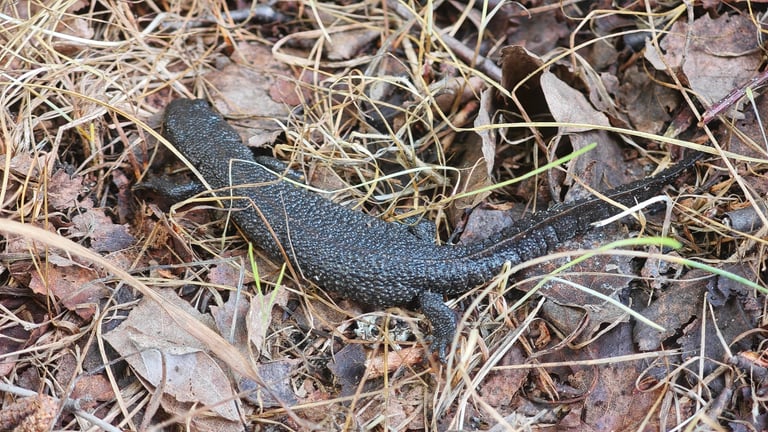
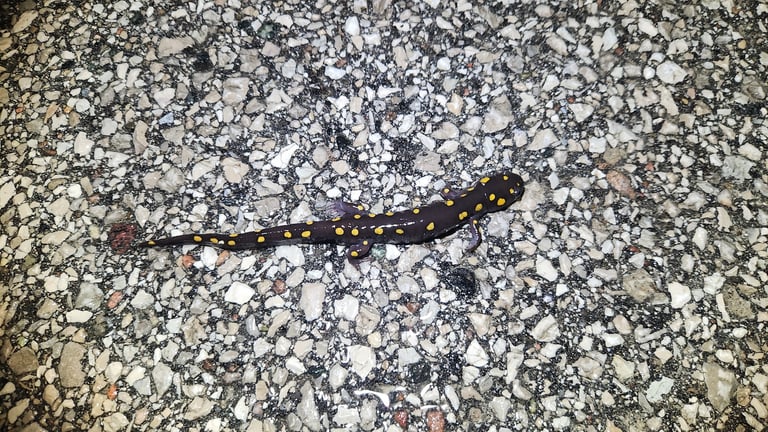
A fire salamander can return to the exact same hibernation cave for up to 20 years running, following what seems to be a mental map of landmarks it remembers season after season.
Salamandra salamandra is an amphibian in the order Caudata, the tailed amphibians, found across much of southern and central Europe. It lives in shaded woodland near the ponds and streams it needs for breeding, spending most of its life hidden beneath logs, rocks, and leaf litter. The IUCN currently lists the species as Least Concern, reflecting its broad range, though this global rating sits alongside serious local declines described later in this profile.
What makes the fire salamander worth a closer look is its chemical defenses and unusual reproduction: it is one of the few salamanders that gives birth to live, well-developed larvae rather than laying eggs, and it can actively spray neurotoxic secretions at predators rather than simply relying on escape.
Identification and Appearance
Adults of Salamandra salamandra weigh about 19 grams (0.0191 kg), giving them a light but sturdy build typical of terrestrial salamanders that spend most of their time under logs, rocks, and leaf litter rather than moving in the open.
Distribution and Habitat
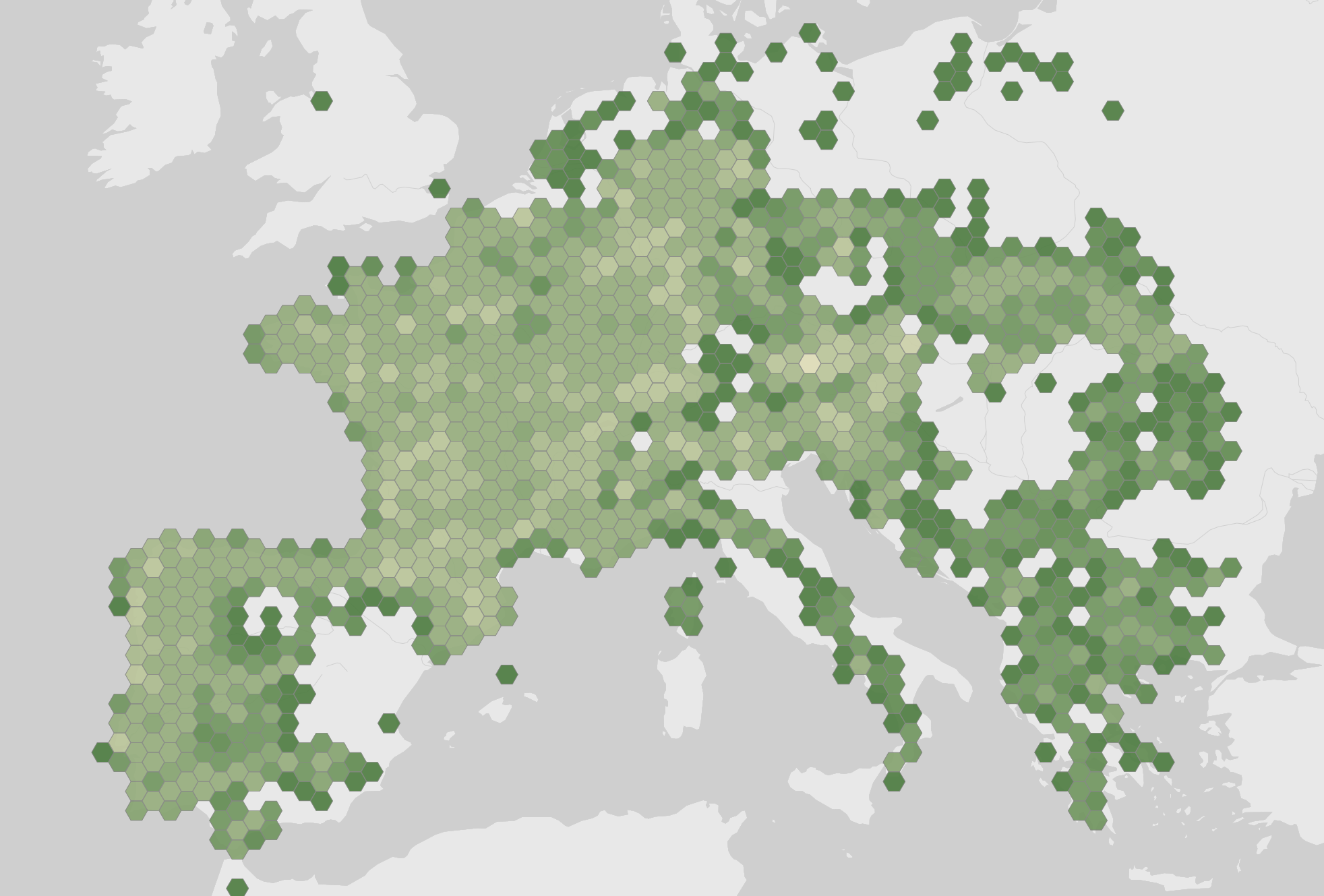
Salamandra salamandra occurs across most of southern and central Europe, typically at elevations between 250 and 1,000 meters (820–3,300 feet). In northern Germany it is occasionally found as low as 25 meters, while populations in the Balkans and Spain regularly extend to higher elevations than is typical elsewhere in the range.
The species favors shaded woodland, especially where standing water is nearby for breeding. It shows a strong preference for sites near ponds or streams, spending most of its life hidden beneath rocks, logs, or in damp crevices that keep its skin from drying out.
Citizen-science observation records show a clear seasonal pattern in sightings, with counts rising sharply through late winter and peaking in April and May, then falling through summer before a smaller secondary rise in October. This pattern most likely tracks the salamander's surface activity during mild, humid conditions rather than actual population size, since these are presence records rather than abundance counts.
Behavior and Lifestyle
The fire salamander is a shy, largely nocturnal animal, most active on mild, humid nights. It avoids the temperature extremes of its range, becoming inactive during the cold winters of its European populations and, in the warmer Middle Eastern populations, during the hot, arid summer months instead.
Individuals stay loyal to the same home range for years and return repeatedly to the same overwintering site — one study recorded a salamander using the same hibernation cave for up to 20 consecutive years. These journeys appear to rely on a genuine homing sense guided by landmarks along familiar routes; researchers are not certain whether this navigation depends more on visual or scent cues, though some evidence points to vision playing a significant role.
Fire salamanders are solitary outside of brief courtship encounters. Their main defense against predators is chemical: rows of poison glands running the length of the body, plus large parotoid glands behind the eyes, secrete neurotoxins, and the animal's bold black-and-yellow coloration acts as a warning signal. Rather than relying purely on escape, the salamander can actively spray these secretions at a threat.
Hunting and Diet
The fire salamander adjusts its hunting strategy to the available light. When some light is present, it keys in on the movement of potential prey and ignores anything that stays still. In darkness, where eyesight is of little use, it switches to relying on smell, and will strike at prey it can scent even if the animal isn't moving.
Its diet consists entirely of invertebrates, drawn from whatever species are locally abundant. Soft-bodied prey such as earthworms and slugs feature alongside harder prey like flies, beetles, millipedes, and centipedes.
Young fire salamanders appear to imprint on particular prey types during the first few weeks after metamorphosing from larva to adult, a preference that can shape their foraging choices going forward.
Reproduction and Life Cycle
Courtship takes place entirely on land. A male that encounters a receptive female blocks her path and rubs her with his chin before crawling beneath her and gripping her front legs in amplexus. He then deposits a spermatophore on the ground and maneuvers to bring the female's cloaca into contact with it so she can draw the sperm in and fertilize her eggs internally.
Salamandra salamandra is viviparous: females retain the fertilized eggs internally, where the developing embryos live off yolk reserves. Peak mating happens in summer, but the female can store sperm before fertilization occurs, stretching the gap between mating and the birth of larvae the following spring, after winter hibernation. In warmer Middle Eastern populations this calendar shifts entirely: breeding runs from October to January, and larvae are born the following November or December, timed to follow the dry summer period of inactivity rather than a cold winter.
Females deposit their larvae directly into water, and the young are usually already well developed at birth; in some populations the female instead retains her offspring even longer and gives birth to fully metamorphosed juveniles. Fire salamanders can live beyond 14 years — with a recorded lifespan of up to 24 years — giving females repeated chances to breed, since the species breeds once per year across its lifetime.
Conservation and Threats
The IUCN Red List classifies Salamandra salamandra as Least Concern overall, reflecting its broad distribution across southern and central Europe. That global rating, however, sits alongside a 2023 reassessment that reclassified the species as Vulnerable, driven by severe, well-documented population collapses in parts of its range.
The most severe threat is the introduced chytrid fungus Batrachochytrium salamandrivorans (Bsal), first identified in the Netherlands in 2013 and thought to have arrived in Europe through the captive amphibian trade from East Asia. Dutch populations were already declining before the fungus struck, having lost 57% of their range since 1950 to habitat degradation and reduced water availability, and were listed as Endangered nationally. Once Bsal was confirmed, one Dutch population crashed from 241 individuals to just four by 2011 — a 96% collapse — and the disease has since spread into Belgium, western Germany, and an isolated site in Spain affecting the subspecies S. s. hispanica. Some previously occupied sites in the Eifel Mountains now appear to have no fire salamanders left, though most affected populations persist at low numbers, and at least one site shows signs of recovery.
Beyond disease, habitat fragmentation is a significant concern because fire salamanders show strong fidelity to their home ranges and overwintering sites, making them slow to recolonize lost habitat. Like all amphibians, they are also sensitive to pollutants in water and soil. Historic collection for the pet trade and for research once added pressure to wild populations, though improved legislation has since reduced this particular threat.
Conservation status
- LC
- NT
- VU
- EN
- CR
Least Concern
Cultural Significance
Fire salamanders sit at the root of one of Europe's oldest animal myths: the belief that salamanders could endure, and even extinguish, fire. Aristotle and his successor Theophrastus described this lore as early as the 4th century BC, and folklore later cast the salamander as one of the four elemental creatures, paired with fire despite its genuinely moist, semi-aquatic skin. Most historians trace these myths specifically to Salamandra salamandra, whose habit of hibernating inside hollow, rotting logs likely explains the connection: a salamander disturbed when such a log was thrown on a fire would appear to emerge from the flames itself.
Beyond myth, the species has practical human uses: it has long been popular in the exotic pet trade and has served as an animal model in scientific research. Its skin secretions, containing toxic alkaloids, have also drawn scientific interest, though the species' cultural legacy today rests mainly on its enduring symbolic association with fire and the four elements.
Fun Facts
- Aristotle and his successor Theophrastus documented salamander fire-lore as early as the 4th century BC.
- The species' link to fire likely comes from its habit of hibernating inside hollow, rotting logs, which could appear to "birth" a salamander when thrown onto a hearth fire.
- Toxin production only begins at maturity — larvae do not produce the alkaloids samandarin and samandarone found in adult skin secretions.
- The ratio of samandarin to samandarone in an individual's skin secretions varies between animals but is not linked to sex.
- Beyond its wild role, the species has been used both as a pet-trade animal and as a model organism in scientific research.
Ecology
Diet
- Carnivore
Behavior
- Nocturnal
- Predator
- Solitary
- Hibernating
Habitat
- Forest
- Woodland
- Freshwater
Photos
SourcesGBIFiNaturalistWikidataWikipediaAnimal Diversity WebAnAge