The American alligator is the larger of the two living alligator species, the other being the Chinese alligator. This large crocodilian reptile lives in the Southeastern United States and is listed as Least Concern by the IUCN Red List.
Large males can reach , though most mature males grow to about 3.4 m. Individuals can live up to , a figure that comes mostly from animals kept in captivity.
The species is considered a keystone species in the Everglades. Its burrows and ponds shape the wetlands that many other animals depend on, which makes it a central species for understanding how southern wetlands work.
Identification and Appearance
Size is the most useful guide to an adult American alligator. Large males can reach , and most mature males grow to about 3.4 m and weigh up to 360 kg (790 lb). Mature females are normally about 2.6 m long and weigh up to 91 kg (201 lb).
The body is robust in large adults, and they look bulkier than other crocodilians of similar length. Body shape varies from long and slender to short and robust, with growth rate, diet and climate all thought to play a part. Alligators from the northern edge of the range tend to be smaller.
Males are much larger than females. The largest free-ranging female measured 3.35 m and weighed 147 kg (324 lb), while the largest males are far bigger.
Hatchlings are tiny copies of the adults, with a series of yellow bands around the body that help camouflage them.
Distribution and Habitat
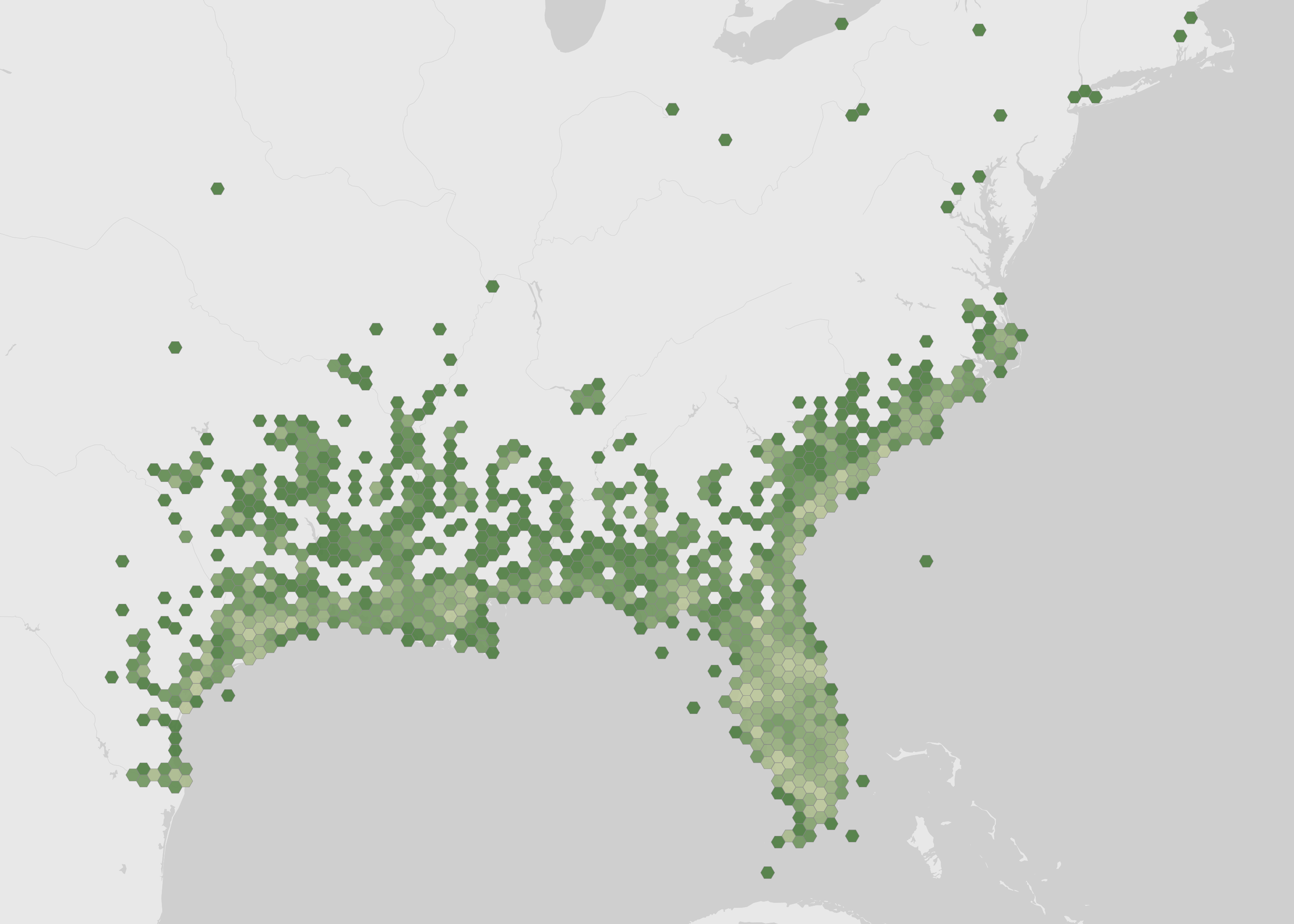
The American alligator is native to the Southeastern United States. Its range runs from the Lowcountry of South Carolina south to Everglades National Park in Florida, and west to South Texas. It occurs in North Carolina, South Carolina, Georgia, Florida, Louisiana, Alabama, Mississippi, Arkansas, Oklahoma and Texas, and it is also found in parts of northern Mexico.
Louisiana has the largest population of any U.S. state. The range is slowly expanding north, and the species has established a small population in southwestern Tennessee through inland waterways. It has been extirpated from Virginia, though occasional animals wander into the Great Dismal Swamp from North Carolina.
The species favors marshes, swamps, rivers, ponds and lagoons. It also uses canals, wetland prairies and man-made water such as fishponds, swimming pools and dammed lakes in towns and suburbs. Golf courses are often favored because they offer water and plenty of fish and birds.
The American alligator tolerates little salt, so it stays mostly in fresh water, though it sometimes wanders into brackish water. Sightings cluster in March and April.
Behavior and Lifestyle
American alligators are most active in spring, and their activity follows the seasons. In early spring they bask longer into the day, while in summer they bask earlier in the morning and later in the afternoon. In winter, basking can happen across the whole day.
As ectotherms, they warm themselves on shore in the early morning. They climb onto tree limbs to bask when no shoreline is available, but they jump back into the water quickly if disturbed.
Adults are territorial. The average home range is about 4.1 hectares for females and about 6.9 hectares for males, and males inhabit larger areas than females. Hatchlings stay together in groups for safety, while adults tend to form smaller, close-knit groups.
Alligators dig holes in the ground to shelter during extreme heat, cold, drought and tropical storms. When the water freezes, they keep their snouts above the ice and can remain in this state for several days. Alligators are strong swimmers, and on land they walk slowly on all fours with the tail dragging.
Communication
American alligators hear both in air and in water. Underwater, they respond to sounds from 100 Hz to 2,000 Hz, with peak sensitivity at 800 Hz. In air, the range runs from 100 Hz to 8,000 Hz, with peak sensitivity at 1,000 Hz.
Adults bellow to advertise their presence and to start courtship. Both sexes bellow, and males use infrasound during mating bellows. Bellows can start large choruses in the breeding season, which are often felt more than heard. Males also slap their heads on the water to signal females, and the slap can carry over long distances.
Hatchlings give high-pitched distress calls that bring adults to the scene. Juveniles also yelp to alert their mothers when they are ready to leave the nest, and adults growl, hiss or cough to threaten rivals.
Diet and Nutrition
The American alligator is a generalist carnivore whose diet changes with its size. Juveniles eat mostly small fish, insects and invertebrates, while larger alligators take bigger animals and greater volumes of food. Mature alligators also eat larger mammals, reptiles and birds.
In a Texas study, invertebrates made up 15.7 to 34.6 percent of the diet. Amphibians and reptiles made up 11.9 to 26 percent, mammals 2 to 11.4 percent, and birds and fish 0 to 11.3 percent.
Named prey includes largemouth bass, water moccasins and green tree frogs. When its main food is scarce, it may eat carrion and non-food items such as rocks and bottle caps, and the stones help grind food and bones in the stomach.
Because its limbs are relatively small for its size, the alligator spends most of its time in the water, where it takes more aquatic prey.
Nesting and Breeding
The breeding season starts in spring, when males and females both search for mates. Males bellow and follow scent trails left by the anal glands of females, and a male usually mates with one female per season, though he may mate with several in a season. Courtship often takes place in large group bellowing displays called water dances, and the displays are most intense on spring nights.
The female builds a nest of vegetation, mud, leaves and sticks in a sheltered spot in or near the water, typically 3 to 5 meters from the water's edge. She lays in one clutch, usually once a year, with an average of about 39 eggs. The eggs are about the size of a goose egg and are white. Eggs are laid at night in early June, and the decaying vegetation heats the nest.
The nest temperature decides the sex of the hatchlings. Nests kept at around 31.5 °C or below, or 34.5 °C or above, produce females, while temperatures between 32.5 and 33.5 °C produce males. Warmer levee nests produce mostly males, and cooler wet-marsh nests produce mostly females.
The female stays close to the nest during incubation, which lasts 65 to 70 days, and she guards it from raccoons and other predators. When the young begin to hatch, the mother digs them out and carries them to the water in her mouth. Hatchlings weigh about 65 g and usually stay with their mother for about a year. Males reach sexual maturity when they are about 1.83 m long, at 10 to 18 years, and females at 10 to 20 years.
Population and Ecological Role
The American alligator has a large population, and Louisiana holds the largest share of it. Parasites are common in wild populations. In a 2016 Texas study, every specimen was infected by at least 20 species, including lung pentastomids, gastric nematodes and intestinal helminths.
Alligators shape their wetlands. Their holes hold water through the dry season, and the drier banks they create give nesting space to other reptiles and birds. Alligators also feed on nutria, a South American rodent that damages coastal marshes, and large alligators eat the most nutria.
Burmese pythons have become established in Everglades National Park, and alligator populations may help keep python numbers lower. Young alligators also eat large numbers of invasive apple snails in north-central Florida.
Conservation and Threats
The American alligator is listed as Least Concern on the IUCN Red List. Hunting and habitat loss badly reduced its numbers in the 19th and 20th centuries, and the species was listed as endangered in the late 1960s, when people feared it might be lost across much of its range.
Alabama banned alligator hunting in 1938, becoming the first state to do so. Protection under federal law and state monitoring allowed numbers to grow, and the U.S. Fish and Wildlife Service removed the species from the endangered list in 1987.
Threats remain from people. Alligators are killed by vehicles, caught in nets and trout-lines, and struck by boats in shallow waterways. Trade is still controlled because the species is listed under Appendix II of CITES, which requires certificates and permits for export and import.
Cultural Significance
People hunt alligators for meat, skin and teeth. The meat is eaten, the skin is used for boots and jackets, and the teeth are made into jewelry, buttons and cane handles. Alligators are also a major draw for tourism, especially in Florida, where they support ecotourism at zoos and other attractions.
Alligator farming is a large industry in Georgia, Florida, Texas and Louisiana. These states produce about 45,000 hides a year, and about 300,000 pounds (140,000 kg) of meat are produced annually.
Since the late 1880s, alligator wrestling has drawn tourists. The Miccosukee and Seminole tribes first used the practice to obtain food, and it is still popular despite criticism from animal-rights activists.
Photos
Photographs from via iNaturalist, licensed under CC0 1.0., by Danielle via iNaturalist, licensed under CC BY 4.0., by westie44 via iNaturalist, licensed under CC BY 4.0., by Northcut via iNaturalist, licensed under CC BY 4.0., by Daughter Dad via iNaturalist, licensed under CC BY 4.0., by Britt Wren via iNaturalist, licensed under CC BY 4.0., by Daniel Nunez via iNaturalist, licensed under CC BY 4.0., by Andrew Meeds via iNaturalist, licensed under CC BY 4.0., by Karen Guin via iNaturalist, licensed under CC BY 4.0., by Matthew Inabinett via iNaturalist, licensed under CC BY 4.0., by EJ Burns via iNaturalist, licensed under CC BY 4.0., and by Kaden Slone via iNaturalist, licensed under CC BY 4.0., credited on each photo.
Ecology and classification
Classification
- Phylum
- Chordata
- Class
- Crocodylia
- Family
- Alligatoridae
- Genus
- Alligator
- Species
- Alligator mississippiensis
Sources
- GBIF Species names and classification
- iNaturalist Photos
- Wikidata Common names and conservation status
- Wikipedia Summary extract
- Animal Diversity Web Animal habitat, behavior and diet
- AnAge Longevity
- The Reptile Database Reptile distribution and common names
- ReptTraits Reptile size, lifespan, clutches or litters, habitat and habits
- GloBI What it eats, what eats it, parasites and pollinators
- Wardeh et al. 2015 (EID2)
- HWML Parasite Collection