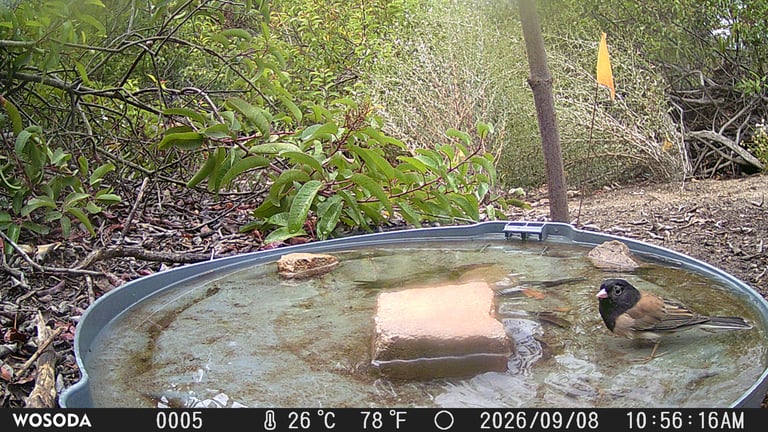
The white-crowned sparrow is a passerine bird whose range covers about of North America. It belongs to the New World sparrow family Passerellidae and is a medium-sized songbird, weighing about on average.
This species breeds in brushy areas of the taiga and tundra in the far north of the continent, as well as in the Rocky Mountains and along the Pacific coast. Southern populations in the mountains and coast are largely resident, while northern birds migrate and winter across most of North America, south to central Mexico. Its conservation status is Least Concern.
Its wide range and mix of migrating and resident populations make it a useful species for studying how a single songbird adapts to very different climates. Individuals can live up to about .
Identification and Appearance
The most useful field mark is the head pattern: adults have bold black and white stripes on the crown above a plain gray face. The upperparts are brown and streaked, and the wings are brown with bars.
The underparts are gray, and the bill is pink or yellow. The long tail adds to the bird's overall length of about 15 to 16 cm, with a wingspan of 21 to 24 cm and a weight of 25 to 28 g.
The white-throated sparrow looks similar, but it lacks the white throat patch and yellow lores of this species.
Distribution and Habitat
The white-crowned sparrow breeds in brushy habitat across northern Canada and the western United States. Breeding populations in the far north are migratory, while those in the Rocky Mountains and along the Pacific coast are largely resident.
The species is very flexible about habitat. It uses the edges of parking lots, meadows in the Rocky Mountains and boreal forests. It needs tall coniferous trees at the edge of its territory, grass and bare ground for foraging, and dense cover to hide a nest or roosting area. It has bred at elevations as low as 800 meters and as high as within the Rocky Mountains.
In spring and fall, it travels in groups that often include other sparrow species. Presence in the region peaks around May and October.
It is a very rare vagrant to western Europe. Sightings include England, Scotland, Ireland and Norway. In 2008, one was seen at Cley next the Sea in Norfolk, England, and a window at St Margaret's Church there shows the bird to commemorate the event.

Behavior and Lifestyle
The white-crowned sparrow is fairly solitary outside the breeding season, although migrating birds travel in small groups of about eight. In winter, migrants stay in a steady group with which they forage and roost.
Males are highly territorial. Most return each year to the same non-overlapping territories they held the year before. When an intruder or predator appears, the male puffs up his chest, raises his crown feathers and sings loudly. Fights are common when a male first settles a territory, and the territories a male holds help set a clear hierarchy within the species.
It forages by hopping around on bare ground and in low vegetation, and it sometimes makes short flights to catch flying insects. At night it enters a state of shallow hypothermia. Its cover-seeking habits keep it low and close to shrubs, where predators such as Belding's ground squirrel and the western terrestrial garter snake may be present.
The species is known for unihemispheric slow-wave sleep, which lets it stay partly awake for up to two weeks during migration. Researchers have studied this effect for possible alertness applications in shift work and truck driving.
Communication
Males use visible displays in territorial encounters. When threatened or challenged, a male raises his crown feathers and puffs out his chest, and this display works alongside a loud song.
Songs are an important acoustic signal. Studies by ornithologist Elizabeth Derryberry and colleagues have shown that white-crowned sparrow songs are affected by human activity and noise.
The species' perception channels include visual, tactile, acoustic and chemical cues. Its courtship and nest-defense displays depend mainly on sight and sound.
Diet and Nutrition
About ninety-two percent of the white-crowned sparrow's food is plant matter. Its small, tough bill is well suited to seeds, buds, grass and fruit. In spring, it shifts toward eating more insects alongside seeds.
It feeds mainly on the ground. Dense shrubs provide the cover it needs from predators, and feeding activity drops when that cover is lacking.
The species does not store food and lacks a functional crop. Its heaviest feeding happens early in the morning and again late at night.
Nesting and Breeding
Males usually reach the breeding grounds first. Once the females arrive, pairs typically begin building nests about one to three weeks later. The nest is a cup built low in a bush or on the ground under shrubs.
Courtship is led by the female, who bows with her head arched and parts her tail feathers to expose her cloaca. The male responds by raising his crown feathers, lowering his spread tail and standing on her back for about three seconds. To avoid revealing the nest to predators, the birds fly toward it but land a few meters short and walk the rest of the way.
Most pairs raise only one brood. The clutch is about four eggs, which are brown-marked gray or greenish-blue. The female incubates them for about 12 days and develops a brood patch during nest building to keep the eggs warm. She also leaves the nest during the day to forage.
After hatching, the male brings food and gradually takes on more of the feeding, although his share starts to decline around day five. The young are born naked except for a few down feathers, and most fledge by about day 10. They reach adult weight by about day 30 to 35.
Brown-headed cowbirds sometimes lay their eggs in white-crowned sparrow nests. Each cowbird usually lays about one egg per nest, and the cowbird young tend to survive as well as the sparrow's own young.
Population and Ecological Role
The white-crowned sparrow's breeding and wintering populations are widespread across North America, and the species has a large, flexible range. Its population size and trend are not summarized here.
Its most established parasites include feather lice from the order Psocodea and blood parasites of the genus Leucocytozoon, including Leucocytozoon majoris. Feather lice such as Brueelia vulgata are also common on the species, and it hosts a range of other arthropods and parasites in smaller numbers.
Conservation and Threats
The IUCN Red List rates the white-crowned sparrow as Least Concern. It is protected under the US Migratory Bird Treaty Act, but it has no special status under the US Federal List or CITES.
So far, the species has not required any management. Logging, which disturbs many bird species, has created new bare ground and grassland that the sparrow uses for foraging. Cattle grazing is the one practice shown to deter it from its habitat.
The species has adapted well to human-altered landscapes, including the edges of parking lots and cleared forest. Its wide range and broad habitat tolerance help keep its status secure.
Photos
Photographs from via iNaturalist, licensed under CC0 1.0., by Julio Cesar Ruiz García via iNaturalist, licensed under CC BY 4.0., by Michele Jones via iNaturalist, licensed under CC BY 4.0., by Cricket Raspet via iNaturalist, licensed under CC BY 4.0., by coniferfan07 via iNaturalist, licensed under CC BY 4.0., and by Jonathan Eisen via iNaturalist, licensed under CC BY 4.0., credited on each photo.
Ecology and classification
Classification
- Phylum
- Chordata
- Class
- Aves
- Order
- Passeriformes
- Family
- Passerellidae
- Genus
- Zonotrichia
- Species
- Zonotrichia leucophrys
Sources
- GBIF Species names and classification
- iNaturalist Photos
- Wikidata Common names and conservation status
- Wikipedia Summary extract
- Encyclopedia of Life Habitat, diet and behavior traits
- Animal Diversity Web Animal habitat, behavior and diet
- AnAge Longevity
- AVONET Bird mass, habitat, migration, diet and range size
- GloBI What it eats, what eats it, parasites and pollinators
- Wardeh et al. 2015 (EID2)
- HWML Parasite Collection