Colorado chose the lark bunting as its state bird in 1931, honoring a songbird of the open plains. The lark bunting is a medium-sized American bunting that lives across central and western North America. It belongs to the family Passerellidae, and the IUCN lists it as Least Concern.
This bird is worth reading about because it combines a striking look with an unusual social life. Breeding males stand out sharply against the prairie, and females choose mates in ways that change from year to year. Adults weigh about .
Identification and Appearance
Breeding males are almost entirely black, with a large white patch on the upper wing that makes them easy to pick out across the prairie. Their short, thick bill is bluish.
Adults are small songbirds, measuring 5.5–7.1 in (140–180 mm) long, with a wingspan of 9.8–11.0 in (250–280 mm). They weigh about . The tail is relatively short, and its feathers have white tips.
Females and nonbreeding males look alike. Both are grayish brown with white stripes, so the black breeding plumage is the clear way to tell males apart at that time of year.
Distribution and Habitat
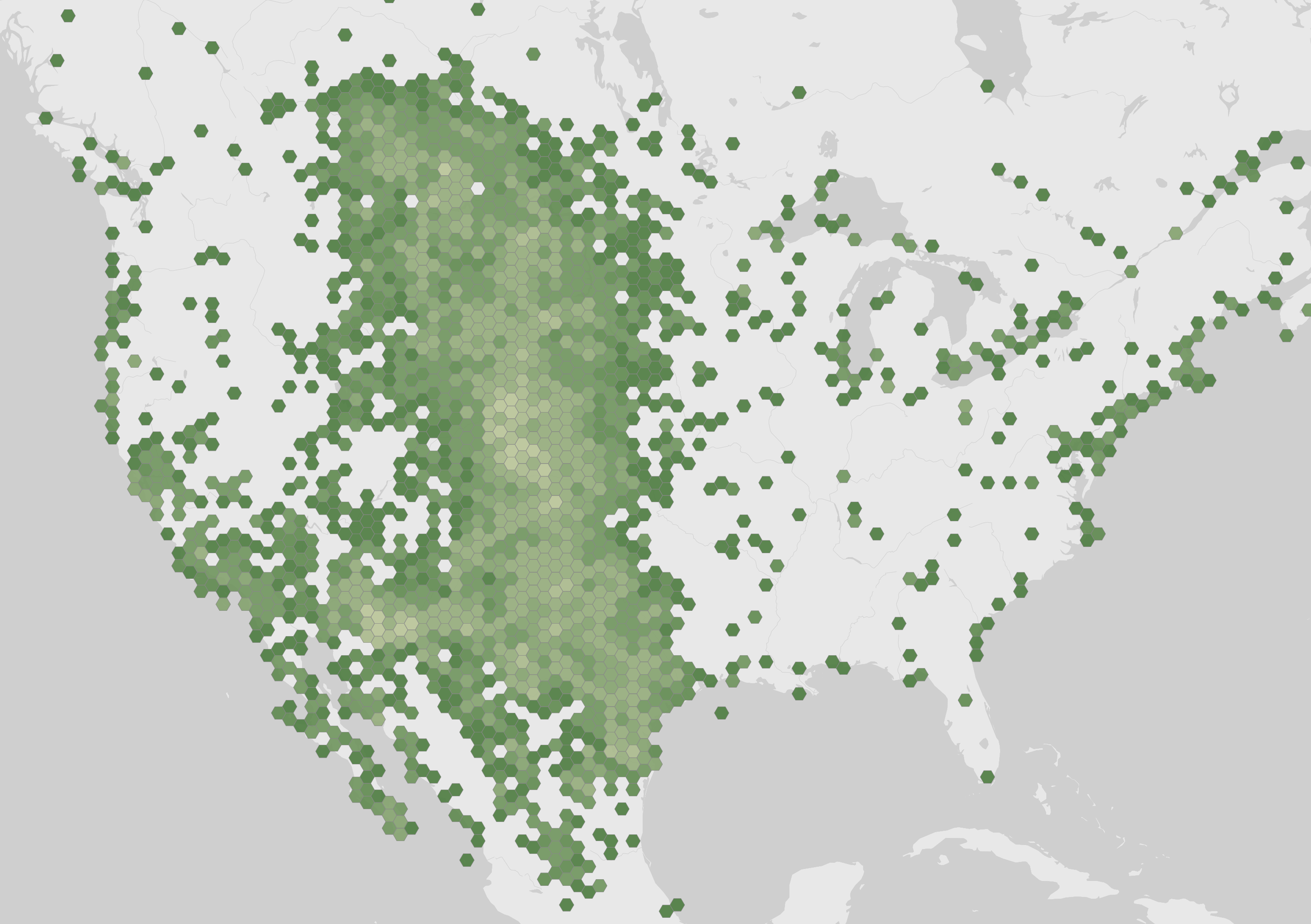
Lark buntings are the most common passerine of North American grasslands. They breed on prairie in central Canada and the midwestern United States.
In the fall, they migrate in flocks to winter in southern Texas, Arizona and the high plateau of northern Mexico. Their range covers open country, and they favor habitats that are open rather than wooded.
Seasonal presence is most pronounced in May, when the birds are on their breeding grounds.
Diet and Nutrition
Lark buntings forage mainly on the ground. They eat mostly insects in summer and switch to seeds in winter, which makes them omnivores.
When chasing insects, they sometimes make short flights to catch them in the air.
Outside the nesting season, they often feed in flocks, which lets them search open ground together.
Nesting and Breeding
Males establish territories by flying up over them and singing while they descend. Their song mixes whistles and trills, and their call is a soft hoo.
The nest is an open cup on the ground in a grassy area. Birds typically nest in dispersed colonies. Males are weakly territorial before mating, and territory features are linked to where females settle. Shade is an important resource for female reproductive success.
Lark buntings are socially monogamous, but extra-pair mating is common. Males and females compete aggressively for mates. The breeding sex ratio is male-biased, so many males cannot find a social mate.
Female mate choice shifts from year to year. In different years, females favor males with blacker plumage, larger wing patches or larger bills. Birds can live up to about .
Conservation and Threats
The IUCN classifies the lark bunting as Least Concern, which means it is widespread and not considered at risk of extinction.
Its population has decreased as natural prairie habitat has been lost. Converting prairie to other land is the main threat the context identifies.
Photos
Photographs from via iNaturalist, licensed under CC0 1.0., by Joshua Ebright via iNaturalist, licensed under CC BY 4.0., by Tom Kennedy via iNaturalist, licensed under CC BY 4.0., by Rajan Rao via iNaturalist, licensed under CC BY 4.0., by Sam Kieschnick via iNaturalist, licensed under CC BY 4.0., by Jo Roberts via iNaturalist, licensed under CC BY 4.0., and by CK2AZ via iNaturalist, licensed under CC BY 4.0., credited on each photo.
Ecology and classification
Classification
- Phylum
- Chordata
- Class
- Aves
- Order
- Passeriformes
- Family
- Passerellidae
- Genus
- Calamospiza
- Species
- Calamospiza melanocorys
Sources
- GBIF Species names and classification
- iNaturalist Photos
- Wikidata Common names and conservation status
- Wikipedia Summary extract
- AnAge Longevity
- AVONET Bird mass, habitat, migration, diet and range size
- GloBI What it eats, what eats it, parasites and pollinators
- HWML Parasite Collection