Eating Ampulloclitocybe clavipes alongside alcohol can trigger a disulfiram-like reaction, a strange quirk for a mushroom otherwise considered potentially edible. Known as the club-foot or club-footed clitocybe, it is a gilled fungus native to Europe and North America, identified by its grey-brown cap, yellowish decurrent gills, and a distinctly bulbous stalk.
It grows in both deciduous and conifer woodlands, and no conservation concern has been documented for it. What makes this mushroom worth knowing is less its appearance than its behavior at the table: it resembles poisonous species closely enough, and reacts badly enough with alcohol, that caution outweighs curiosity.
Fruiting Body and Identification
The most useful identifying feature is the stem's markedly bulbous base, which gives the species both its scientific epithet clavipes ("club-shaped foot") and its common name. The stem stands 3 to 7 centimeters tall and 1 to 1.5 centimeters wide, covered in silky fibers and colored the same grey-brown as the cap.
The cap spans 4 to 8 centimeters across, starting convex with a small central boss before flattening and eventually developing a depression. Its surface is smooth but often fibrillose, usually moist, grey-brown in tone and sometimes tinged with olive, with a paler margin. Beneath the cap, the gills are strongly decurrent and cream-yellow, a sharp contrast against the duller cap and stem. Smaller gills appear between the regular ones, occasionally forking near the stem, and their edges are straight in young specimens but can turn wavy with age.
The flesh is thick and white, tinged slightly yellow at the stem base. It has a firm, tough texture at the stem surface but turns spongy and soft toward the center, and it is watery throughout. The smell is distinctive and variably described as sweet, resembling bitter almond, orange blossom, cinnamon, or even grape bubble gum. Spores are round to oval, measuring 4.5 to 5 by 3.5 to 4 microns, and produce a white spore print.
In the western United States, A. clavipes can be confused with A. avellaneialba, a larger species with a darker cap and white rather than yellow gills. It also resembles the clouded agaric, Clitocybe nebularis, but can be told apart by its bulbous stem, more deeply decurrent gills, and generally darker overall coloring.
Distribution and Habitat
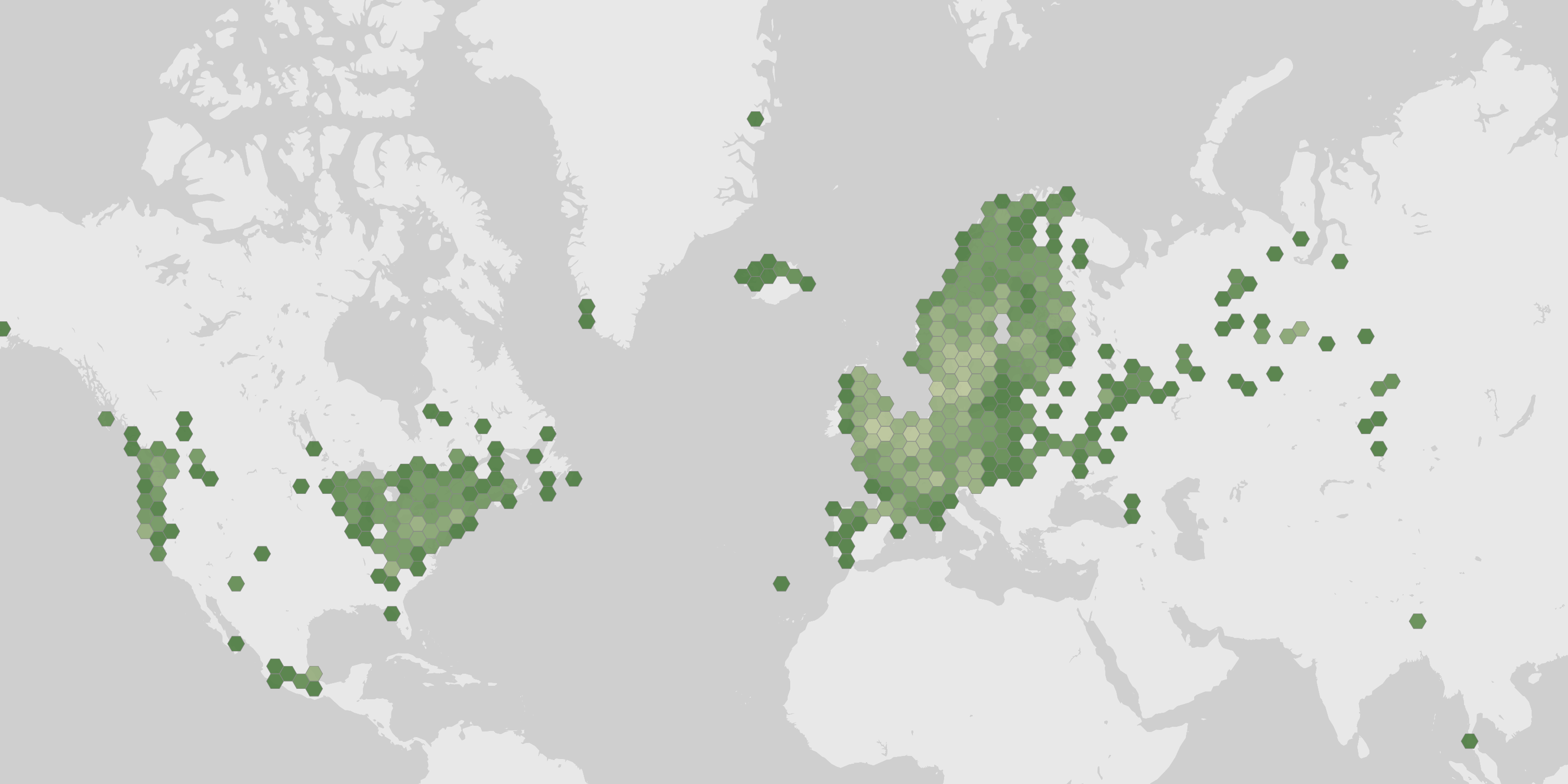
Ampulloclitocybe clavipes is widespread and abundant across Northern Europe and the British Isles, where it appears to be growing more common. In North America it is frequently found under pine plantations in the east, though it occurs less often in the Pacific Northwest.
The species favors both conifer and deciduous forests, showing a particular association with beech woodland. In northern Europe, fruiting bodies emerge from August through November.
Observation records collected through GBIF, which reflect presence rather than abundance or full range, show a sharp rise in reports from July onward, peaking in September at over 7,600 recorded sightings before tapering off by November. This pattern lines up closely with the documented fruiting season and suggests late summer through autumn as the period when the mushroom is most reliably encountered, though the counts say nothing about how many individuals are actually present in any location.
Fun Facts
- The genus name Ampulloclitocybe combines ampula-, referring to a flask-shaped cavity resembling ancient Roman ampulla vessels, with -clitocybe, meaning "with a sloping head."
- Its flask-shaped stem base and funnel-shaped mature cap, sloping downward from the margin, directly inspired that genus name.
- The specific epithet clavipes comes from Latin for "with a club-shaped foot," and the common name Club Foot is simply a literal translation of it.
- Among clitocyboid mushrooms, this species stands out for its grayish-brown cap, white spore print, frequently bulbous stem, and its usual preference for growing among conifers.
- The mushroom has been recorded as a possible occasional food source for adult pleasing fungus beetles, Tritoma humeralis.
Ecology
Habitat
- Forest
- Woodland