Few grassland mushrooms announce themselves as boldly as Hygrocybe coccinea. Its fiery, slick cap has earned it a string of vivid common names: the scarlet hood, the scarlet waxcap, and the somewhat theatrical "righteous red waxy cap."
It belongs to the genus Hygrocybe, in the family Hygrophoraceae, within the class Agaricomycetes of the kingdom Fungi. Beyond its striking looks, the species offers a good entry point into the waxcap group, fungi known for their glistening, waxy-textured gills and their preference for undisturbed ground.
Fruiting Body and Identification
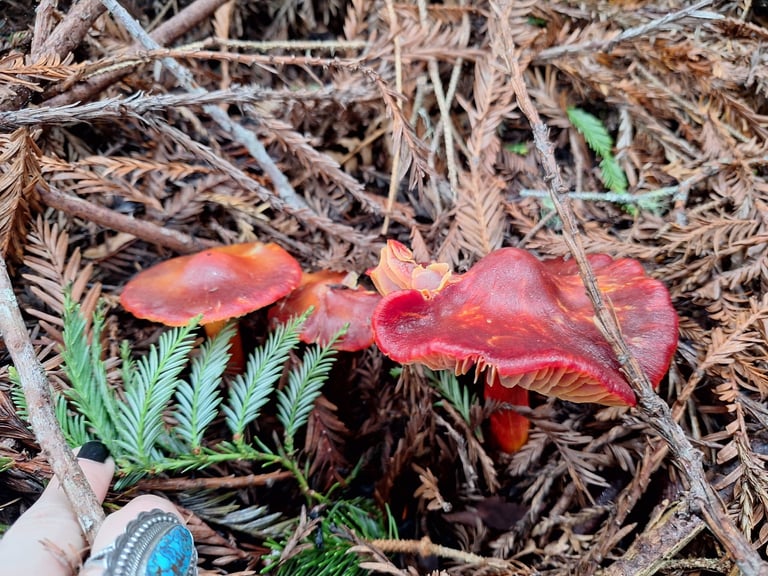
The most dependable identifying feature of Hygrocybe coccinea is its scarlet, slimy cap, which starts out bell-shaped and flattens as the mushroom matures. The cap spans only 2 to 5 centimeters across, keeping the whole mushroom compact and easy to overlook in dense grass despite its color.
Beneath the cap, the adnate gills are thick, widely spaced, and shift from yellow to red. The stipe is ringless, standing 2 to 5 centimeters tall and just 0.3 to 1 centimeter wide, colored red above a yellowish base that offers a useful two-tone clue when examining a specimen closely.
The flesh inside is yellowish-red, with a smell and taste both described as faint, giving little to go on beyond appearance. Spores are oval, measuring 7 to 9.5 by 4 to 5 micrometers, and produce a white spore print when released.
Hygrocybe coccinea is fairly similar to other red waxcaps in its genus, including H. marchii and H. punicea, which share the same slimy, scarlet look and can require close comparison of gill attachment, stipe base color, and spore measurements to separate reliably.
Distribution and Habitat
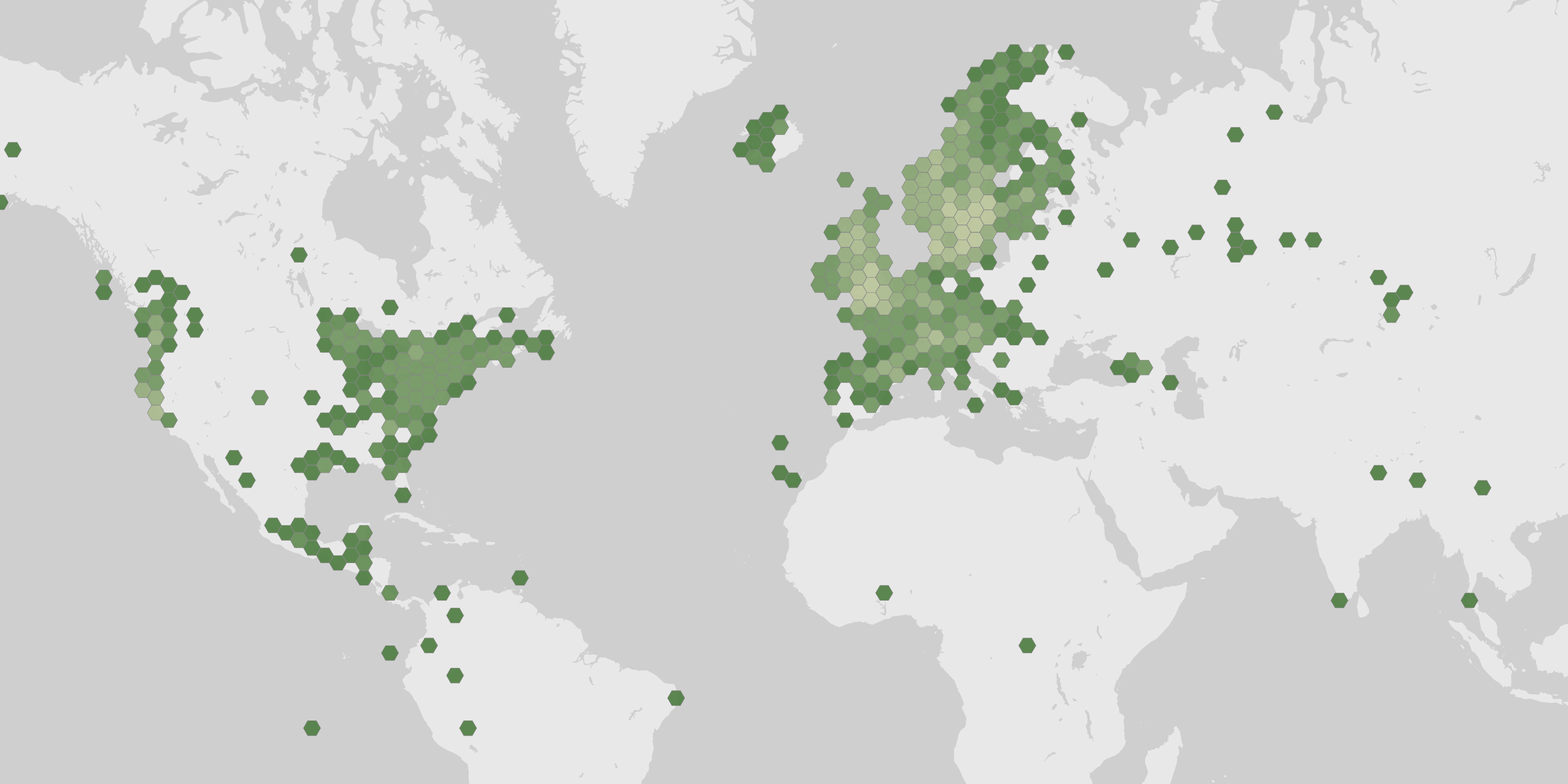
Hygrocybe coccinea is widespread in unimproved grasslands across Europe, fruiting mainly from August through October. In Britain, as with other Hygrocybe species, its best season falls in the frost-free months of late autumn, when unimproved, undisturbed pastures give it the conditions it favors.
Monthly observation records show a sharp seasonal pattern, with counts climbing from a few hundred in the summer months to a peak in October and staying high through September and November before dropping off sharply by December. This pattern points to a strong autumn fruiting season, though these figures are presence observations rather than a measure of abundance or population size.
Outside Europe, the species has a broader footprint. In western North America it turns up under redwoods or in mixed woodland, but during winter rather than autumn. It has also been recorded growing under Rhododendron and oak (Quercus) in Sagarmatha National Park in Nepal, and it occurs more widely across India, China, and Japan.
Records once attributed to H. coccinea in Australia have since been reclassified as H. miniata or H. kandora, a reminder that red waxcaps across different continents are not always the same species they first appear to be.
Uses and Cultural History
Hygrocybe coccinea itself is not documented as having a history of use in indigenous medicine or traditional cuisine. Waxcaps of this kind tend to be valued more for their appearance in the field than for any practical application.
Within the same genus, the related species H. conica has picked up folkloric significance of its own, driven largely by its dramatic look and the evocative common name "Witch's Hat." That kind of cultural attention, tied to color and shape rather than culinary or medicinal use, is typical of how people have engaged with small, brightly colored waxcaps more broadly.
Fun Facts
- The species was first described in 1774 by German mycologist Jacob Christian Schäffer, who placed it in the genus Agaricus as Agaricus coccineus.
- Elias Magnus Fries moved it to Hygrophorus in 1838, before Paul Kummer finally placed it in its current genus, Hygrocybe, in 1871.
- The specific epithet coccinea comes from the Latin word for "scarlet," a fitting label for a mushroom defined by its intense red color.
Ecology
Habitat
- Forest
- Woodland
- Grassland