The crimson waxcap, Hygrocybe punicea, is one of the relatively few fungi to carry a global conservation assessment: the IUCN Red List lists it as Vulnerable, a reflection of how scarce its grassland habitat has become.
It is an agaric in the family Hygrophoraceae, part of the waxcap group known for its greasy, brightly colored caps and waxy gills. The species grows across Europe, where it favors old, agriculturally unimproved pastures and lawns with short turf, though it is generally rare wherever it occurs.
What makes the crimson waxcap worth seeking out is as much about the landscape it signals as the mushroom itself: its presence marks grassland that has escaped decades of fertilizer and plowing, a rare and shrinking kind of ground.
Fruiting Body and Identification
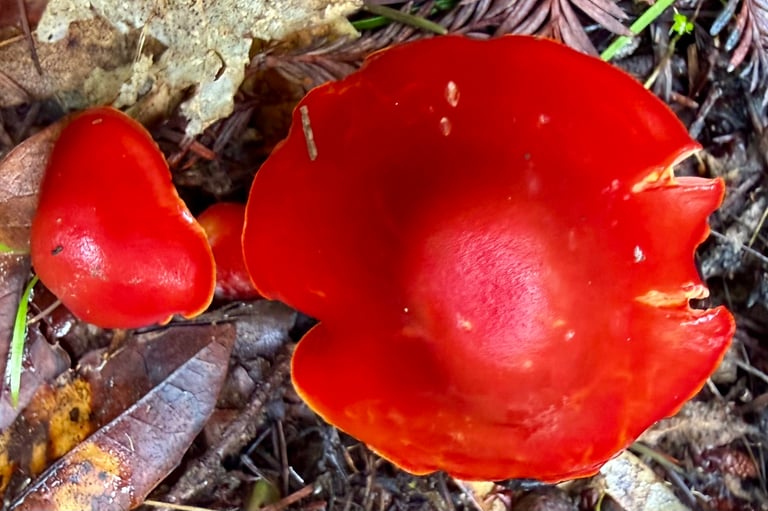
The most reliable field mark is the combination of a smooth, greasy to viscid cap in dark red to crimson tones with a fibrillose, streaky stem, a pairing not shared by its closest lookalikes. Basidiocarps reach up to 15 centimeters tall, with the cap starting convex to broadly umbonate before flattening out, sometimes spanning up to 15 centimeters across. As the cap dries it fades unevenly, turning pale yellow to buff in patches while retaining crimson elsewhere.
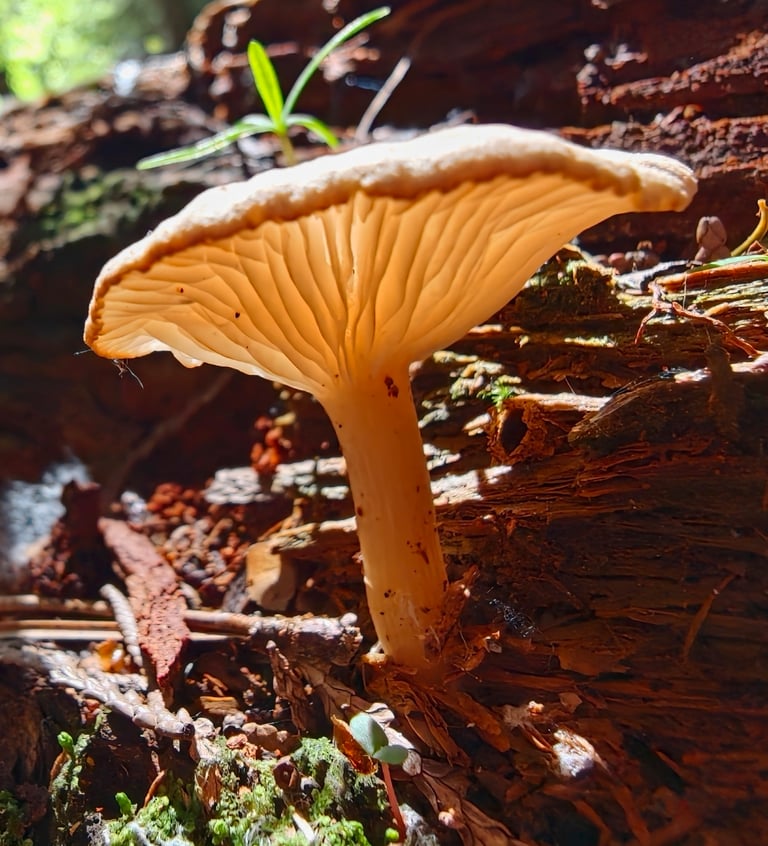
The gills are waxy in texture, dark red to buff with purple tints, and carry a paler yellowish edge. The stipe is smooth but distinctly fibrillose and streaky, colored yellow to orange-red and whitening toward the base; it lacks a ring entirely. The spore print is white, and under a microscope the spores are smooth, inamyloid, and ellipsoid, measuring roughly 8.5 to 10 by 4.5 to 5.5 micrometers.
Distribution and Habitat
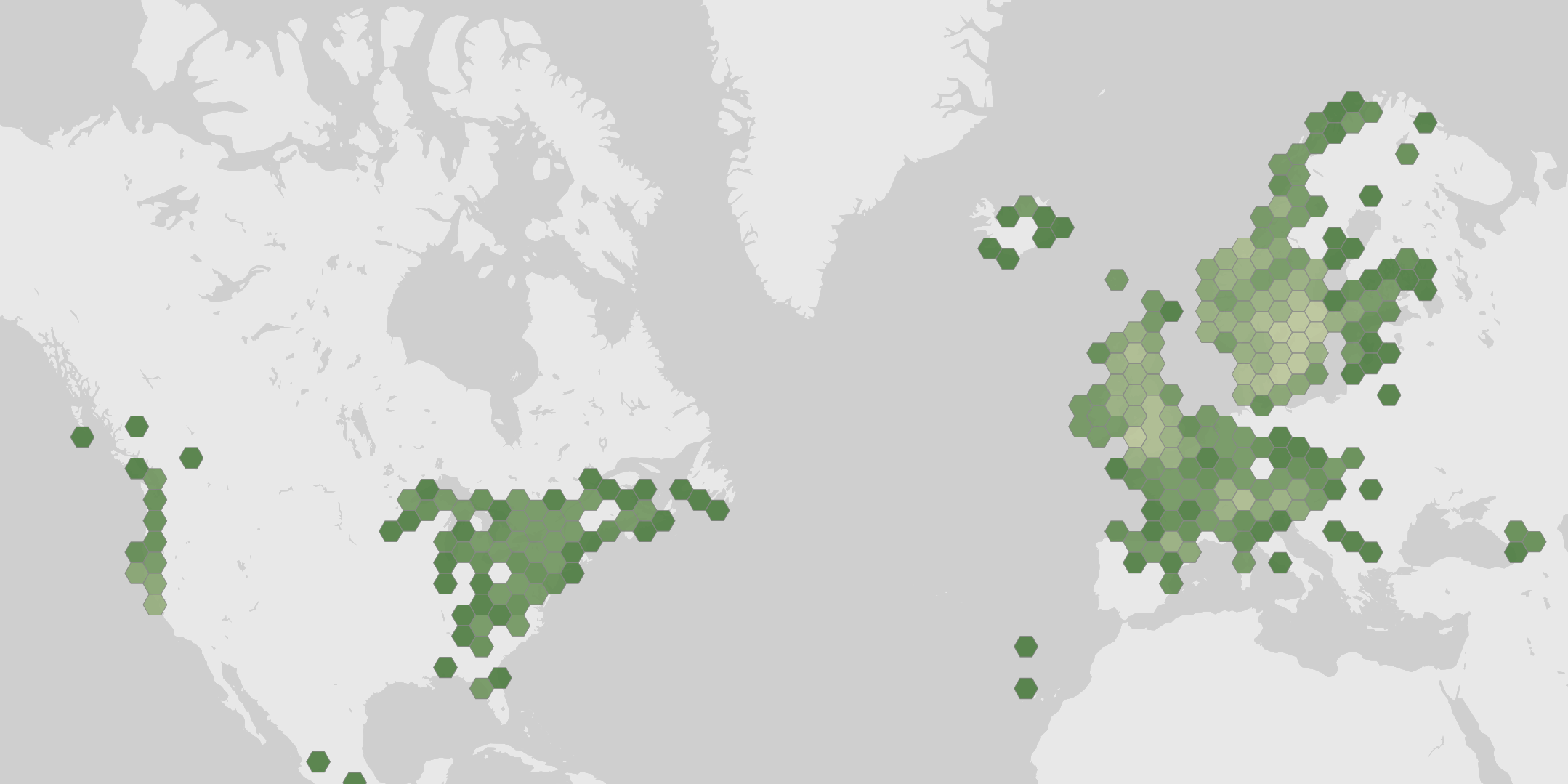
Hygrocybe punicea is widespread across Europe but generally rare, following the same pattern as most European waxcaps: it turns up in old, agriculturally unimproved grassland with a short sward, including traditional pastures and unfertilized lawns. Its dependence on this specific, undisturbed habitat type explains much of its scarcity.
Records also exist from East Asia, North America, where it is known as the scarlet waxy cap and reported from woodland rather than grassland, and Australia. These occurrences need further study to confirm whether they represent the same species or a related lookalike, since the ecology described for North American material differs from the grassland habit typical of Europe.
Observation data, which reflect presence records rather than true abundance or a complete range, show a sharp seasonal pattern: sightings are minimal from December through July, then climb steeply from August onward, peaking in October before tapering by December. This pattern is consistent with an autumn-fruiting grassland fungus, though it should be read as a record of when the species was observed and reported, not as a measure of its population.
Ecology and Relationships
Hygrocybe punicea belongs to the waxcap grassland community, a group of fungi tightly bound to old, unimproved pastures and short-sward lawns rather than to any single host tree or plant. Its close association with this specific habitat type, rather than with woodland trees, sets it apart from many other well-known agarics.
The traditional assumption that waxcaps are either mycorrhizal partners of plants or straightforward decomposers of dead matter has been called into question. Recent research points instead toward a possible association with mosses, though the exact nature of this relationship in H. punicea remains an open question rather than settled fact.
Because the species depends on the specific conditions of long-undisturbed grassland, its presence functions as an indicator of ecological continuity: where it fruits, the ground beneath has likely avoided fertilizer, reseeding, and plowing for a long time.
Uses and Cultural History
Hygrocybe punicea has sometimes been claimed as an edible mushroom, but this claim carries a real hazard: the species accumulates cadmium, a toxic heavy metal, and consuming it can cause poisoning as a result. No other documented food, material, or medicinal use is recorded for this species.
Beyond the risk tied to eating it, there is no noted history of cultural, craft, or trade use for the crimson waxcap.
Conservation and Threats
Hygrocybe punicea is assessed as Vulnerable on the IUCN Red List, a status reserved for species facing a high risk of extinction in the wild. The classification reflects the condition of its habitat rather than direct persecution or harvesting pressure.
The primary threat is the ongoing loss of waxcap grasslands, old and agriculturally unimproved pastures that have become increasingly rare as farming practices have shifted toward intensification, fertilizer use, and reseeding. Because the species depends on this narrow habitat type, the decline of unimproved grassland translates directly into a decline in suitable ground for it to fruit.
The species' precarious status is echoed at the national level: it appears on official or provisional red lists of threatened fungi in Bulgaria, Croatia, the Czech Republic, Denmark, Estonia, Germany, and Sweden, underlining that its decline is a pattern repeated across much of its European range rather than a localized problem.
Conservation status
- LC
- NT
- VU
- EN
- CR
Vulnerable
Fun Facts
- The crimson waxcap has also been classified historically as Agaricus puniceus and Godfrinia punicea, reflecting shifts in fungal taxonomy over time.
- Despite long assumptions about how waxcaps feed, recent research suggests H. punicea may not be mycorrhizal or saprotrophic at all, but instead loosely tied to mosses.
- A single fruiting body can reach 15 centimeters in height and 15 centimeters across the cap, making it one of the larger waxcaps.
- The mushroom accumulates cadmium, a toxic metal, which makes claims of its edibility risky despite occasional reports of it being eaten.
- It is listed as Vulnerable on the global IUCN Red List, an unusual distinction for a mushroom, and appears on national red lists in at least seven European countries.
- Observation records peak sharply in autumn, especially October, matching the species' typical fruiting season in unimproved grassland.
- It can be confused with two other red waxcaps, Hygrocybe coccinea and Hygrocybe splendidissima, which differ in size, stem texture, or smell.
Ecology
Habitat
- Woodland
- Grassland