Apis mellifera pollinates crops worth an estimated $200 billion a year worldwide, making it arguably the single most economically valuable insect on the planet.
The western honey bee is a eusocial insect in the family Apidae, order Hymenoptera, and is the most common of the 7 to 12 recognized honey bee species found worldwide. It is believed to have originated in Africa or Asia, spreading naturally across Africa, the Middle East, and Europe before humans carried it to every inhabited continent. Its IUCN Red List status is currently listed as Data Deficient.
What makes the species worth a closer look is not just its honey. Its colonies run on a caste system of tens of thousands of workers built around a single queen, its foragers use a symbolic 'waggle dance' to report the location of food, and its wax combs and thermoregulated hives represent some of the most complex social engineering found in any insect.
Identification and Appearance
The clearest clue to this species' identity is built into its scientific name: Apis mellifera, Latin for 'honey-bearing bee', a direct reference to the honey it produces and stores inside its hive.
Apis mellifera is one of only 7 to 12 recognized honey bee species in the world, and it is by far the most common and widely known of them. Beyond this taxonomic distinction, what sets it apart from other bees is mostly a matter of its social structure and behavior rather than a single fixed size or color pattern, both of which vary across its many geographic subspecies.
Distribution and Habitat
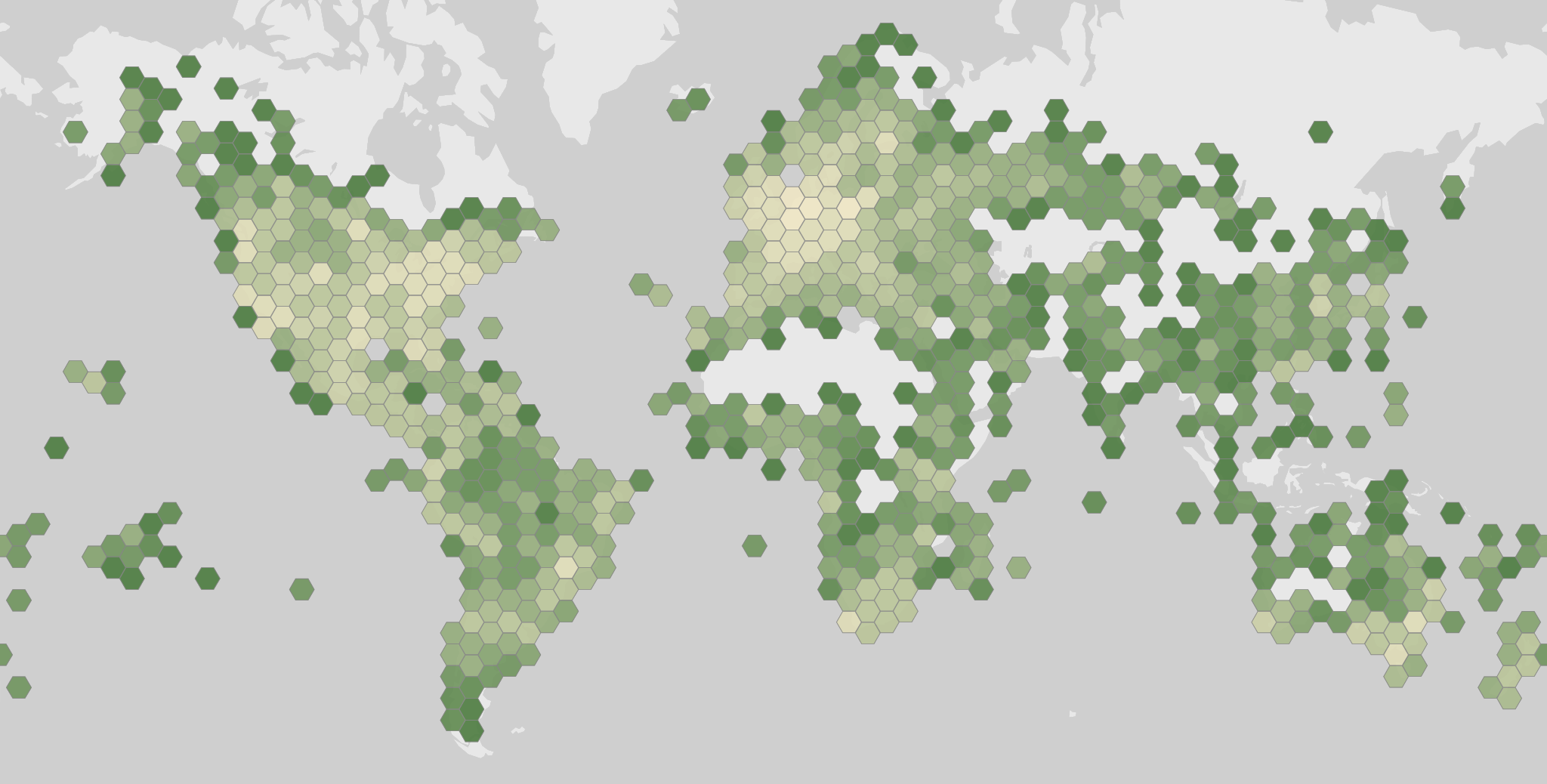
Apis mellifera occurs on every continent except Antarctica, but only part of that range is natural. The species is believed to have originated in Africa or Asia, spreading on its own through Africa, the Middle East, and Europe long before humans intervened. Its enormous additional range is a product of human activity: European subspecies were introduced to North America in the early 1600s and later carried to South America, Australia, New Zealand, and eastern Asia.
The species nests wherever it can find a sheltered cavity close to abundant flowering plants — hollow trees in woodland, for instance, were its original nest site before beekeeping began roughly 5,000 years ago in Egypt. Managed or feral, colonies favor meadows, open wooded areas, gardens, and agricultural land, and they can persist in grassland, desert, or wetland habitats as long as water, forage, and a nesting cavity are all present. Wild nests still occasionally form in dead trees when a domesticated colony escapes and establishes itself independently.
Monthly observation counts show a clear seasonal pattern, rising from roughly 65,000 sightings in January to a peak of over 176,000 in July before falling back to around 31,000 in November. This likely reflects seasonal activity and observer effort during the warmer foraging months rather than a true measure of colony abundance.
Behavior and Lifestyle
Apis mellifera colonies run on a strict division of labor that shifts with a worker's age, a pattern known as age polyethism. Newly emerged workers begin by cleaning cells; within days they move on to hive maintenance, removing debris, fanning to regulate air and temperature, and feeding the queen and larvae with secretions from glands in their heads. In their second week their wax glands activate and they help build and repair the comb, and between roughly 12 and 25 days old they take a turn guarding the hive entrance, driving off intruders. Only after about three weeks, once their food and wax glands atrophy, do workers switch to foraging, a role they keep for the rest of their lives.
Flight demands a body temperature of about 35°C (95°F), a temperature the colony also maintains inside the nest to raise brood and produce wax. In winter, workers and the queen form a tight cluster and vibrate their flight muscles to generate heat, keeping the cluster's core at 20–22°C (68–72°F) even as the periphery cools with the outside air. Foragers can operate across a 30°C range of air temperatures thanks to shivering before flight, passive heat regulation tied to their workload, and evaporative cooling — regurgitating a warm droplet of honey-crop fluid that can drop head temperature by 10°C. Below about 7–10°C bees become immobile, while above 38°C their activity slows, though they can tolerate brief spells up to 50°C.
Healthy colonies reproduce and relocate through two related behaviors. Swarming happens when a new queen is raised to replace the old one: the departing queen leaves with a portion of the workforce, forming a temporary cluster on a nearby branch while scouts search for a new nest site. Absconding, in which the whole colony abandons a nest that has become unsuitable, is more common in tropical honey bees responding to seasonal drought, and beekeepers actively try to prevent it in managed hives. Some colonies also show hygienic behavior, detecting the odor of diseased brood, uncapping the cell, and removing the affected larva before disease such as Varroa mites, chalkbrood, or American foulbrood can spread.
Communication
Apis mellifera relies mainly on chemical signals. Each hive carries a distinct chemical signature that lets its members recognize nestmates and detect intruders from other colonies, and workers constantly exchange pheromones while feeding and grooming each other, the queen, and the brood, passing on information about the queen's health and the state of the colony. A stinging bee releases an alarm pheromone that agitates nearby workers and helps them locate a threat, while a successful forager passes on the scent of a flower patch to recruit nestmates to the same source.
Vision matters mainly outside the dark hive. Honey bee eyes detect ultraviolet wavelengths invisible to humans, letting them locate the sun on overcast days and read ultraviolet markings on flowers that are otherwise hidden. A separate portion of the eye is sensitive to polarized light and is used for navigation.
The best-known channel is the 'dance' used by returning foragers to share the location of food. A round dance signals food within roughly 50 to 300 meters of the hive without indicating direction, while the more elaborate waggle dance encodes both distance and direction using the position of the sun and the memory of the flight itself — a form of symbolic communication rare among invertebrates that earned Karl von Frisch the 1973 Nobel Prize in Physiology or Medicine. Workers and queens also sense these signals through vibration, and a separate 'shaking signal', delivered by one bee vibrating against another, is used mostly by experienced foragers to rouse inactive nestmates into action or, later in the day, to dampen it.
Diet and Feeding Habits
Apis mellifera feeds on the nectar and pollen of blooming flowers, sucking up nectar with its tongue and storing it in an internal crop while grooming pollen onto the pollen baskets on its hind legs. Because foraging moves flower by flower across a patch, the species acts as a major pollinator of the plants it visits, transferring pollen between blossoms as it works.
Back at the hive, returning foragers pass their nectar load to younger workers, who add enzymes and store it in open cells to evaporate down into honey, and also process the collected pollen into stores. Young workers convert pollen and nectar into 'royal jelly' and 'worker jelly', glandular secretions fed to larvae; the amount and type a larva receives determines whether it develops into a queen or a worker.
Foraging is confined to daylight and is sensitive to weather: bees avoid heavy rain, strong wind, and temperatures below 10°C, and even light rain halts pollen collection because moisture interferes with gathering it, though nectar collection continues. Warm, calm, cloudy conditions can still produce strong pollen hauls.
Beyond flowers, the species collects honeydew, the sugary fluid excreted by sap-feeding insects such as aphids, and workers will opportunistically rob nectar and honey from weakened or poorly defended hives, especially when flowers are scarce.
Reproduction and Life Cycle
Mating takes place away from the hive, at 'drone assembly areas' where males gather during mild spring and summer weather. A virgin queen flies into the assembly, releasing pheromones that draw a pursuing swarm of drones — sometimes forming a trailing 'comet' of males — and mates with up to 10 of them in a single flight, over no more than a couple of days after emerging. Each male dies within hours or days of mating, and the queen never mates again after this brief window.
A mated queen lays eggs almost continuously, sometimes as many as 1,000 a day and up to 200,000 over her lifetime, pausing only in late autumn in cold climates. She controls fertilization at will: unfertilized eggs are haploid and develop into males (drones), while fertilized, diploid eggs become workers or new queens depending on how the larvae are fed. It takes a queen about 16 days to reach adulthood and a further week or more before she starts laying; males take about 24 days to emerge and begin visiting assembly areas a few days later.
Colonies themselves reproduce by swarming, typically once or twice a season around the point of peak nectar flow. Workers raise several new queen larvae, and shortly before they emerge the old queen leaves with up to half the workforce to found a new nest while scouts locate a suitable cavity. The new queens that remain fight each other until only one survives, and she then begins laying in the original hive.
If a colony loses its queen and stays queenless too long, the pheromones that normally suppress worker reproduction fade, and some workers begin laying unfertilized eggs of their own, which develop only into males.
Population and Ecological Role
Apis mellifera acts as a keystone pollinator in many ecosystems, and in regions such as North America and Australia, which lack native bees that form comparably large colonies, it can exert an especially strong influence on flowering plants and on other pollinators, including solitary bee species, partly because its dance-based recruitment lets colonies exploit flower patches more efficiently than competitors.
The species also hosts a long list of parasites and pathogens that shape its population dynamics: at least 18 viruses, the bacteria behind American and European foulbrood, the chalkbrood fungus, the protozoan Nosema apis, and mite species including the tracheal mite Acarapis woodi and Varroa destructor. Varroa, which likely shifted onto A. mellifera from the Asian honey bee Apis cerana, has spread nearly worldwide except Australia and is blamed for wiping out most of North America's untended feral colonies along with a large share of managed ones.
North American and European populations were severely depleted by Varroa infestations in the early 1990s, and U.S. beekeepers faced a further wave of losses from colony collapse disorder in 2006 and 2007. Feral populations are recovering slowly, mainly in milder climates, through natural selection for Varroa resistance and the spread of resistant bred lines.
Domestication and Human History
Beyond its ecological role, Apis mellifera has become deeply woven into human economies through managed beekeeping, or apiculture. Kept colonies pollinate billions of dollars' worth of commercial crops each year and are essential to many economically important wild plant populations as well.
Hives also yield a range of marketable products beyond honey and wax, including pollen, propolis, and royal jelly, which are sold for use in medicines and cosmetics. Some research points to potential medical applications for honey bee venom in treating autoimmune disease or inflammation.
The species has also become a major model organism in science, particularly for studying how nervous system structure relates to behavior, a role that reflects the complexity of its caste system, dances, and chemical communication.
Conservation and Threats
The IUCN currently lists Apis mellifera as Data Deficient, meaning there is not enough information to assign it a formal threat category, even though the species remains numerous overall. Neither the US federal list nor CITES gives it special status.
The clearest threats come from parasites and disease. Infestations of the tracheal mite Acarapis woodi and, more severely, Varroa destructor have devastated feral colonies across North America and weakened managed ones worldwide; Varroa is believed to have jumped onto A. mellifera from the Asian honey bee and has spread nearly everywhere except Australia. Colony collapse disorder, first documented in North American commercial apiaries in 2006 and 2007, causes sudden, unexplained mass mortality of workers, leaving too few bees behind to tend the queen and brood.
Agricultural chemicals add further pressure. A 2020 study found that neonicotinoid insecticides disrupt developmental stability, with haploid males more vulnerable than diploid females, and separate research has linked insecticides, herbicides, and miticides to disruption of the bees' gut microbiome. In Europe, there is additional concern that the commercialization of beekeeping is diluting locally adapted subspecies and populations, and outside its native range feral A. mellifera can compete with and displace native bees, with documented pathogen transmission between managed and wild bee populations.
Improved husbandry and chemical treatments against Varroa have saved most commercial operations, and new bee lines selectively bred for mite resistance are beginning to reduce beekeepers' reliance on acaricides.
Conservation status
- DD
Data Deficient
Cultural Significance
Bees carried heavy symbolic weight across ancient cultures. In Egyptian mythology, bees symbolized life, rebirth, and resurrection, tied directly to their role in pollination and honey production, while Greek and Roman traditions linked bees to fertility and the underworld. In Hindu mythology, bees are described as divine assistants that help keep the natural world in harmony.
Their products carried practical as well as symbolic value: beyond honey, wax was prized across cultures for uses including candle-making and waterproofing. The Latin word 'Apis', meaning bee, has itself become a lasting symbol of strength and virility, adopted directly into the species' own scientific name, Apis mellifera.
Modern beekeeping using the European honey bee spread beyond its native range through colonization and trade; in India, for example, methods of Apis mellifera beekeeping were introduced in the late 19th century, alongside a long-standing regional tradition of keeping the native giant honey bee, Apis dorsata.
Fun Facts
- Karl von Frisch won the 1973 Nobel Prize in Physiology or Medicine for decoding the meaning of the honey bee's waggle dance.
- Honey bees can tolerate air temperatures up to 50°C (122°F) for short periods, far above the point where their activity normally slows.
- At least one subspecies, Apis mellifera cypria, can kill invading hornets by asphyxiation, even though it cannot generate the lethal heat that some Asian honey bees use for the same purpose.
- Individual worker bees show consistent, personality-like differences in sociability, including how long they spend exchanging food with nestmates (trophallaxis), a pattern that persists over an individual's lifetime.
- Honey bees with more flight experience accumulate more oxidative DNA damage in their flight muscles, a change linked to faster aging and a shorter lifespan.
- A single mated queen can lay up to 1,000 eggs a day and around 200,000 over her lifetime, even though she only mates during one brief window early in her life.
Ecology
Habitat
- Woodland
- Grassland
- Urban
- Savanna
Behavior
- Territorial
- Aggressive
- Social
- Diurnal
Diet
- Nectarivore
Photos
SourcesGBIFiNaturalistWikidataWikipediaEncyclopedia of LifeAnimal Diversity WebAnAge