A single colony of Atta cephalotes can hold up to 5 million members, all descended from one queen capable of living more than 20 years underground.
Known as the hairy-headed leafcutter ant, this species belongs to the tribe Attini within the ant family Formicidae, a group defined by its habit of farming fungus rather than hunting or foraging for ready-made food. It ranges across the rainforests of the Neotropics, building some of the most architecturally sophisticated nests found among insects.
What makes Atta cephalotes worth a closer look is its caste system: minims, medias, and majors, each locked into a distinct role that keeps the fungus garden fed, the brood tended, and the colony defended, all without any central command beyond the queen's presence.
Identification and Appearance
The clearest way to recognize Atta cephalotes is not a single fixed appearance but its dramatic size polymorphism: within one colony, workers range from tiny minims to bulky majors, all recognizable by the spiny, hairy texture on the head that gives the species its common name, the hairy-headed leafcutter ant.
This variation is functional rather than incidental. Minims are the smallest members, sized for delicate work inside the nest, while majors are built noticeably larger and heavier, with the strength suited to defense. Medias fall between the two, proportioned for carrying leaf fragments.
Because caste membership is tied to body size rather than age or sex in a simple sense, an observer watching a foraging trail will see a wide spread of body sizes moving together, from ants barely visible against a leaf fragment to much larger guards patrolling alongside them.
Distribution and Habitat
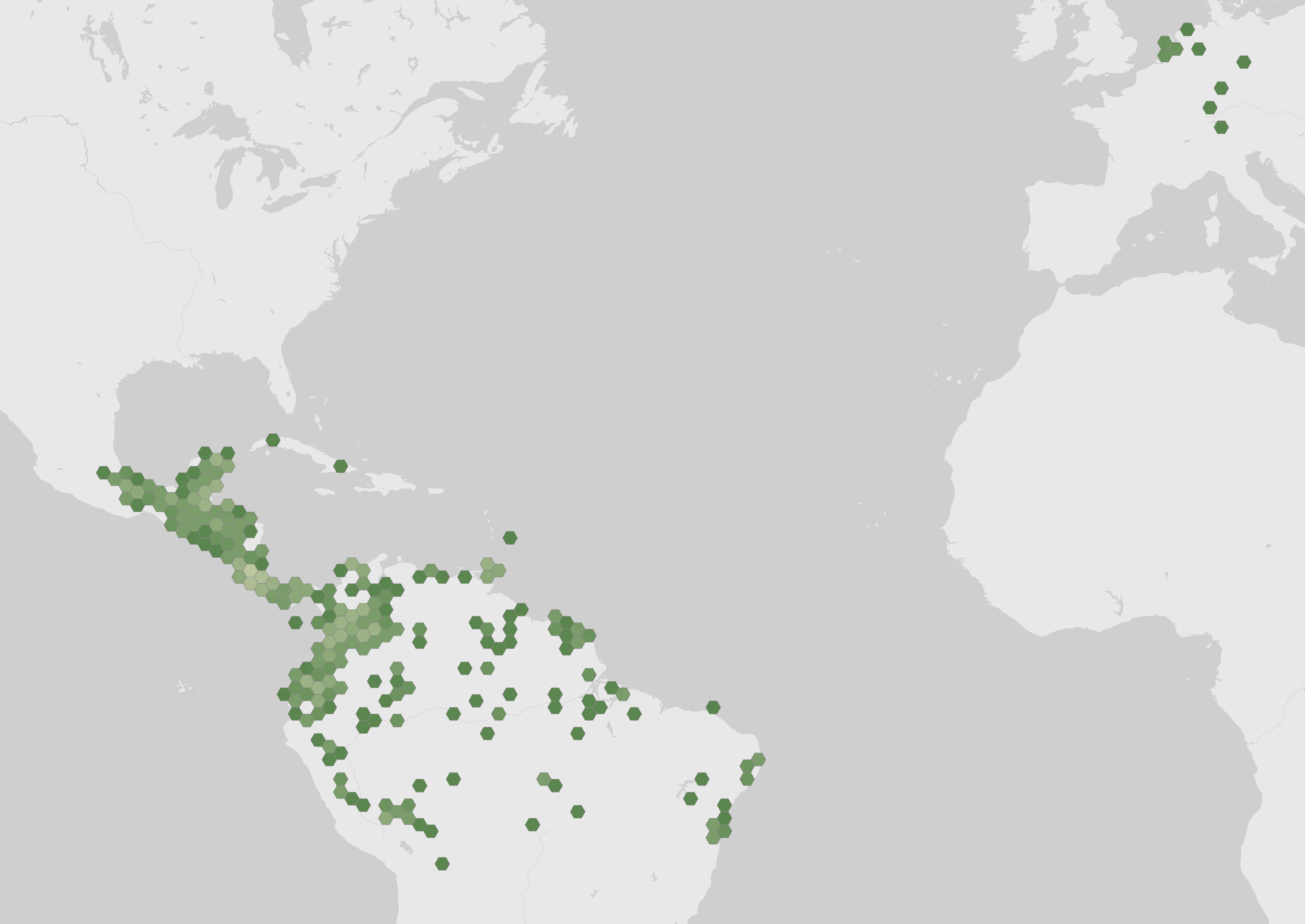
Atta cephalotes occurs widely across the Neotropical region, from Mexico south through Central America to Bolivia, with additional, disjunct populations recorded in the Amazonas region and northeastern Brazil.
On the rainforest floor, a single colony typically occupies an area of about 200 square meters, honeycombed with chambers that can reach 7 meters in depth. Nest entrances and tunnels are carefully positioned so that natural breezes ventilate the underground chambers, clearing away the dangerous levels of carbon dioxide produced by the fungus gardens the ants cultivate for food.
Monthly observation counts show a peak in February and March, with over 1,000 records in each month, before tapering through the second half of the year to lows near 400. These figures reflect presence records rather than actual abundance or population size, but the pattern hints at seasonal differences in when the ants, or their conspicuous foraging trails, are most often noticed.
Behavior and Lifestyle
Colony life in Atta cephalotes runs on a strict division of labor, with each caste locked into a specific job. Minims stay inside the nest, digging chambers, tending the fungus gardens, and caring for brood; they also ride on the backs of larger foragers carrying leaf fragments, guarding against parasitic phorid flies that try to lay eggs in the heads of leaf-carrying workers.
Medias serve as the colony's harvesters, cutting and hauling leaf fragments back to the nest to feed the fungus gardens, while majors take on almost exclusively defensive duties, patrolling the harvesting trails against other insects. Ants navigate these trails using pheromone signals, laying scent trails to guide nestmates back to newly discovered food sources.
Elder workers are assigned to manage the colony's refuse, a job that comes with a harsh cost: these rubbish workers are excluded from the rest of the colony, and any that wander back into the main nest are killed or forced away by their nestmates. Constant exposure to disease and toxins in the waste pile means these workers live only about half as long as ants performing other tasks.
Fun Facts
- At a study site in Costa Rica, Atta cephalotes attacked only 17 of 332 available plant species, favoring woody plants over herbaceous ones and introduced species over native ones.
- Most workers have ovaries too rudimentary to function normally, but a few, usually those attending the queen, can produce trophic eggs that are fed directly to her.
- Despite this egg production by workers, no Atta cephalotes worker-laid eggs have been found to develop into males.
Ecology
Habitat
- Forest
Behavior
- Territorial
- Social