The rusty patched bumble bee has vanished from 87% of its historical range in just a few decades, a decline so steep that in 2017 it became the first bee species placed on the U.S. Endangered Species list in the continental United States.
Bombus affinis is a eusocial bumblebee native to eastern North America, historically ranging from Quebec and Ontario south to Georgia and west to the Dakotas. The IUCN lists it as Critically Endangered, and Canada assessed it as Endangered in 2010.
Once one of the most common bumblebees in the upper Midwest and southern Ontario, it now survives in scattered, isolated populations, making it a focal species for pollinator conservation across North America.
Identification and Appearance
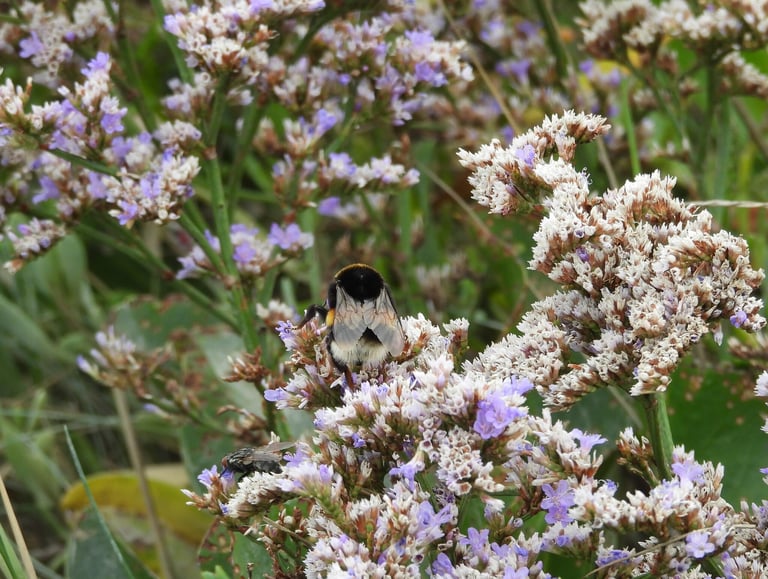
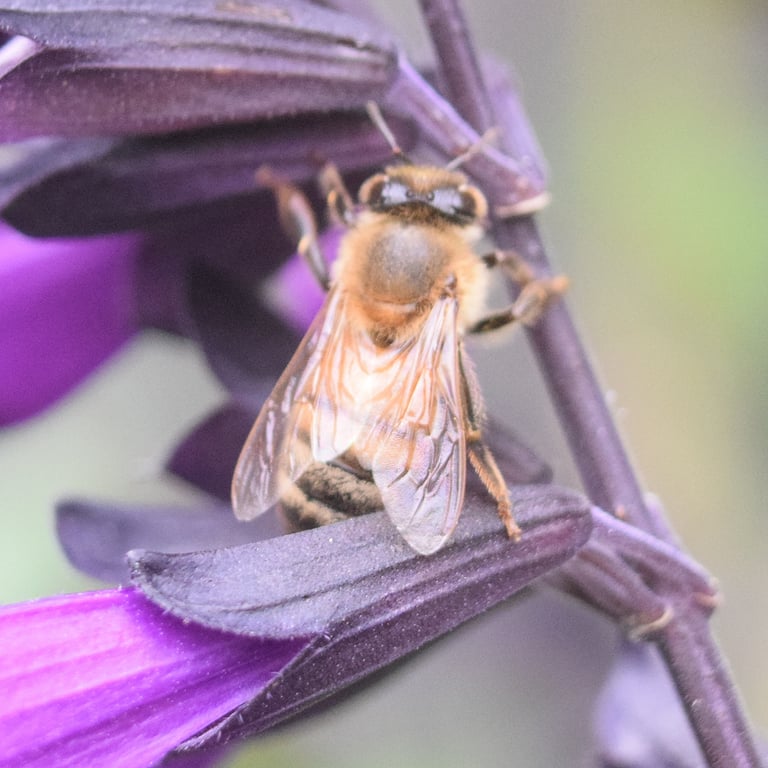
A rust-colored patch of hair on the basal half of the second abdominal segment, visible only in workers and males, gives the rusty patched bumble bee its name and is the single most reliable field mark, though queens lack it entirely.
Queens measure 20 to 22 mm long and 9 to 11 mm wide, noticeably larger than workers, which run 10 to 16 mm long and 6 to 9 mm wide. Males are intermediate in size, at 13 to 17.5 mm.
All castes carry black hair on the head, legs, and lower abdomen, with black hair over most of the abdomen except the two basal segments. Workers show a mix of yellow and black hairs near the wing bases forming a distinct "V," in addition to the rusty patch. Males differ further, with pale hairs on the crown, black streaking across a mostly yellow abdomen, and sometimes pale yellow abdominal hair.
Because of its size and furry build, the species is easily confused with other bumblebees such as Bombus citrinus, B. griseocollis, B. perplexus, and B. vagans. One consistent difference across all castes is tongue length: rusty patched bumble bees have shorter tongues than any other North American bumblebee species.
Distribution and Habitat
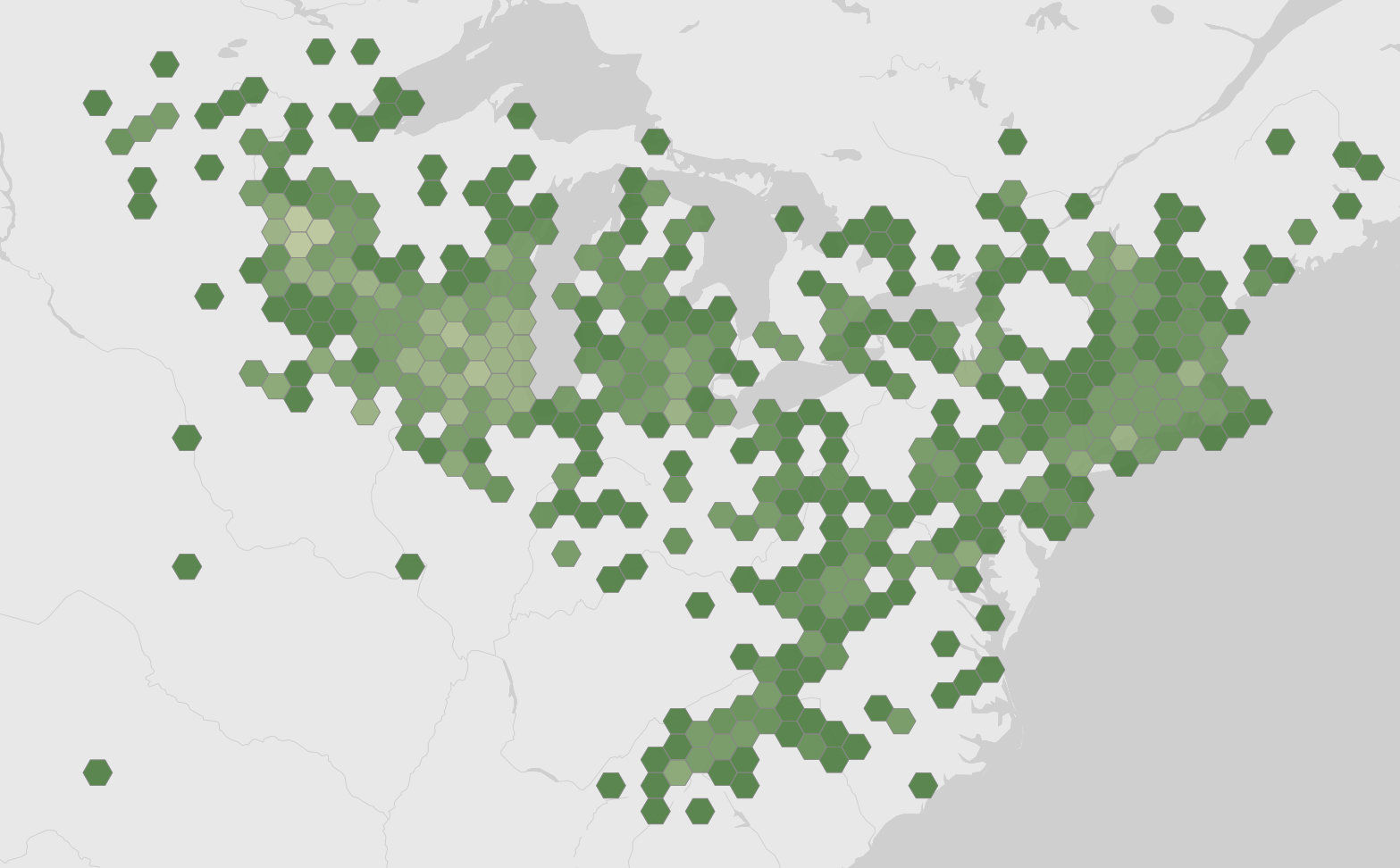
Bombus affinis historically ranged across the eastern and upper midwestern United States, north into Ontario and Quebec, south to Georgia, and west to the Dakotas. It has been recorded in mixed farmland, sand dunes, marshes, and both urban and wooded habitats.
Colonies nest underground, often in abandoned rodent burrows as deep as 1.2 meters, though nests have also turned up in grass clumps, house foundations, and even inside an abandoned armchair left outdoors. Overwintering queens instead shelter in shallow holes, leaf litter, or fallen logs within woodlands, often along the edge where forest meets grassland.
Because foraging, nesting, and overwintering each demand different habitat types within roughly 10 km of one another, the species depends on a mosaic of woodland and open grassland, which makes it unusually vulnerable when any one habitat type disappears. Colonies increasingly persist in urban and suburban settings; one Minnesota study found 75 to 100% developed land cover within 1 km of nest sites.
Presence records peak sharply from June through September, with the highest numbers in August, matching the species' active season from mid-March to mid-October. Once common in southern Ontario, it has not been confirmed there since a 2009 sighting at Pinery Provincial Park, and surveys from 2001 to 2008 found it only in Illinois, Iowa, Maryland, and southern Ontario; part of one known Illinois site, Bell Bowl Prairie, was demolished in 2023 for an airport expansion.
Behavior and Lifestyle
Colonies follow a strict eusocial hierarchy of one egg-laying queen, female workers, and late-season males and new queens. Activity depends heavily on air temperature: the bees fly from mid-March to mid-October, later at latitudes above 42°N, and remain active near dawn and dusk down to about 4°C, though they avoid rain, fog, and freezing conditions.
Workers typically forage within about 1 km² centered on the nest, though colony ranges can reach 10 km² depending on local floral diversity. The bees are generally docile and defend only the immediate area around the nest entrance, and only when directly provoked.
As colonies grow, workers sometimes challenge the queen for reproductive rights, biting her legs and body and destroying eggs she lays in response. If a queen dies, the pheromones that normally suppress worker reproduction disappear, and workers fight each other, rearing up and grappling with their mandibles until a hierarchy for egg-laying is established. Because workers cannot mate, any eggs they produce are unfertilized and become male offspring.
Communication
Vision plays a central role in locating flowers: each compound eye holds about 6,000 ommatidia, giving the bees blue, green, and ultraviolet color vision but no ability to see red. Many flowers reflect ultraviolet patterns that act as nectar guides, directing bees toward pollen and nectar.
The bees also sense their surroundings electrically. Because flight leaves them positively charged, antennal hairs detect the electric fields created as they approach negatively charged, grounded objects, letting them judge shape and size, while Johnston's organs in the antennae detect airborne vibrations.
Chemical signals coordinate mating and colony life. Drones mark patrol routes and landmark "buzzing places" with pheromones from leg glands to attract unmated queens, which respond with their own mandibular gland pheromones. Inside the nest, queens release pheromones that suppress worker egg-laying, while infertile workers release compounds signaling their own infertility to avoid conflict.
Diet and Feeding Habits
Short-tongued at just 5 to 6 mm, rusty patched bumble bees can only reach nectar in shallow, open flowers rather than deep tubular blooms, but within that constraint they are generalists that visit a wide range of native and introduced plants.
Documented forage plants include Virginia bluebells, columbines, beebalms, milkweeds, asters, sweet yellow clover, sunflowers, and willows, among others. Queens emerge from diapause timed to the earliest spring blooms, often foraging within 1 km of the nest in wooded areas before their first brood of workers takes over colony-wide foraging.
Nectar supplies carbohydrates while pollen delivers the proteins, lipids, and sterols needed for hormone production and disease resistance; the amount of pollen a colony collects directly determines how many new queens it can rear. Workers appear to favor flowers with pollen protein-to-lipid ratios similar to those preferred by related bumblebee species.
As generalist pollinators with a long foraging season running from April to September, rusty patched bumble bees also visit commercially important crops such as tomatoes, cranberries, blueberries, peppers, stone fruits, and squash.
Reproduction and Life Cycle
Mated queens spend the winter alone in diapause, then emerge around mid-March as temperatures warm, search out a nest site, and begin stockpiling pollen and nectar before using stored sperm to fertilize their first clutch of eggs.
A queen lays her eggs in wax cells about 1 cm across; larvae hatch roughly two days later, feed on pollen and nectar for about two weeks, then are sealed into their cells to pupate for another two weeks. Total development from egg to adult takes 4 to 6 weeks, with incubation fastest between 29 and 32°C and nest humidity around 50 to 65%; workers develop about four days faster than future queens or males, which have more complex reproductive anatomy.
Once the first brood of workers matures, around five weeks after the first eggs were laid, they take over foraging and nest care while the queen continues laying successive broods. Colonies lay 50 to 1,000 eggs over a season, averaging around 500, with clutch size shaped by food supply, nest space, and temperature.
From late July through October, the colony produces its final brood of new queens and males, which leave the nest to mate with individuals from other colonies after a courtship dance and copulatory flight. Males die soon after mating, workers and the old queen die off as the weather cools, and only newly mated queens survive the winter to start the cycle again the following spring.
Population and Ecological Role
The IUCN estimates a 92.54% decline in rusty patched bumble bee abundance between the 1990s and 2010s, a drop steep enough to reshape its role in the ecosystems it once dominated.
As a generalist pollinator, it supports reproduction in a wide range of native flowering plants and several commercial crops, and it also serves as prey for predators such as goldenrod crab spiders and bee-killer wasps. Its nests are frequently targeted by the obligate brood parasite Bombus bohemicus (cuckoo bumble bee), which locates burrows by scent, kills or displaces the resident queen, and relies on host workers to raise its own young; smaller nests are especially vulnerable because they have fewer workers to defend them.
Conservation and Threats
The species is listed as Critically Endangered by the IUCN and Endangered under the U.S. federal Endangered Species Act and in Michigan, though it carries no special status under CITES. The 2017 U.S. listing made it the first bee species protected under the Act in the continental United States.
Habitat loss ranks among the most severe threats: urbanization and paved surfaces reduce nest densities, while agricultural conversion to livestock grazing and monoculture farming strips away the diverse, season-long floral supply the bees need and compacts or destroys nesting sites. Pesticide exposure, whether direct contact while foraging or contaminated groundwater near nests, adds further pressure, and climate change compounds these threats through increased drought, flooding that can waterlog underground nests, and mistimed frosts that disrupt diapause.
Conservation responses include national and international efforts to formalize its critically endangered status, habitat restoration projects aimed at reconnecting fragmented woodland and grassland, and campaigns to restrict pesticides linked to bumblebee decline. Prescribed burns are being used in some areas to restore native prairie and grassland habitat.
Conservation status
- LC
- NT
- VU
- EN
- CR
Critically Endangered
Cultural Significance
The rusty patched bumble bee's main significance to people is economic rather than symbolic: as a generalist pollinator, it contributes to the productivity of crops including tomatoes, currants, cranberries, blueberries, peppers, stone fruits, and squash.
It obtains an estimated 12% of its pollen and nectar from plants in the pea family alone, underscoring its broad role in both wild plant communities and cultivated fields even as its own numbers collapse.
Fun Facts
- A rusty patched bumble bee nest was once discovered inside an abandoned armchair left outdoors.
- The species has five eyes: two large compound eyes and three simple ocelli.
- Its antennal hairs can detect the weak electric fields created by its own positively charged, flying body as it approaches grounded objects.
- Drones mark regular flight paths with pheromones and repeatedly revisit landmark "buzzing places," such as large trees or stumps, to attract mates.
- Part of Bell Bowl Prairie in Illinois, a known habitat for the species, was demolished in March 2023 for an airport expansion.
- In January 2017 it became the first bee species added to the U.S. federal endangered species list in the continental United States.
- Its nests are targeted by the cuckoo bumble bee Bombus bohemicus, which cannot forage for itself and instead relies entirely on host workers to raise its young.
Ecology
Habitat
- Wetland
- Forest
- Grassland
- Urban
Behavior
- Hibernating
- Territorial
- Social
- Diurnal
Diet
- Nectarivore
Photos
SourcesGBIFiNaturalistWikidataWikipediaEncyclopedia of LifeAnimal Diversity Web