Araucaria araucana is the hardiest species in the entire conifer genus Araucaria, able to tolerate cold and exposure that would kill any of its tropical or temperate relatives. That resilience has let it survive for millions of years on the volcanic slopes of the southern Andes largely unchanged.
It is a large evergreen tree, reaching 30 to 40 meters in height with a trunk 1 to 1.5 meters across, and it belongs to the conifer family Araucariaceae within the order Pinales. Native to central and southern Chile and western Argentina, it grows in a landscape shaped by volcanoes and cold Andean winters.
Few trees look as strange or as ancient as this one. Its rigid, reptilian branches and needle-armored leaves have made it a favorite in gardens worldwide, even as its wild populations face mounting pressure.
Identification and Appearance
The single most reliable field mark is the tree's covering of thick, triangular, scale-like leaves with sharp edges and tips, which clothe the branches so densely that bark is visible only on the oldest wood. Each leaf measures 3 to 4 centimeters long and 1 to 3 centimeters wide at the base, and according to research cited for the species, individual leaves can remain attached and alive for up to 24 years.
Mature trees stand 30 to 40 meters tall with trunks 1 to 1.5 meters in diameter, developing a distinctive umbrella-shaped crown as they age, in contrast to the broadly pyramidal or conical shape of younger trees. The bark is notably thick, up to 15 centimeters, likely an adaptation that helps the tree survive wildfire.
Araucaria araucana is usually dioecious, meaning male and female cones grow on separate trees, though individuals bearing both sexes occur occasionally. Male pollen cones are oblong and cucumber-shaped, starting at 4 centimeters and expanding to 8 to 12 centimeters long by 5 to 6 centimeters wide at the time of pollen release, while female seed cones are globose and much larger, reaching 12 to 20 centimeters in diameter and holding roughly 200 seeds each.
The seed cones mature in autumn, about 18 months after pollination, and disintegrate at maturity to release nut-like seeds 3 to 4 centimeters long. This slow, two-stage reproductive cycle and the tree's armored, symmetrical silhouette make it hard to confuse with any other conifer in its range.
Distribution and Habitat
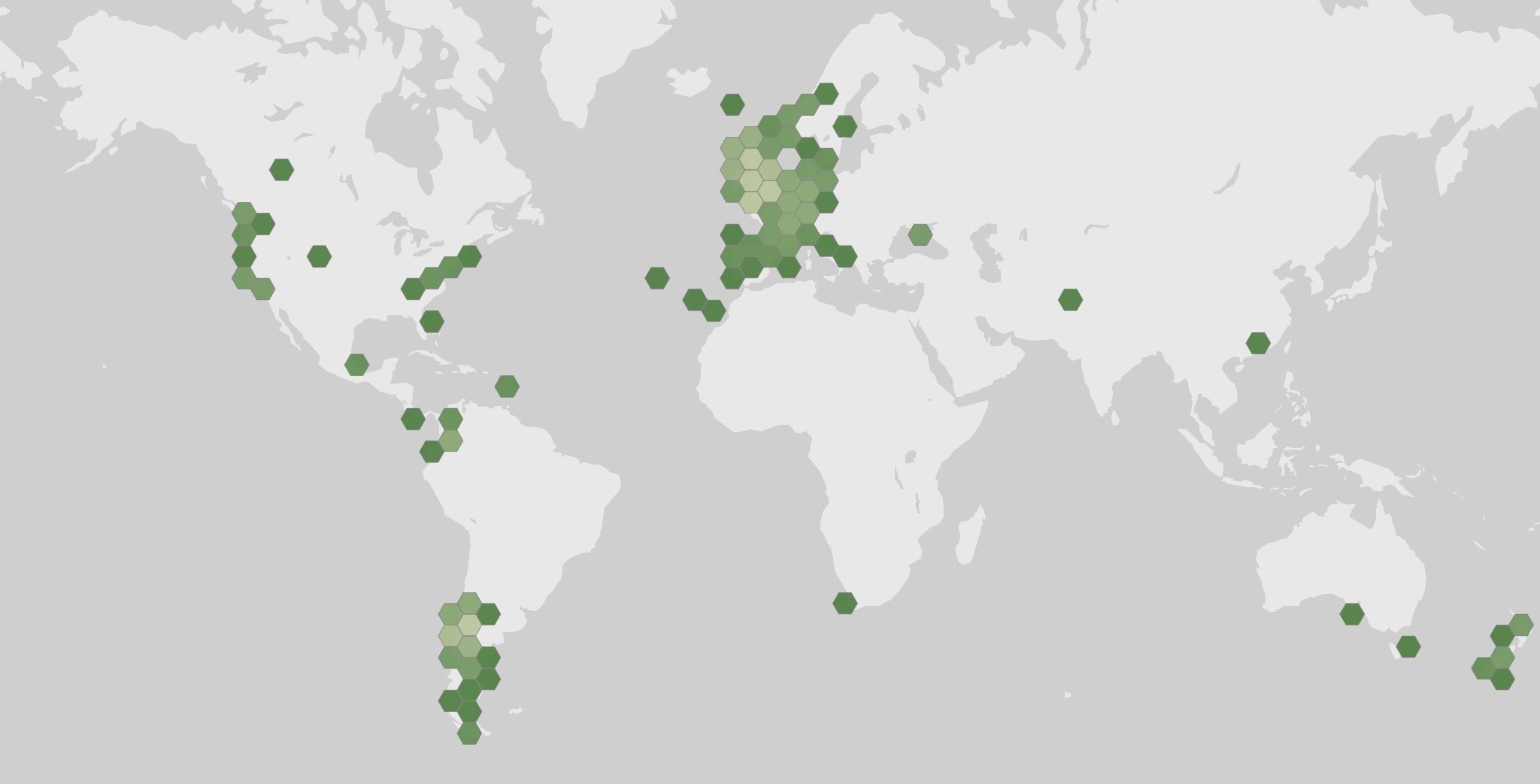
Araucaria araucana is native to the lower slopes of the south-central Andes in Chile and Argentina, typically growing between 1,000 and 1,700 meters in elevation. In the Chilean Coast Range it extends as far south as Villa Las Araucarias, around latitude 38°30' S, at a much lower altitude of 640 meters.
It often grows in mixed forests alongside the deciduous Nothofagus pumilio, with the taller monkey puzzle trees emerging above the surrounding canopy to create a distinctive high-altitude skyline. The species favors well-drained, slightly acidic, volcanic soil, though it tolerates other soil types as long as drainage is good.
Regeneration depends heavily on disturbance: seedlings rarely compete well against established vegetation and tend to survive only in canopy gaps or exposed, isolated sites. Notably, Araucaria araucana is almost never found growing together with Chusquea culeou, Nothofagus dombeyi, or Nothofagus pumilio saplings, since these plants typically outcompete it at the seedling stage.
Monthly observation records show counts ranging from 198 to 691 sightings, with a peak in April and a secondary rise in August; this pattern likely reflects when observers are active in the field rather than the tree's actual abundance or a complete picture of its native range.
Reproduction and Life Cycle
Araucaria araucana is a masting species, meaning it produces large seed crops in some years and few or none in others, a strategy that influences the animals that depend on its seeds. Rodents are important seed consumers and dispersers, and the long-haired grass mouse, Abrothrix longipilis, is considered the most significant disperser because it buries whole seeds in locations favorable for germination, unlike animals that simply eat them on the spot.
The austral parakeet is another key disperser, carrying seeds away from the parent tree. This service becomes especially valuable after volcanic eruptions or other major disturbances, since adult Araucaria araucana trees are highly resistant to such events and the parakeets can then reseed the surrounding area once conditions allow.
Female seed cones mature in autumn, roughly 18 months after pollination, before breaking apart to release their seeds, so each reproductive cycle spans more than a full year from pollination to seed release.
Uses and Human Relationships
In Chile, Araucaria araucana is known as pehuén and holds deep religious significance for the Mapuche people, who regard the tree as a sacred being, a provider of nourishment through its seeds, and a symbol of wisdom and resilience. One local myth holds that speaking while passing the tree brings bad luck or even causes a tail to grow, like a monkey's, a belief tied to the tree's English name, monkey-puzzle, said to come from its maze-like branches that were said to puzzle a climbing monkey.
The species is a popular ornamental tree grown for the striking, "reptilian" appearance of its thick, symmetrical branches. It thrives in temperate oceanic climates with abundant rainfall, tolerating temperatures down to about −20°C, and has been successfully planted well outside its native range, including in western and central Europe, the west and east coasts of North America, southern Chile, New Zealand, and southeastern Australia; it tolerates coastal salt spray but not air pollution.
Its durable, decay-resistant timber was once prized for railway sleepers and for veneers and plywood, and mills in the Araucanía Region specialized in working it before logging was banned by law in 1990. The species is now listed on CITES Appendix I, prohibiting commercial trade in wild-sourced specimens. In the 19th century, the plant collector William Lobb sent thousands of seeds from the Araucanía Region back to Veitch Nurseries in England, and the tree has since become locally naturalized in Great Britain, with young self-sown trees found at Kyloe Woods in Northumberland.
Conservation and Threats
Logging was long the primary threat to Araucaria araucana, but the practice was finally banned in Chile in 1990. Since then, large wildfires have become one of the most severe dangers: fires in 2001–2002 burned thousands of acres of Araucaria forest, including areas within national parks that destroyed trees over 1,300 years old.
Overgrazing, invasive trees, and extensive human harvesting of piñones, the tree's seeds, also threaten regeneration, since heavy seed collection can prevent new trees from establishing. Non-native seed-eating mammals have been shown to restrict reproduction more severely than native seed eaters in some studies, though other research found that native species actually caused more seed destruction, possibly because introduced species are still relatively recent arrivals with smaller populations. Cattle ranching by both small landowners and larger timber companies within the tree's range has also been found to severely affect seedling regeneration.
Conservation efforts have shown promise: a Global Trees Campaign project that planted 2,000 trees recorded a 90 percent survival rate after ten years, demonstrating that active planting can help offset losses from fire and grazing pressure.
Fun Facts
- Araucaria araucana is Chile's national tree and is known locally as pewén, a name carrying deep spiritual meaning for the Mapuche people of the Andean foothills.
- According to Mapuche legend, speaking while walking past the tree brings bad luck or could even cause the offender to grow a tail like a monkey.
- The tree's English name, monkey-puzzle, is said to come from its maze-like, spiky branches, which supposedly would puzzle any monkey attempting to climb them.
- Its seeds, called piñones, resemble pine nuts but are far larger; roasted seeds from two different trees have measured 5 centimeters and 3 centimeters long.
Ecology
Habitat
- Forest
- Mountain
Growth habit
- Tree