No other woody plant on Earth covers as much ground as the common juniper. Juniperus communis holds a circumpolar, Holarctic distribution that stretches across the cool temperate Northern Hemisphere, from the Arctic tundra south through mountain ranges to roughly 30°N latitude in North America, Europe, and Asia.
This evergreen conifer belongs to the cypress family Cupressaceae and grows as either a small tree or a low, spreading shrub depending on where it takes root. Its conservation status is listed as Least Concern, reflecting its enormous range and adaptability.
Few plants combine such geographic reach with such deep cultural roots. From ancient purification rituals to the flavor behind gin, the common juniper's story extends far beyond its unassuming, prickly appearance.
Identification and Appearance
The clearest field mark is the foliage itself: needle-like leaves arranged in whorls of three, each with a single white stomatal band on its inner surface. Unlike most other junipers, Juniperus communis never develops the scale-like adult foliage typical of the genus, so it keeps its sharp, needled look throughout life.
Size varies enormously with growing conditions. In favorable sites it reaches 10 meters tall, rarely up to 16 meters, but in exposed or harsh locations it becomes a low, often prostrate spreading shrub pressed close to the ground.
The species is dioecious, with male and female cones borne on separate plants and relying on wind for pollination. Male cones are small, yellow, and only 2-3 millimeters long, shedding pollen and falling soon after in March-April. Female plants produce the familiar juniper berries: green at first, they take 18 months to ripen into a purple-black color with a blue waxy coating, typically 4-12 millimeters across with three, occasionally six, fleshy fused scales, each holding a single seed.
Male and female individuals also differ in longevity. Male trees or shrubs generally outlive females, with some male specimens surviving more than 2,000 years.
Distribution and Habitat
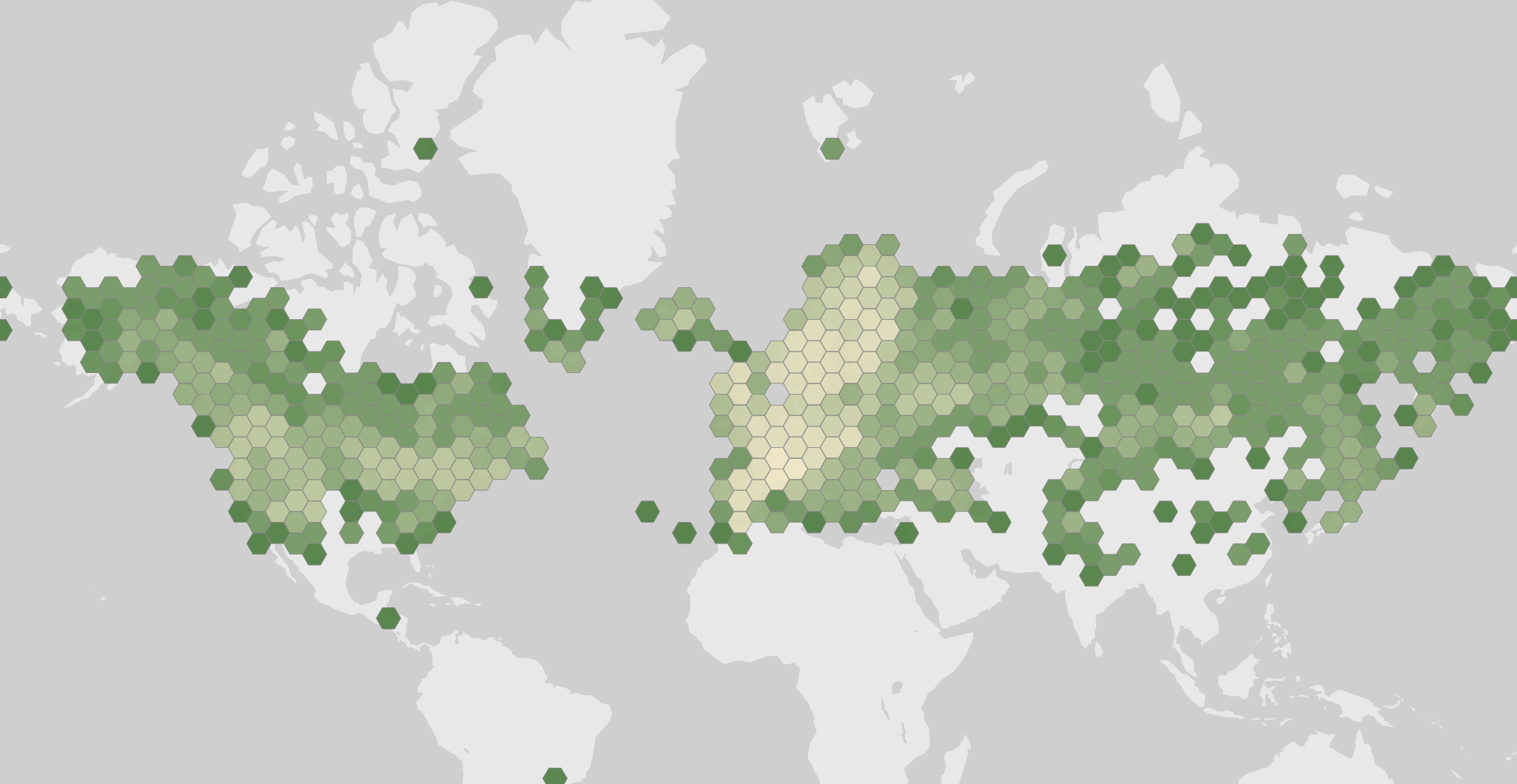
Juniperus communis occupies a circumpolar band across the cool temperate Northern Hemisphere, running from the Arctic south through mountain systems to about 30°N in North America, Europe, and Asia, with isolated relict populations surviving in Africa's Atlas Mountains. This breadth gives it the largest range of any woody plant.
Its native habitat centers on rocky slopes in coniferous forests of mountains and plains. In the western United States it often grows as a low shrub near timberline, while across North American forests it commonly serves as an understory dominant beneath ponderosa pine, Douglas-fir, lodgepole pine, limber pine, white fir, Engelmann spruce, white spruce, quaking aspen, blue spruce, whitebark pine, subalpine fir, or Rocky Mountain bristlecone pine. It also appears in drier and more open systems, including sagebrush steppe, pinyon-juniper woodland, mountain grasslands and meadows, and alpine zones, though it is comparatively rare on open sand dunes.
Monthly observation counts show a pronounced rise from spring into a peak around June-July, before tapering off through autumn and winter. Because these are presence observations rather than true abundance or population data, the pattern most likely reflects when the plant is easiest to notice and record rather than a true seasonal shift in where it grows.
Growth and Form
As a woody evergreen conifer, Juniperus communis grows extremely slowly, and that slow pace translates into exceptional longevity. Dendrochronological studies of shrubs growing in tundra environments have identified specimens among the oldest trees or shrubs ever recorded in Europe.
One specimen found in Finnish Lapland, within the Arctic Circle, was dated at 1,647 years old. Such ages are far beyond what most temperate shrubs achieve, and they underscore how the harsh, cold conditions of the tundra can favor extreme persistence over rapid growth.
Uses and Human Relationships
Juniper carries deep cultural weight. In Native American tradition it was treated as a sacred plant, its branches used in cleansing rituals and ceremonies meant to purify the spirit and invite blessings. Native peoples also brewed the berries with barberry root bark as a herbal tea, and used juniper berries as a female contraceptive.
The plant is widely grown in horticulture as an evergreen ornamental. Four cultivars, 'Compressa', 'Green Carpet', 'Hibernica' (Irish juniper), and 'Repanda', received the Royal Horticultural Society's Award of Garden Merit in 1993, alongside other cultivars such as 'Fontan', 'Hornibrookii', 'Kantarell', and 'Vembo'. The wood itself, though too small for general lumber, has practical uses: Scandinavian craftspeople use it for containers to store butter and cheese and for wooden butter knives, shipwrights once used it for trenails in wooden shipbuilding, and in Estonia its aromatic, dense wood is prized for decorative items and eating utensils. Juniper burl wood is also used for knife handles on French pocketknives such as the Laguiole. A Kashubian Easter Monday tradition in northern Poland even involves boys gently whipping girls' legs with juniper twigs for good fortune in love.
The berries themselves, too astringent and bitter to eat raw, are dried and crushed to flavor meats, sauces, stuffings, and strongly flavored game. They give gin its name and character, the word "gin" deriving from an Old French term for juniper, and they flavor other spirits and beers as well, including Finnish sahti, Slovak Borovicka, and Dutch Jenever. Farmhouse ale traditions across Norway, Sweden, Finland, Estonia, and Latvia use juniper infusions or twigs in brewing, a practice with roots that may reach back to the early medieval period based on juniper remains found at migration-period and early Merovingian sites in southwestern Germany.
Fun Facts
- In France, people once burned juniper wood to purify the air and guard against infection during outbreaks of plague.
- Some ancient cultures are believed to have burned juniper to purify temples, and in Celtic tradition its smoke was used to commune with the Otherworld during Samhain, the festival that became modern Halloween.
- The genus Juniperus includes between 50 and 67 species and roughly 400 cultivars, but not all are edible; Juniperus sabina, a close relative, is toxic.
- Juniper leaves have been found to harbor fungi that produce potent antifungal compounds, including ibrexafungerp, now FDA-approved to treat fungal infections.
Conservation status
- LC
- NT
- VU
- EN
- CR
Least Concern
Ecology
Habitat
- Forest
- Woodland
- Mountain
- Tundra
Growth habit
- Shrub