No other freshwater fish lives farther north than the Arctic char. It is the only fish species found in Lake Hazen on Ellesmere Island, at 81°56′N, deep inside the Canadian Arctic, and it holds a mostly circumpolar range across the coldest freshwater and coastal habitats on Earth.
Salvelinus alpinus is a cold-water member of the salmon family (Salmonidae), native to alpine lakes and Arctic and subarctic coastal waters across the Holarctic. Some populations stay landlocked in lakes for their entire lives, while others migrate to sea each summer. The IUCN lists it as a species of Least Concern.
What makes the char worth a closer look is its extraordinary plasticity: within a single lake, one population can split into tiny dwarf fish and giant predators several times their size, a split driven by nothing more than resource competition.
Identification and Appearance
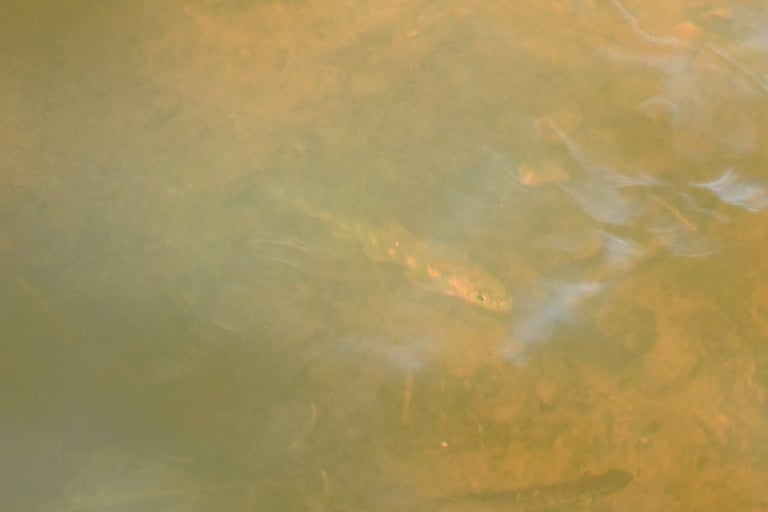
The clearest field mark is the strong contrast between a dark, often bluish-gray back and a ventral side that flushes red, yellow, or white, a pattern that shifts with season and the chemistry of the home lake. Because coloration is so variable between populations, size and shape are often more reliable guides than color alone.
Arctic char shows a striking size dimorphism. Dwarf forms weigh between 0.2 and 2.3 kg and average just 8 cm in length, while giant forms weigh 2.3 to 4.5 kg and average around 40 cm. Exceptional individuals, especially trophy fish taken by anglers in northern Canada, where the species is known as iqaluk or tariungmiutaq in Inuktitut, can top 9 kg. Market-sized fish sold whole typically run between 1 and 2.5 kg. Males and females do not differ in overall size.
The flesh itself ranges from pale pink to bright red, a trait anglers and cooks often use to judge quality and diet history.
As a close relative of both salmon and trout, such as the Atlantic salmon and lake trout, Arctic char shares features of both groups, which can make it easy to confuse with either at a glance without checking the belly color and body proportions described above.
Distribution and Habitat
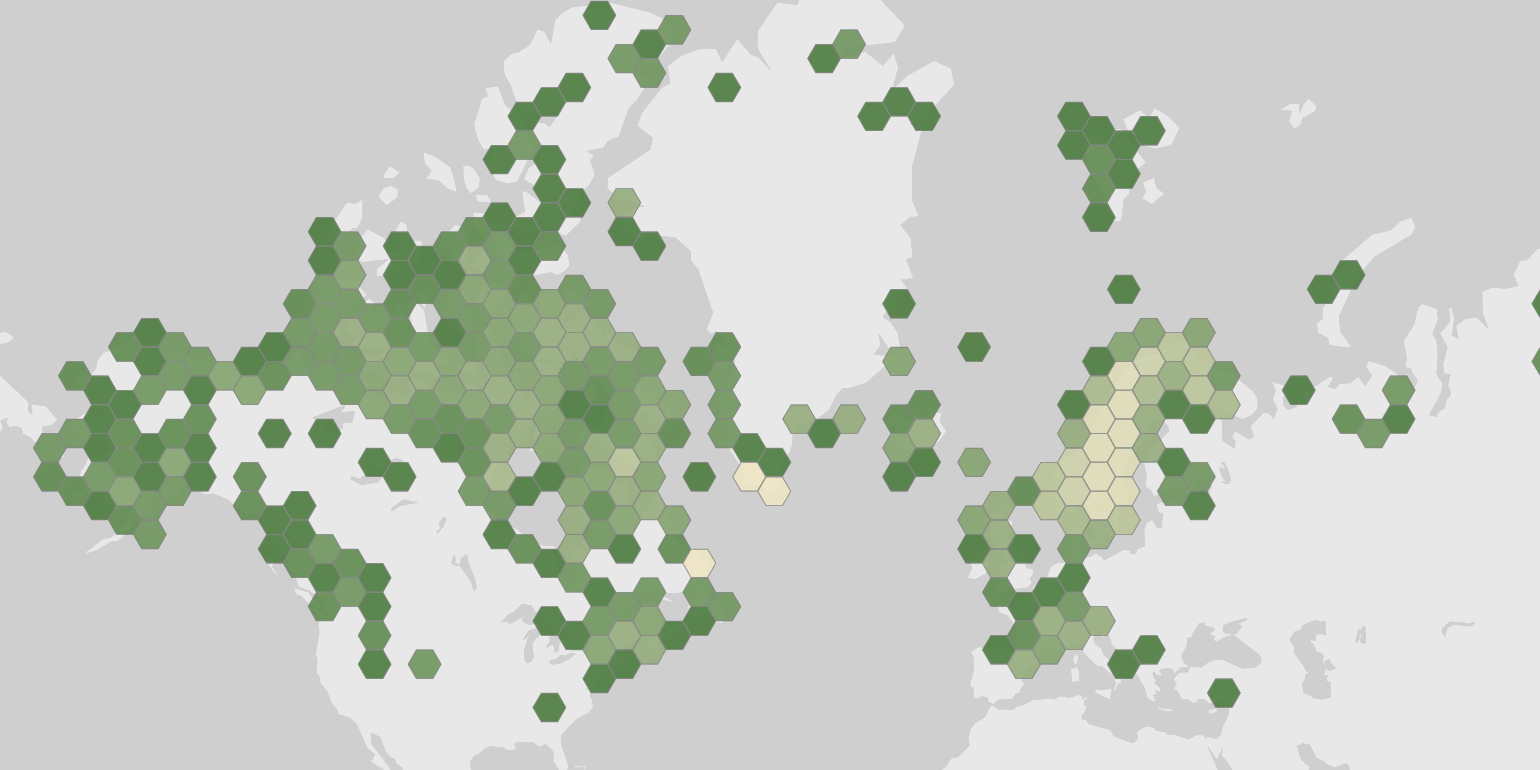
Arctic char has a mostly circumpolar distribution and holds the record as the most northerly freshwater fish on the planet. It occurs across the Canadian Arctic, Greenland, Iceland, Scandinavia, Siberia, and Alaska, in Arctic and subarctic coastal waters and in high-elevation lakes farther south.
Populations follow one of three life histories: landlocked, anadromous, or semi-anadromous. Fish living above 65°N latitude are generally anadromous, spending their first one to nine years in freshwater before migrating to the sea each summer between mid-June and mid-July. After roughly 50 days feeding in coastal and intertidal waters, they return through estuaries and brackish channels to freshwater lakes to spawn and overwinter.
Most char stay within 0 to 1 meter of the surface, occasionally to 3 meters, with a recorded maximum depth of 16 meters. The species turns up in unusual, isolated waters, such as Lake Pingualuit, a Quebec lake inside a 1.4-million-year-old impact crater where char is the only fish present, and Elgygytgyn Lake in Siberia, where introduced char now threaten smaller endemic species like the small-mouth char. In Britain and Ireland, it survives only in deep, cold glacial lakes and is one of the rarest fish in the region, threatened there by acidification.
Monthly observation counts peak sharply from June through September, exceeding 37,000 sightings in several months compared with roughly 20,000 to 27,000 in winter. This pattern lines up with the summer sea migration and greater visibility of fish near coasts and river mouths, though these figures reflect where char have been recorded, not how many exist.
Behavior and Lifestyle
Arctic char behavior centers on an annual migration between fresh and salt water. Anadromous fish head to sea each year from mid-June to mid-July, spend about 50 days feeding along coasts and in intertidal zones, then return to frozen lakes to reproduce and overwinter.
Sociability shifts with the calendar. Char travel and feed in groups during migration, but the mood changes at spawning time, when males turn solitary and territorial, competing for the best spawning ground. Larger males dominate smaller ones, establishing clear dominance hierarchies that determine access to females.
Unlike most salmonids, which rely heavily on vision to feed, Arctic char studied in Ellidavatn, a lake near Reykjavík, Iceland, were found to depend more on taste and tactile cues than sight, feeding actively both by day and by night.
Territories are not fixed in size: they expand with a fish's body size and shrink when food is abundant. Boundaries are loose, overlapping between neighbors, and rarely defended to the point of exclusion, an economy of effort that fits a species living in food-poor Arctic waters.
Communication
A well-developed lateral line lets Arctic char detect vibrations and movement in the water around them, useful for sensing both predators and rivals in murky or turbid lakes.
Chemical signaling drives reproduction. Males release a pheromone that attracts ovulating females during spawning, and fish more broadly use scent to sort friend from stranger: char have been shown to choose water carrying a sibling's odor over water scented by an unrelated char.
That chemical sensitivity extends to danger detection. Research on juvenile Arctic char found some individuals with highly tuned recognition of predator odors, responding to chemical cues tied to specific fish predators and even to what those predators had been eating.
Diet and Nutrition
Arctic char is an opportunistic carnivore whose menu shifts dramatically with location. An early survey by Grainger found more than 30 different prey species in char stomachs, underlining how little the diet is fixed.
At sea, the diet leans heavily on plankton and small crustaceans: research off the coast found marine-feeding char eating mostly a single copepod species, Calanus finmarchicus, along with krill of the genus Thysanoessa. Fish that stay in lakes instead target insects and zoobenthos on the bottom.
In Northern Labrador, capelin (Mallotus villosus) and mailed sculpin (Triglops murrayi) rank among the primary prey items. Beyond fish, char also take fish eggs, mollusks, zooplankton, amphipods, and other aquatic crustaceans depending on what a given lake or coastline offers.
Some giant char take the opportunism further, turning cannibalistic and preying on their own young as well as on dwarf char sharing the same lake.
Reproduction and Life Cycle
Arctic char reproduction runs on an unusual mating asymmetry: males are polygynous within a single season, while females mate with one partner. Ahead of spawning, males stake out and defend a territory, then court by circling a female and quivering alongside her.
The female chooses a spot inside a male's territory and digs the nest, or redd, in gravel, on rocky lake shoals exposed to wave action or in slower gravel-bottomed river pools. Spawning happens in groups, with eggs and milt released together into the pit for external fertilization; most populations spawn in fall between September and December, though some spawn in spring, summer, or winter instead.
A female can lay between 2,500 and 8,500 eggs, with anadromous females often producing 3,000 to 5,000. Incubation typically takes two to three months, occasionally stretching to five, and hatchlings emerge at a tiny 40 to 70 milligrams.
Sexual maturity arrives late and varies widely, from 4 to 15 years old, at a length of roughly 50 to 60 cm; recorded averages are 9.7 years for males and 10.3 for females. There is no parental care after spawning. Hatchlings are independent from the moment they emerge, staying buried in the gravel until they reach 15 to 18 cm, then living in the river for five to seven months. Unlike Pacific salmon, Arctic char do not die after spawning and typically breed again every second or third year.
Population and Ecological Role
Arctic char sits in the middle of its food web rather than at the top. It is a key prey species for the apex predator ferox trout (Salmo ferox) in many lakes, and it is also hunted by sea otters, polar bears, and other fish, with giant char adding dwarf and juvenile char to the list through cannibalism.
The species carries a long roster of parasites, including multiple protozoans, flukes, tapeworms, nematodes, thorny-headed worms, a leech, and several crustacean species, a diversity that reflects its role as both predator and prey across freshwater and marine food webs.
Char defends itself with crypsis, darkening in freshwater and lightening in marine water to blend with each environment, and some juveniles carry a finely tuned ability to detect the chemical scent of specific predators, an early-warning system built into the species' biology.
Conservation and Threats
The IUCN Red List classifies Arctic char as Least Concern, and it carries no special protections under the US Federal List, CITES, or the State of Michigan List. That global status, however, masks serious regional declines.
Humans are described as the biggest threat to the species, through fishing pressure and habitat change, followed closely by stream and lake acidification. Acidification has already driven several populations extinct in southern Scotland, and many Irish populations have vanished due to acidification and reduced water quality from domestic and agricultural pollution. A further, subtler threat is low genetic variation: the population in Lake Siamaa in southeast Finland now depends on aquaculture to survive, likely because limited genetic diversity raises egg and alevin mortality and disease susceptibility.
Where populations are struggling, conservationists have proposed sustainable development practices, transplanting juvenile stock, controlling nutrient input, and preventing the introduction of predatory fish into char lakes, measures discussed specifically for Ireland's remaining populations. Restocking efforts, as practiced at Lake Siamaa, offer a direct way to rebuild numbers where natural recruitment has failed.
Conservation status
- LC
- NT
- VU
- EN
- CR
Least Concern
Cultural Significance
Arctic char holds real economic value as food, marketed as a highly priced delicacy. Prices tracked in 2018 averaged around $9.90 per kilogram for dressed fish, though fillets have historically fetched as much as $24.18 per kilogram, with scarcer catches commanding the highest prices.
Beyond the table, the species supports sport fishing and specimen collecting, the latter valued specifically as a source for research and education, linking the fish's commercial appeal to its ongoing study.
Fun Facts
- Arctic char are considered living links to Ireland's Ice Age past, surviving only in the country's deepest, clearest lakes, where their presence signals pristine water quality.
- In Inuit tradition, the sea woman Sedna is said to control sea animals and withhold them when rules are broken, and coastal-run Arctic char are treated with a similar sense of respect and reciprocity.
- It holds the title of the world's most northerly freshwater fish, and it is the only fish species known from Lake Hazen on Ellesmere Island, at nearly 82° north.
Ecology
Habitat
- Wetland
- Marine
- Coastal
- Freshwater
Diet
- Carnivore
Behavior
- Territorial
- Social
- Diurnal
- Migratory
Photos
SourcesGBIFiNaturalistWikidataWikipediaAnimal Diversity WebAnAge