Atlantic salmon hatch in cool freshwater rivers, spend one to several years feasting at sea on herring, capelin, and other prey, then find their way back — often to the exact stream where they were born — to spawn.
The species, Salmo salar, belongs to the family Salmonidae within the order Salmoniformes and ranks as the third-largest salmonid alive, behind the Siberian taimen and the Pacific Chinook salmon, growing up to 1 meter in length. It ranges across the northern Atlantic Ocean and the rivers that drain into it, moving between saltwater and freshwater over the course of its life. The IUCN lists the species as Near Threatened, a status reflecting population declines across parts of its historic range.
Few fish combine such a demanding life cycle with such economic and cultural weight — Atlantic salmon support recreational fisheries, a global aquaculture industry, and centuries of folklore tied to their instinctive homeward journey.
Identification and Appearance
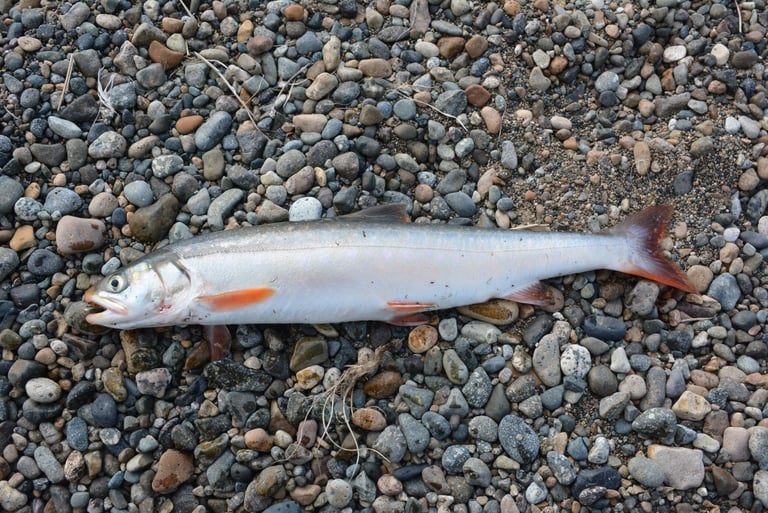
The clearest field mark is a scattering of black spots concentrated above the lateral line, paired with a caudal fin that is usually plain and unspotted — a combination that separates adult Atlantic salmon from many similar-looking relatives. All fins except the adipose fin carry a dark border.
Size varies enormously with age at sea. Fish that have spent two winters feeding in the ocean average 71 to 76 cm in length and weigh 3.6 to 5.4 kg, but individuals that overwinter at sea four or more times, or that survive to spawn repeatedly, grow far larger. The heaviest Atlantic salmon on record, netted in 1960 in the estuary of Scotland's River Hope, weighed 49.44 kg; the longest on record, taken in Norway in 1925, measured 160.65 cm.
Body shape is fusiform and streamlined, built for sustained swimming, with well-developed teeth. Color changes dramatically with life stage: juveniles living in fresh water carry blue and red spots along a mottled body, while mature adults take on a silver-blue sheen.
Sex and season leave their own marks. As spawning approaches, males develop an elongated head and a hooked lower jaw called a kype, and both sexes take on a faint green or red flush.
Distribution and Habitat
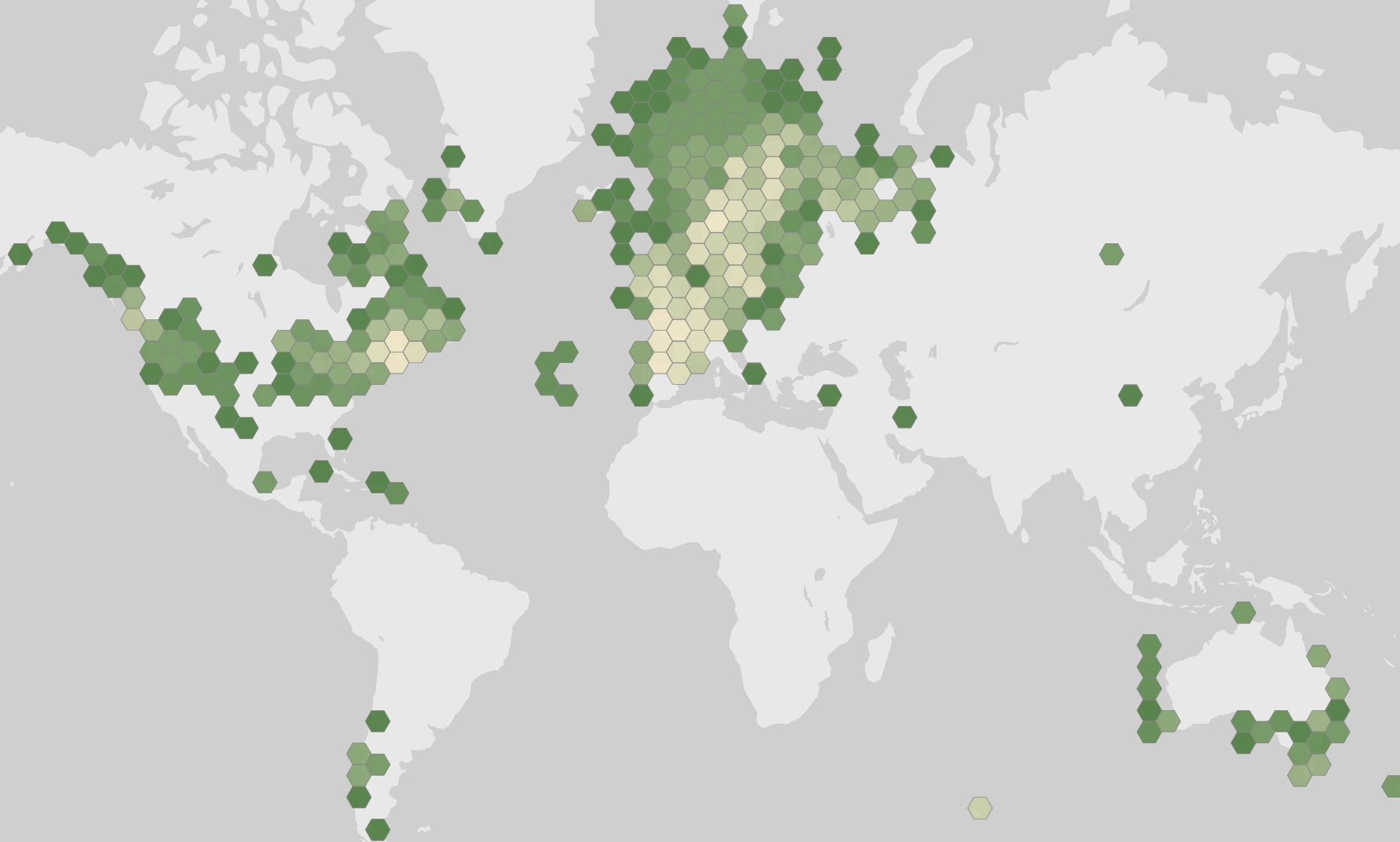
Atlantic salmon breed in rivers on both sides of the North Atlantic. In Europe their range runs from northern Portugal north through Norway, Iceland, and Greenland to the Pechora River in Russia, and since the early 2000s they have colonized rivers as far north as Svalbard at 78°N as the region has warmed. In North America, native spawning rivers stretch from Connecticut north to Labrador and Arctic Canada; the Housatonic and Naugatuck rivers once held the southernmost U.S. runs, and a 1609 account by Henry Hudson describes salmon running up the Hudson River, a population long since gone.
The species depends on relatively large, cool rivers with gravelly headwaters for spawning and early growth, then moves to sea to mature before returning upstream. At sea, salmon favor water temperatures between 4°C and 12°C and can only briefly tolerate extremes from -0.7°C to 27.8°C.
GBIF occurrence records show observations concentrated from midsummer through autumn, with a sharp peak in September, tapering off by winter. This pattern likely reflects when salmon are most visible in rivers and coastal waters during spawning migrations and estuarine transitions, rather than a measure of how many fish are actually present.
Populations closer to the southern edge of the range, including those in northern Spain, have grown smaller under sport-fishing pressure, and freshwater habitat loss from dams, logging, and agriculture eliminated many historic runs in New England and eastern Canada well before the 20th century.
Behavior and Lifestyle
Atlantic salmon behavior shifts sharply with life stage. Fry and parr occasionally act aggressively toward each other, though the evidence for true territory defense is inconclusive, and schooling becomes more pronounced once young fish reach the estuary.
Adults are markedly more aggressive than other salmon species and are more prone to attacking other fish. Their movement is inherently migratory and nomadic: schools of Atlantic salmon from many different rivers mix together for much of their time at sea before splitting apart again to head home.
Fine senses of smell, hearing, and taste guide feeding and help detect danger, and salmon can even feel the vibration of waves against their bodies. The same senses, combined with an ability to imprint the chemical signature of their birth stream as young fry, guide adults back toward their natal river to spawn — though researchers are still not certain exactly how the mechanism works.
Communication
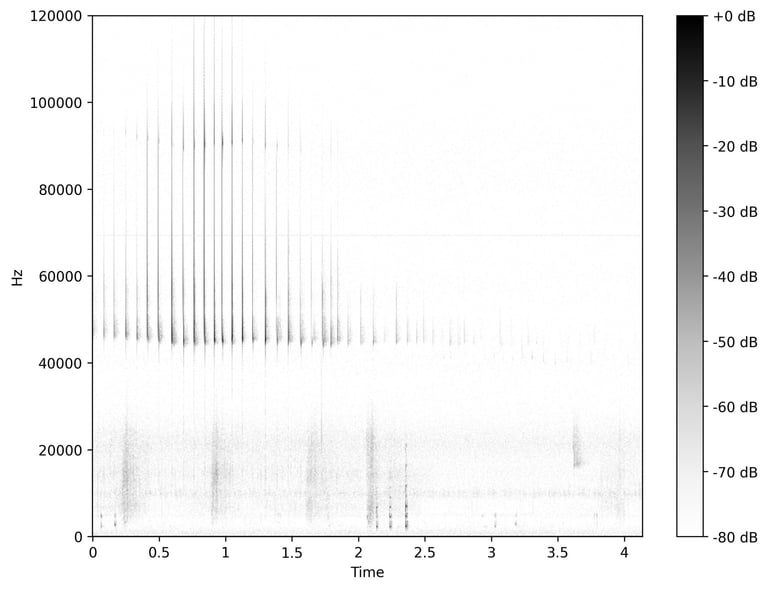
Atlantic salmon rely on visual, tactile, and chemical channels rather than sound. Vision and touch — including sensitivity to the pressure of waves against the body — help detect predators and navigate moving water.
Chemical cues do the heaviest lifting over long distances. Young fry imprint the specific odor of their home stream during the smolt stage, and this stored chemical memory is thought to be the main cue that guides adults back to the same river, sometimes years later, to spawn.
Hunting and Diet
Feeding behavior changes as soon as the fish develops the physical means to hunt. Alevins become active hunters as their gills mature even before leaving the gravel of the redd, and young parr in streams target the larvae of blackflies, stoneflies, caddisflies, and chironomids, supplementing these with terrestrial insects that fall into the water, especially in late summer.
Moving to sea changes the menu entirely. Pre-grilse feed heavily on planktonic euphausiids, along with amphipods and decapods, before graduating to a fish-based diet as they grow — herring, alewives, smelt, capelin, small mackerel, sand lance, and small cod all feature in the diet of larger salmon.
Feeding stops entirely once spawning approaches: salmon re-entering fresh water to breed do not eat again, even though they will still strike at an angler's artificial fly out of habit or aggression rather than hunger.
Reproduction and Life Cycle
Spawning peaks in late October, following a run upriver that leaves fish exhausted by the time breeding is complete. Males develop the hooked kype and drive off rival males while a female selects a gravel-bottomed riffle above a pool and excavates a nest, or 'redd,' by flapping her tail and body against the streambed.
Once the redd is ready, the male positions himself beside the female and both release eggs and sperm together, fertilizing the eggs externally as the gametes mix in the current. A female deposits roughly 700 to 800 eggs per pound of her body weight, then buries them under 12.7 to 25.4 cm of gravel before resting and repeating the process at a new redd; the entire sequence can take a week or more.
Unlike Pacific salmon, Atlantic salmon are iteroparous — many survive spawning as 'kelts' and either drop downstream to rest before heading back to sea or overwinter in the river, with a few individuals returning to spawn a second or even third time. Eggs hatch the following April, and the young, called alevins, stay in the gravel until their yolk sac is absorbed, emerging as fry in May or June.
Growth from there is a slow climb through life stages: fry become parr, and parr become smolt once they reach 12 to 15 cm and are ready for the sea. Sexual maturity arrives at 1 to 2 years of age in both sexes, though the age at which fish actually return to spawn varies widely, some coming back after a single year at sea as 'grilse,' others after two years or more.
Population and Ecological Role
Atlantic salmon connect marine and freshwater food webs across their range. In their first years in the river, young salmon are heavily preyed upon — trout alone account for nearly 40% of losses at this stage, alongside other fish and birds — and only 14 to 53% of smolts survive the initial move to sea.
At sea, the species becomes prey for seals, Greenland sharks, skate, cod, and halibut, in addition to human fisheries; grey and common seals in particular continue to take adult fish that have outgrown most other predators. Some populations never leave fresh water at all — landlocked strains exist throughout the Northern Hemisphere, including a population that once lived its entire life cycle within Lake Ontario's watershed before going extinct there.
The long-term decline of anadromous Atlantic salmon runs across the North Atlantic tracks closely with the historical decline of beaver populations, whose dams and wetlands once supported salmon nurseries, though modern studies suggest beaver dams themselves rarely block upstream or downstream salmon migration even during low flows.
Conservation and Threats
The IUCN classifies Atlantic salmon as Near Threatened, and regional assessments rate European populations as vulnerable. Some local populations carry harsher listings still: salmon along the coast of Maine are listed as Endangered under the U.S. Endangered Species Act, and those in Canada's Inner Bay of Fundy are listed as Endangered under the Species at Risk Act.
The most severe threats are overfishing and habitat change. Dam and mill construction, logging, and soil erosion drove the species to extirpation from Lake Ontario by 1896, and a commercial drift-net fishery that formed around Greenland and the Faroe Islands in the 1950s saw catches collapse from four million fish in 1979 to 700,000 by 1990. Since around 1990, at-sea mortality has more than doubled in the western Atlantic, and rivers along the coast of Maine, southern New Brunswick, and much of mainland Nova Scotia have seen runs drop sharply or vanish outright. Pollution, acid rain, dams blocking spawning grounds, and interbreeding or disease spread from escaped farmed salmon add further pressure.
Trends are not uniformly negative. Returns to Maine's Penobscot River climbed from about 940 fish in 2007 to 1,938 by mid-July 2008 and to more than 3,100 by 2011, the best return since 1986, with similar recoveries reported from Newfoundland to Quebec — improvements some researchers attribute to better ocean feeding conditions.
Restoration relies on artificial spawning channels, hatchery stocking, and international cooperation through bodies such as the North Atlantic Salmon Conservation Organization. Ontario's Atlantic Salmon Restoration Program, launched in 2006, has stocked Lake Ontario and its tributaries with more than 6 million young salmon since the species was wiped out there in the 19th century.
Conservation status
- LC
- NT
- VU
- EN
- CR
Near Threatened
Cultural Significance
Atlantic salmon carry deep symbolic weight wherever they run. In Irish mythology the species appears as An Bradán Feasa, the Salmon of Knowledge, and across its range it has long been associated with strength, wisdom, and spirituality. Among many Northwest Coast Indigenous peoples, the fish holds sacred status tied to its seasonal return to home rivers.
That symbolism sits alongside enormous economic use. Atlantic salmon is prized both as a game fish pursued by fly anglers during its river runs and as a food fish sold fresh, canned, or frozen, and farmed production has grown from just 297 tonnes in 1970 to more than 2.3 million tonnes by 2014 as wild-caught fish have become increasingly scarce in the marketplace.
Fun Facts
- Landlocked, freshwater-only populations of Atlantic salmon are called 'ouananiche' in North America, including a now-extinct population that lived its entire life cycle within Lake Ontario's watershed.
- Adults navigate the open ocean partly by sensing the Earth's magnetic field through iron deposits in their lateral line.
- Unlike Pacific salmon, which always die after spawning, many Atlantic salmon survive as 'kelts' and can return to spawn two or three times.
- In parts of northern Spain, Atlantic salmon hybridize with brown trout at rates up to 7.7%, the highest natural hybridization rate recorded for the species.
- Global farmed production of Atlantic salmon rose from just 297 tonnes in 1970 to more than 2.3 million tonnes by 2014.
- In Irish mythology, the species is revered as 'An Bradán Feasa,' the Salmon of Knowledge.
Ecology
Habitat
- Marine
- Coastal
- Freshwater
Diet
- Carnivore
Behavior
- Predator
- Aggressive
- Social
- Migratory
Photos
SourcesGBIFiNaturalistWikidataWikipediaAnimal Diversity WebAnAge