The brown trout is one of the most widely distributed fish in its genus, and it has spread far beyond its native waters. Native to most of Europe, West Asia and parts of North Africa, it has been introduced worldwide as a game fish and is now counted among the world's worst invasive species outside its native range.
This carnivorous ray-finned fish belongs to the salmonid family Salmonidae. It lives mainly in rivers and streams, though some populations migrate to lakes or the sea. Its conservation status is Least Concern, and individuals can live up to .
The brown trout matters to anglers, ecologists and fisheries managers alike. Its success in new waters shows how a single species can reshape the ecosystems it enters.
Identification and Appearance
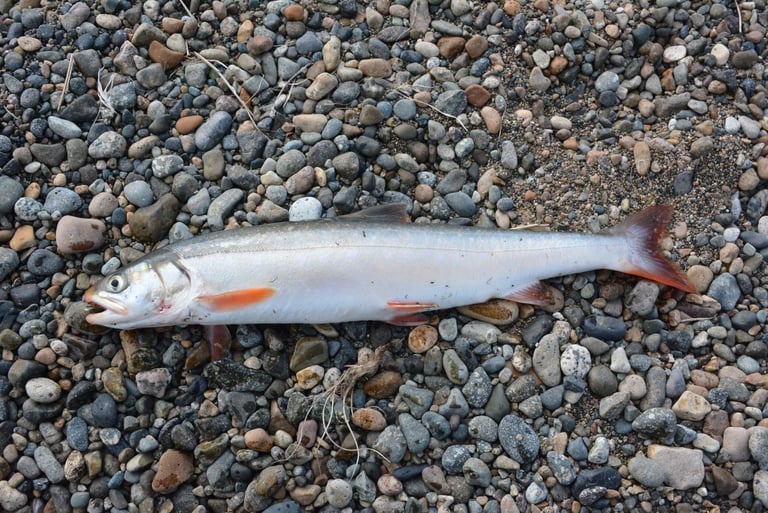
The most useful field mark is the spotting. Dark and red spots appear on the sides of the body but do not extend to the tail, and the caudal fin is deltaform, without the fork seen in the Atlantic salmon.
The brown trout has a slender body and a long, narrow head with a large mouth. Zig-zag rows of vomerine teeth sit on the roof of the mouth. Adults can grow to 20 kg (44 lb) or more and reach about 100 cm (39 in) in some localities, although in many smaller rivers a mature weight of 1.0 kg (2.2 lb) or less is common.
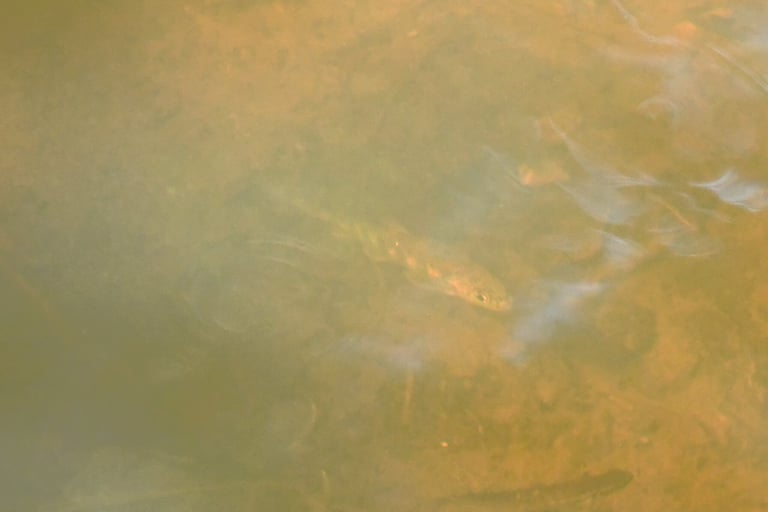
Color varies widely. Some freshwater fish are largely silver with few spots and a white belly, while others show a brassy reddish-brown cast that fades to creamy white on the belly, with medium-sized spots surrounded by lighter halos. Silver forms can be mistaken for rainbow trout.
Juvenile parr often have a red margin on the adipose fin and dark blotches along their sides, and these fade with age. Regional strains differ too. The 'Loch Leven' trout has larger fins, a slimmer body and heavy black spotting but no red spots, while the continental European strain has a lighter golden cast, some red spotting and fewer dark spots.
Distribution and Habitat
The native range extends from northern Norway and White Sea tributaries in Russia in the Arctic Ocean to the Atlas Mountains in North Africa. Iceland marks the western limit in the North Atlantic, and Aral Sea tributaries in Afghanistan and Pakistan mark the eastern limit.
The species prefers well-oxygenated streams and rivers with moderate to low currents, although it also lives in lakes. Parr feed in shallow water less than 30 cm deep and hold in currents of 20 to 50 cm/s, while larger adults occupy slow water nearer the middle of the channel. Rocky bottoms that provide cover are preferred, but gravel, sand, silt and mud are also used.
Brown trout have been introduced across North and South America, Australasia, Asia, and South and East Africa. The first introduction was to Australia in 1864, when 300 of 1500 eggs from the River Itchen survived a four-month voyage from Falmouth, Cornwall to Melbourne. In the United States, the first release followed in April 1884 into the Baldwin River in Michigan.
In presence observations, the species appears most often in September.

Behavior and Lifestyle
Brown trout are mobile. Many fish migrate from their home stream to lakes or the ocean where access allows, then return to their birth stream to spawn. Others, called residents, never leave their home stream.
Males defend personal territories year round. Territory size grows with body length and mass, and it also depends on rank in the hierarchy. Young fry establish territories too, once they emerge from the gravel redd into the open riverbed.
During the spawning season, males fight for the right to mate. They quiver side by side, charge with open mouths, ram one another and bite at fins to show dominance. A defeated male is chased for a few seconds to confirm the winner.
Dominant fish feed at the most productive times of day, such as dusk and early night, while subordinate fish feed at other times. The species is active both by day and by night.
Communication
Chemical signals play a major part in spawning. Once females ovulate, they release sex pheromones that prompt males to move further upstream, grow more aggressive and increase milt production.
Males also show a visual signal. A hooked upward projection called a kype develops on the lower jaw and announces to females and rival males that a male is ready to breed.
Like other fish, brown trout sense changes in water currents, vibrations and pressure through their lateral lines. This helps them find food and detect nearby predators.
Hunting and Diet
Brown trout hunt by sight, as opportunistic feeders with specialized habits. They often rise to the surface to snatch low-flying terrestrial insects, and they feed most actively at dusk, when insects are most active.
Smaller and younger trout feed near the surface or along the shoreline, while larger trout range farther through the river. Dominant fish may specialize in slow riffles near the surface or in fast water near mid-column.
Insect larvae, pupae, nymphs and adults make up the bulk of the diet. Stream and lake prey includes the larvae of caddisflies, mayflies, stoneflies, true flies and beetles, along with crustaceans and zooplankton. Fish such as the three-spined stickleback and eels are among the main fish eaten.
As trout grow, they become increasingly piscivorous, taking small suckers, minnows, sculpins and darters. Piscivorous trout in rivers also eat trout eggs in autumn and early winter.
Reproduction and Life Cycle
Brown trout mate from autumn into winter. Both sexes choose partners, but males compete intensely. In a study of 14 females and two males, females chose a nest site closest to the male with the larger adipose fin in 74 percent of trials, yet male competition overrode the female's choice in 57 percent of cases.
Sexual maturity varies. Resident freshwater trout mature between 1 and 10 years of age, while anadromous fish mature at sea and return the following season to spawn, or they may remain at sea for 2 to 3 years before returning. Every brown trout returns to its natal stream to mate.
Females dig redds in gravel or stony riverbeds, with larger females digging deeper in coarser material. A female lays between 300 and 1500 eggs across a series of nests, and the male fertilizes them externally. She then buries the eggs with stones or gravel.
Eggs take 1 to 6 months to hatch. After spawning, the female leaves and gives no further care, and males do not care for the eggs either. A male guards eggs only when they fall inside his territory. The young face a gradual habitat shift from the gravel redd into open riverbed as they feed.
Population and Ecological Role
Brown trout are established across much of the world, and in many introduced countries they now sustain self-sustaining wild populations. Their adaptability is a major reason most introductions succeeded.
In small streams, brown trout are important predators of macroinvertebrates, so declines there affect the whole aquatic food web. In introduced ecosystems, they reduce invertebrates that eat algae, which increases algal biomass and changes algal species and nutrient cycling. Native salmonids, invertebrates and amphibians have declined in places where brown trout spread.
Brown trout are eaten by pike, herons, mergansers, kingfishers and other fish-eating species, including Atlantic salmon and eels. Their parasites include flatworms, thorny-headed worms, leeches and the protozoan Myxobolus cerebralis, which causes whirling disease. That disease damages cartilage, giving infected fish a blackened tail and spinal or cranial deformities, and young trout are most susceptible.
Conservation and Threats
The IUCN lists the brown trout as Least Concern, so it is not in danger of extinction. It is still managed heavily across the world, including in the United States, where stocking and harvest limits are common.
Some individual stocks are under stress, mainly from habitat degradation, overfishing and artificial propagation that leads to introgression. Warm summer water holds less dissolved oxygen, which can cause summer kills when temperatures stay high and cooler, deeper or fast, oxygenated water is out of reach. Eutrophication from agricultural fertilizer runoff can make these stresses worse.
Overfishing removes mature females, and each large female lost can mean thousands fewer eggs released when the remaining fish spawn. Climate change is also a concern. Cover such as submerged rocks, logs and overhanging vegetation protects trout from predators, bright sunlight and high temperatures.
Cultural Significance
The brown trout has long been a prized game fish in Europe. The Roman author Aelian, writing around 200 AD in On the Nature of Animals, described speckled fish that many historians credit as the first account of fly fishing for trout, specifically brown trout in Macedonia.
The Treatyse of Fysshynge with an Angle (1496) by Dame Juliana Berners treats the brown trout of English rivers and streams as a key fish, and Izaak Walton's The Compleat Angler (1653) praises it as a generous fish. Angling writers through the 17th, 18th and 19th centuries wrote mostly about brown trout.
Today, fisheries agencies use the species as an indicator and monitor. Declines in its populations signal pollution, and it is sensitive to heavy metals such as copper, lead and cadmium. In Florida, anglers spent nearly $5 billion on fishing in 2011, and the brown trout remains a major draw for sport fishing in many countries, including a specialized fly fishery in Bhutan.
Photos
Photographs from via iNaturalist, licensed under CC0 1.0., by Peter Crowcroft via iNaturalist, licensed under CC BY 4.0., by Nicola Crockford via iNaturalist, licensed under CC BY 4.0., by Justin Schoon via iNaturalist, licensed under CC BY 4.0., by Kagan Vainisi via iNaturalist, licensed under CC BY 4.0., by Henry Miller via iNaturalist, licensed under CC BY 4.0., by mnauky via iNaturalist, licensed under CC BY 4.0., by euqirneto via iNaturalist, licensed under CC BY 4.0., by Amit Naik via iNaturalist, licensed under CC BY 4.0., by Demian Hiß via iNaturalist, licensed under CC BY 4.0., by Susan Murphy via iNaturalist, licensed under CC BY 4.0., by le0p0ld_d via iNaturalist, licensed under CC BY 4.0., by Gergely Nigg via iNaturalist, licensed under CC BY 4.0., and by Michel Frisch via iNaturalist, licensed under CC BY 4.0., credited on each photo.
Ecology and classification
Classification
- Phylum
- Chordata
- Order
- Salmoniformes
- Family
- Salmonidae
- Genus
- Salmo
- Species
- Salmo trutta
Sources
- GBIF Species names and classification
- iNaturalist Photos
- Wikidata Common names and conservation status
- Wikipedia Summary extract
- Encyclopedia of Life Habitat, diet and behavior traits
- Animal Diversity Web Animal habitat, behavior and diet
- AnAge Longevity
- GloBI What it eats, what eats it, parasites and pollinators
- trophiCH
- Wardeh et al. 2015 (EID2)