Beneath the bark of an infected tree, threads of Armillaria mellea mycelium glow faintly in the dark, a phenomenon foresters have long called foxfire. The light comes from active growth in the fungus's underground network, not from the mushrooms themselves.
Known by the common name honey fungus, Armillaria mellea is a basidiomycete in the family Physalacriaceae, order Agaricales. It behaves as a plant pathogen, causing Armillaria root rot across a wide range of broadleaf trees, and belongs to a cryptic species complex whose members are difficult to tell apart by appearance alone.
Found throughout the northern temperate zones, it lives a double life: destructive parasite underground, and a clustered crop of honey-colored mushrooms above ground each autumn. That combination of hidden menace and visible fruiting makes it one of the more consequential fungi a forest or garden can host.
Fruiting Body and Identification
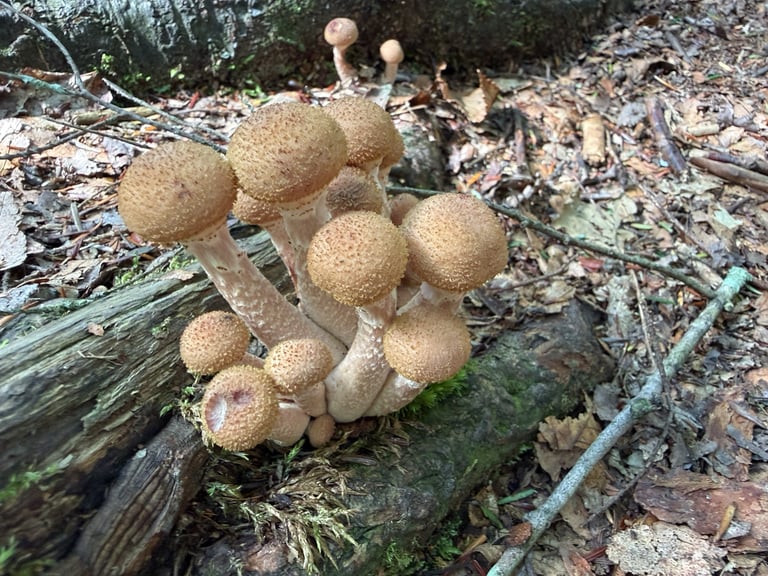
The most reliable field mark is the honey-colored cap, 3 to 15 centimeters across, smooth and sticky when wet, sometimes scattered with a few dark, hairy scales arranged in loose rings near the center. Young caps are convex; with age they flatten, often developing a raised central bump, and the margin arches upward as the mushroom matures into a shallow, dish-like shape.
The gills beneath start white and may turn pinkish-yellow or discolored as the mushroom ages. They are broad, fairly widely spaced, and meet the stem at a right angle or run slightly down it. The flesh is whitish with a sweetish smell and taste that carries a faint bitterness. The stipe runs 5 to 20 centimeters long and 0.5 to 3.5 centimeters thick, firm and spongy at first before becoming hollow, whitish above and brownish-yellow below with a notably dark base where clustered stems fuse together. A broad, persistent, skin-like ring with a velvety, yellow-fluffed underside sits on the upper stem, the remnant of a partial veil that once shielded the young gills.
Under magnification, the spores are roughly elliptical, 6 to 9 by 5 to 7 micrometers, non-amyloid, with a small pointed projection at the base; the spore print is white. Below ground, the fungus spreads through a mat of mycelial threads bundled into black rhizomorphs that can extend for great distances in search of new hosts. Within the species complex, close relatives can be distinguished by cap color and hue: Armillaria gemina lacks the yellow cap background, while Armillaria nabsnona is noticeably darker.
Distribution and Habitat
Armillaria mellea is widespread across the northern temperate zones, occurring throughout North America, Europe, and northern Asia, and it has also been introduced to South Africa. It grows parasitically on a large number of broadleaf trees and fruits in dense clusters at the base of trunks and stumps.
Monthly observation counts show a sharp rise from a low base in spring and summer to a pronounced peak in September and October, before tapering off through winter. This pattern lines up with the species' known autumn fruiting season rather than indicating a true measure of abundance, since mushrooms are only visible above ground for a short window each year while the fungus itself persists year-round underground.

Ecology and Relationships
Armillaria mellea favors moist soil and cooler soil temperatures, with growth inhibited once soil temperatures exceed about 26°C (79°F); its underground position lets it survive disturbances as severe as forest fires. It turns up in a wide range of settings, from gardens, parks, and vineyards to tree plantations and natural forest.
The fungus infects hardwoods, conifers, and even some herbaceous plants, spreading mainly through black rhizomorphs that can grow up to a meter per year through soil in search of living roots, with infection by wind-dispersed basidiospores much rarer. Once rhizomorphs reach a host, mycelium grows across root surfaces and invades between bark and wood, destroying the vascular cambium and causing decay, growth reduction, dieback, and eventual death; stressed trees are especially vulnerable, though healthy ones can be attacked too. Signs are often subtle: honey-colored mushrooms appear only briefly and inconsistently, while white fan-shaped mycelial mats and black rhizomorphs 0.8 to 3.2 millimeters wide, hidden beneath bark and in soil, are more reliable evidence of infection.
The fungus overwinters as rhizomorphs or vegetative mycelium and is counted among the most common causes of death in trees and shrubs in both wild and cultivated landscapes. It also supports other organisms in a small way: adult pleasing fungus beetles, including Tritoma biguttata biguttata, Tritoma atriventris, and related species, occasionally feed on it.
Uses and Cultural History
Beyond its cost to forestry and agriculture, people have put Armillaria mellea to deliberate use. Since 1994, growers have cultivated its mycelium on inoculated wood to support cultivation of Gastrodia elata, a non-photosynthetic orchid used in traditional Chinese medicine; by 2017 farmers in Heilongjiang had also succeeded in producing Armillaria fruiting bodies directly, using either wood pieces or bagged media, and by 2019 spent myceliated wood from the orchid operation was routinely repurposed to seed new mushroom crops.
As food, it is considered a good edible mushroom, though some foragers avoid the tough stalks and specimens grown on buckeye or hemlock, which can cause gastrointestinal upset. Collected young and cooked thoroughly, the mushrooms taste slightly sweet and nutty; parboiling removes bitterness from some specimens, and they can also be dried, pickled, or roasted. Nutritionally, the fruit body is rich in protein and carbohydrates, including polysaccharides, sugars, and sugar alcohols, but low in fat, and its high fiber content has been noted as potentially useful for managing diabetes and obesity. Indigenous peoples are also recorded to have used the mushrooms medicinally as a laxative.
Culturally, the fungus carries symbolic weight in some regions, where it is seen as a sign of good fortune and longevity, its cycle of decay and renewal echoed in literature, painting, and sculpture.
Fun Facts
- In Eastern European folk belief, the rings formed by honey fungus mushrooms were sometimes seen as portals to the spirit world.
- The species was documented as early as 1866, when it was first studied for the economic damage it causes to trees.
- Its mycelium doubles as food for other organisms: adult pleasing fungus beetles occasionally eat it.
- Despite its destructive habits underground, the mushroom itself is prized enough in some cultures to symbolize good fortune and long life.
Ecology
Habitat
- Forest
- Woodland
- Urban
- Disturbed Ground