A single colony of this fungus growing in the Malheur National Forest of eastern Oregon spans roughly 3.5 square miles (2,200 acres), is estimated at around 8,000 years old, and may weigh as much as 35,000 tons — making it one of the largest known organisms on Earth.
Armillaria ostoyae is a pathogenic fungus in the family Physalacriaceae, identified by decurrent gills, a ringed stipe, and mycelium that invades the sapwood of trees. It spreads underground and beneath bark through black cord-like structures called rhizomorphs, or "shoestrings," reaching between trees over great distances. It favors cooler parts of the Northern Hemisphere, particularly conifer forests.
Beyond its record-setting size, the species matters as a working part of the forest: a slow-moving, centuries-old organism that shapes the fate of the trees around it.
Fruiting Body and Identification
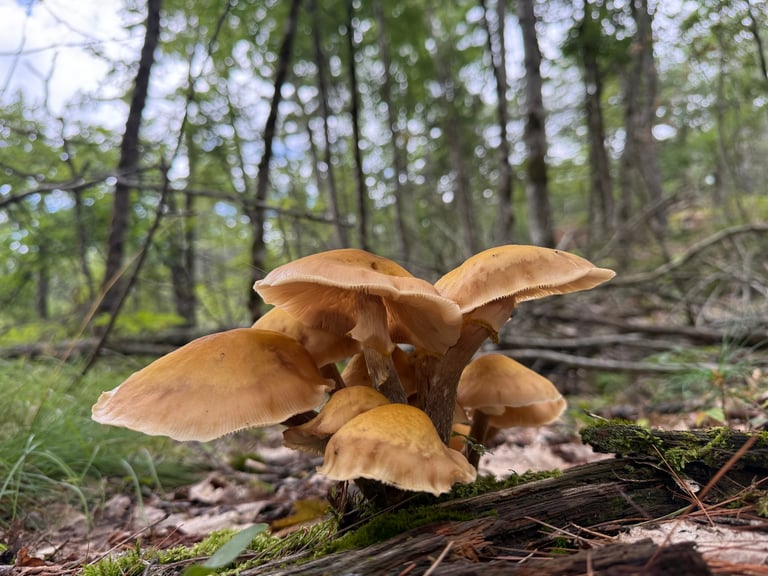
The clearest identifying features in North America are its cream-brown cap tones, prominent cap scales, and a well-developed ring on the stipe — traits that separate it from other Armillaria species growing nearby. The gills are wide, thin, and run decurrently down the stem, producing a white spore print.
Like other parasitic fungi, it reproduces sexually: spores released from a mature mushroom carry one of two mating types, and only spores of the same species but complementary mating type will fuse. Once joined, the resulting colony darkens and flattens, then produces the mycelial cords known as rhizomorphs. These shoestring-like structures let the fungus draw nutrients across distances and are central to its ability to infect new hosts.
The mycelium of A. ostoyae can glow in the dark, a phenomenon known as foxfire, a trait it shares with several other Armillaria species.
Distribution and Habitat
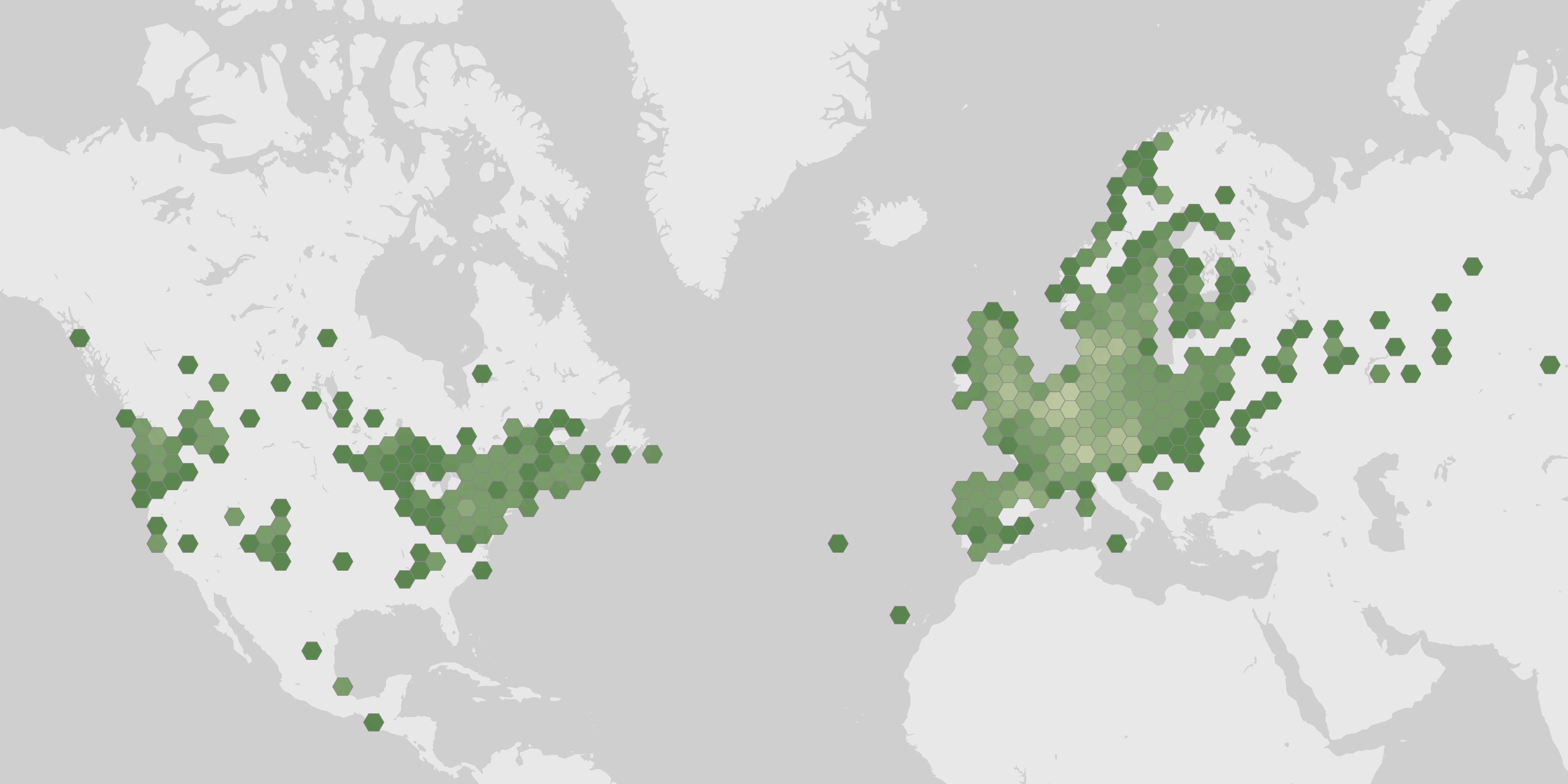
The species is most common in cooler regions of the Northern Hemisphere. In North America it grows on coniferous hosts through the forests of British Columbia and the Pacific Northwest, and it is also present in parts of Asia. Within British Columbia it turns up across multiple biogeoclimatic zones, but causes the most serious root disease in the Interior Cedar Hemlock zone of the interior, while also occurring, less severely, along the coast.
GBIF presence records show observations rising sharply from a low base in spring and summer to a pronounced peak in October, with September and November also elevated before counts fall away by December. This pattern most likely tracks the fall fruiting season of the mushrooms rather than any change in the underlying fungal population, since these figures record sightings, not abundance or the full extent of the species' range.
Ecology and Relationships
This fungus is a significant pathogen of commercial softwoods, including Douglas-fir, true firs, pines, and western hemlock, infecting hosts mainly through rhizomorph strands. Susceptibility shifts with tree age: conifers ten years old or younger face the highest risk of dying from infection, while trees that reach 20 years old rarely succumb, though mortality still occurs in drier climates.
The disease behaves differently by region — pathogenicity is more frequent in interior stands, yet virulence is greater near the coast, where mortality is lower but infection rates can be worse. Infected trees show telltale signs: resin flowing from the base, thinning or discolored crowns, a stress crop of cones, white mycelial fans under the bark, black rhizomorphs penetrating the roots, and honey-colored mushrooms appearing at the base in fall.
Forest managers respond by clear-cutting infected stands and replanting with more resistant species such as western redcedar or deciduous trees, or by physically removing infected stumps so exposure to air kills the fungus. The fungus can stay viable in stumps for up to 50 years, and chemical treatments neither eradicate it nor prove cost-effective. Early experiments suggest another fungus, Hypholoma fasciculare, may competitively exclude A. ostoyae, though this remains under study.
Uses and Cultural History
Historical evidence for cultural, medicinal, or culinary use of this fungus is sparse. Traditional communities appear to have largely avoided it, likely due to its reputation for toxicity or because more desirable mushroom species were preferred instead.
Where it has entered local food traditions, it is treated as a choice edible and has featured in regional feasts and traditional recipes. Even so, foragers are cautioned that it can be confused with non-edible species, underscoring the need for careful identification before any mushroom from this group is eaten.
Fun Facts
- The Malheur National Forest colony may weigh as much as 35,000 tons, built up over an estimated 8,000 years of growth.
- By area, it is rivaled only by a colony of the seagrass Posidonia australis found on the Australian seabed.
- In terms of living biomass, it is considered a rival to the aspen grove known as Pando.
- A related "humongous fungus," a specimen of Armillaria gallica near Crystal Falls, Michigan, covers about 91 acres and is thought to have originated from a parent fungus in Ontario.
- The fungus can remain alive inside tree stumps for as long as 50 years after the tree has died.
Ecology
Habitat
- Forest
- Mountain