The pinecone cap (Strobilurus tenacellus) is best known not for its appearance but for its chemistry: it produces compounds called strobilurins that suppress the growth of other fungi, and synthetic derivatives of these compounds are now among the most important classes of agricultural fungicides worldwide.
This small agaric belongs to the family Physalacriaceae and grows across Europe and Asia on fallen pine and spruce cones. Beyond its role in fungicide chemistry, it offers an example of how an easily overlooked woodland species can have an outsized influence on agriculture.
Fruiting Body and Identification
The most distinctive identifying trait of Strobilurus tenacellus is its habit of fruiting directly from fallen conifer cones, anchored by a root-like pseudorrhiza that extends into the cone and substrate below.
The cap starts convex and flattens with age, sometimes keeping a small central bump or developing a shallow depression, and reaches 5–15 mm across. It is hygrophanous, shifting from reddish to brownish when moist to a faded greyish when dry, and shows shallow radial grooves reaching about halfway up the cap, often paler at the center than the margin. The gills are greyish-white, free to deeply notched at the cap, moderately crowded, numbering 20 to 25 with several tiers of shorter interspersed gills.
The stipe is thin and cylindrical, 4–7.5 cm long and just 0.5–2 mm thick, yellowish brown above and darker orange-brown to reddish brown toward the base, where it tapers into the pseudorrhiza. The flesh is odorless and usually tastes bitter. Microscopically, the mushroom is marked by sharp, thin-walled cystidia on the stipe, gills, and cap, elliptical to tear-shaped spores measuring 5.0–7.5 by 2.4–4.0 μm, and a white spore print; its hyphae lack clamp connections.
Distribution and Habitat
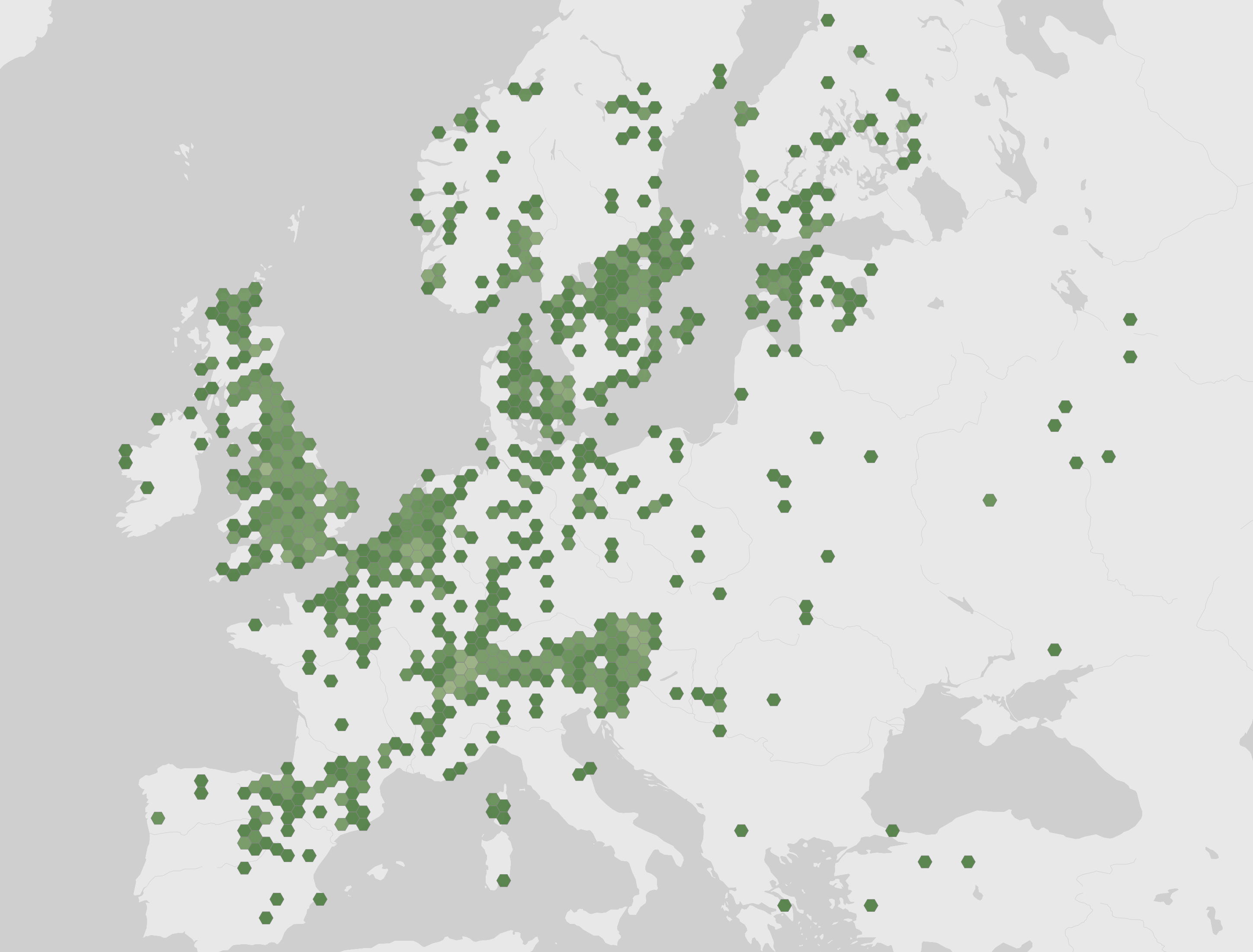
Strobilurus tenacellus occurs across Europe and Asia, with records extending to Japan and Jordan, and is generally described as occurring only occasionally rather than commonly. It grows as a saprobe, breaking down fallen and often partially buried cones of Scots pine (Pinus sylvestris) and European black pine (Pinus nigra), and occasionally spruce (Picea), within coniferous and mixed forests.
In Europe the species typically fruits from March to June, and observation data compiled for the species show a pronounced rise in records through spring, peaking around April and May before tapering off through summer, consistent with this reported fruiting window. These figures reflect only recorded sightings rather than actual abundance or the fungus's full range.
Uses and Cultural History
Although fruit bodies of Strobilurus tenacellus are sometimes described as edible, they are too small to be of any culinary interest, so the species has no meaningful history as a food source. It does not appear in ethnomycological writing and holds no documented place in traditional plant-medicine systems, rituals, symbolism, or food traditions.
Its practical significance lies instead in chemistry rather than culture: the species produces strobilurins, compounds that suppress the growth and development of other fungi. Derivatives of these natural compounds have gone on to form an important class of agricultural fungicides, giving this otherwise obscure woodland mushroom an indirect but substantial role in modern agriculture.
Fun Facts
- Laboratory studies have found that methanol-based extracts of Strobilurus tenacellus fruit bodies show antimicrobial activity when tested with standard susceptibility methods.
- Two cyathane-like diterpenoid compounds isolated from liquid cultures of the fungus have been shown to inhibit the growth of certain tumor cells in vitro.
- The species has been known under several older scientific names, including Marasmius esculentus var. tenacellus and Pseudohiatula esculenta subsp. tenacella.
Photos
Photographs from via iNaturalist, licensed under CC0 1.0., by Manuela Fiorini via iNaturalist, licensed under CC BY 4.0., by Michel Langeveld via iNaturalist, licensed under CC BY 4.0., by Anita Engler via iNaturalist, licensed under CC BY 4.0., by Umut Nuri Erdoğan via iNaturalist, licensed under CC BY 4.0., by Patrick Bayan via iNaturalist, licensed under CC BY 4.0., by Hayley Fulker via iNaturalist, licensed under CC BY 4.0., by victor laborde via iNaturalist, licensed under CC BY 4.0., and by fabrizio_mariani_montesorbo via iNaturalist, licensed under CC BY 4.0., credited on each photo.
Ecology and classification
Classification
- Phylum
- Basidiomycota
- Class
- Agaricomycetes
- Order
- Agaricales
- Family
- Physalacriaceae
- Genus
- Strobilurus
- Species
- Strobilurus tenacellus
Sources
- GBIF Species names and classification
- iNaturalist Photos
- Wikidata Common names and conservation status
- Wikipedia Summary extract