Few plants carry as many folk names as Asclepias syriaca—common milkweed, butterfly flower, silkweed, silky swallow-wort, and Virginia silkweed—each reflecting generations of familiarity with it across eastern North America.
This flowering plant belongs to the family Apocynaceae and is native to southern Canada and much of the United States east of the Rocky Mountains, though it avoids the driest parts of the prairies. It favors sandy soils as well as many other soil types, as long as the site is sunny.
Beyond its ecological weight, its milky latex, tough bast fiber, and long tangle of folklore have made it a plant that keeps turning up in conservation programs, craft traditions, and kitchen experiments alike.
Identification and Appearance
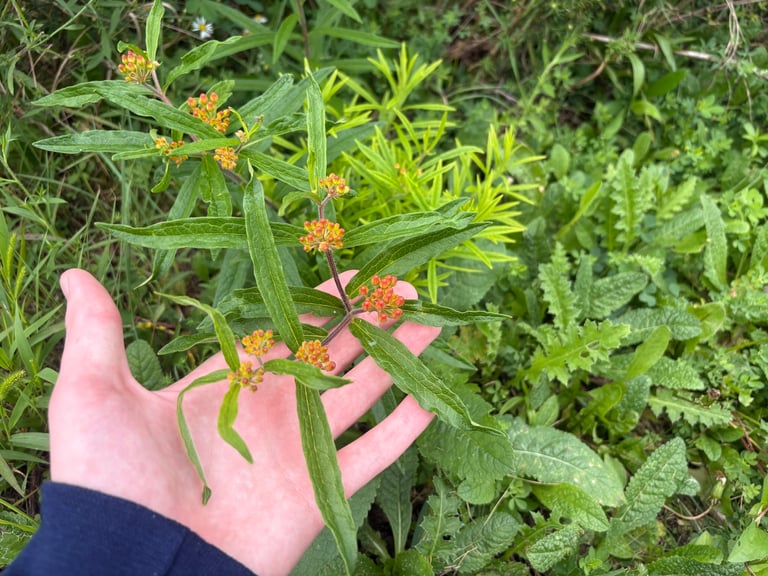
The clearest way to recognize common milkweed is the combination of broad, opposite leaves with reddish main veins and dense, ball-like clusters of fragrant pink to purplish flowers, each ringed by five small, horn-like hoods. Cut any part of the plant and it leaks a milky white latex, the trait that gives all milkweeds their name.
A clonal perennial forb, it typically grows 3 to 5 feet (0.91 to 1.52 m) tall, though plants in ditches and gardens can reach 8 feet (2.4 m). The simple leaves are broadly ovate-lanceolate, 1.5 to 4.75 inches (3.8 to 12.1 cm) wide, usually with entire, undulate margins, short petioles, and velvety undersides; they are sometimes arranged in whorls rather than strictly opposite pairs.
Flowers form in umbellate cymes and are highly fragrant and nectar-rich. Individual flowers measure about 1 cm (0.4 in) across, each with five horn-like hoods and five pollinia rather than loose pollen grains, a structure typical of the milkweed family.
Fertilized flowers develop into large, warty follicles packed with seeds, each seed trailing long, white, silky floss. Fruit set from self-fertilization is rare; in three study plots, outcrossed flowers averaged only about 11% fruit set, a sign of the plant's reliance on cross-pollination between separate individuals.
Distribution and Habitat
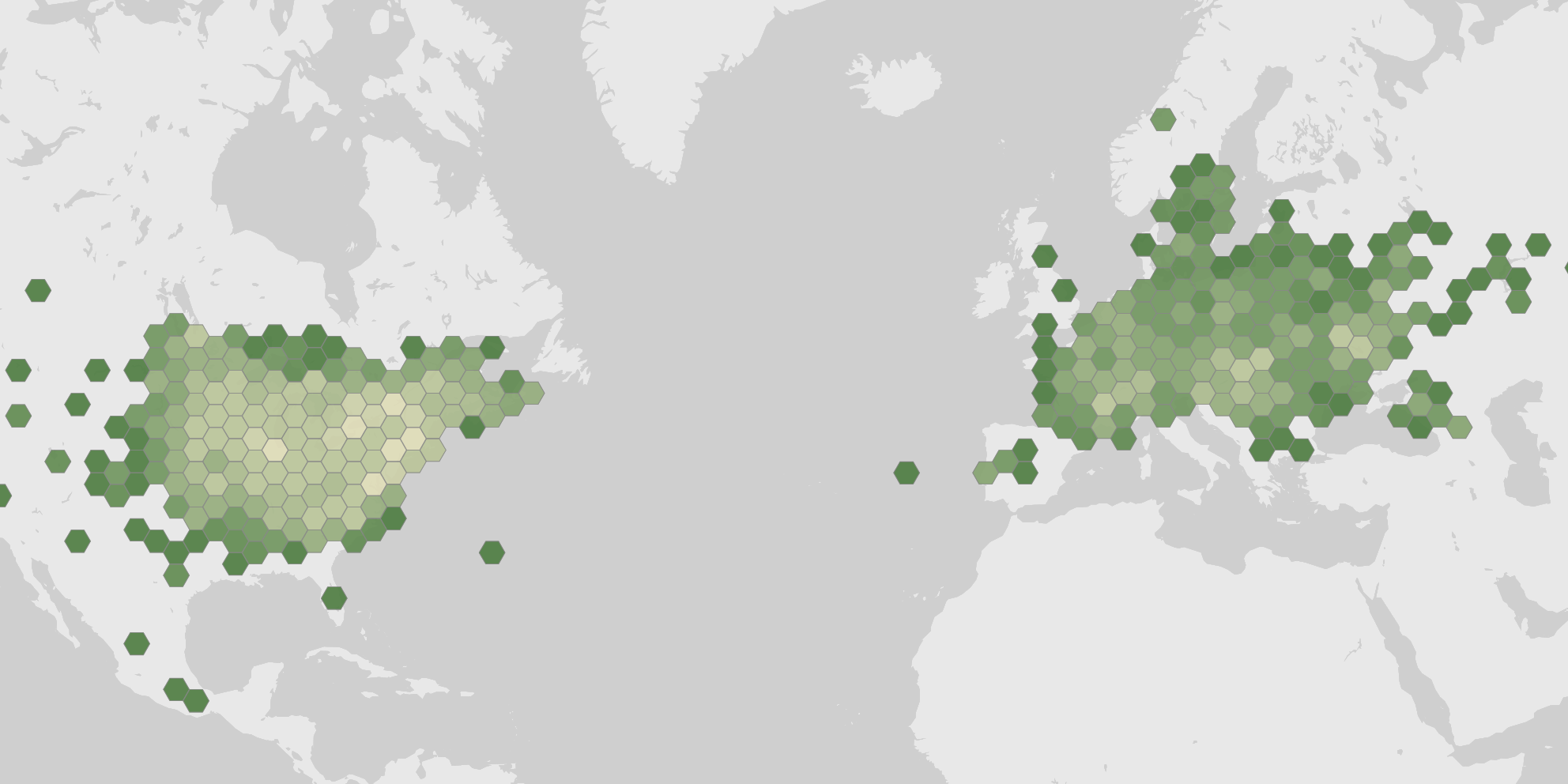
Asclepias syriaca is native to southern Canada and much of the United States east of the Rocky Mountains, avoiding only the driest prairie country.
Observation records show a strong seasonal pattern: monthly counts stay low through winter and early spring, then climb sharply from May onward, peaking in June at over 40,000 recorded observations before tapering through the fall. This pattern likely tracks when the plant is flowering and easiest to spot rather than any change in how much of it exists, since these figures are presence records, not counts of abundance or a full survey of its range.
By late autumn and winter, observations fall back to a few hundred to just over a thousand per month, consistent with the plant dying back to its roots for the dormant season in temperate climates.
Ecology and Relationships
More than 450 insect species feed on common milkweed, including flies, beetles, ants, bees, wasps, and butterflies, among them the red milkweed beetle (Tetraopes tetraophthalmus), the milkweed tussock caterpillar (Euchaetes egle), and both the large and small milkweed bugs (Oncopeltus fasciatus and Lygaeus kalmii); the nonnative oleander aphid (Aphis nerii) can also build up dense colonies on its shoots. Most significantly, it is one of only three milkweed species the eastern monarch butterfly (Danaus plexippus) migration largely depends on, and cardenolide fingerprinting has shown that 85 to 92% of monarchs overwintering in Mexico fed on this species as caterpillars. A 2024 pollinator guide from the U.S. National Capital Planning Commission singled it out as "clearly an important species that is critical to the survival of monarch butterflies," despite more than 100 native milkweed species existing across North America.
Pollination is handled by a range of visiting insects, including the Western honey bee (Apis mellifera) and native Bombus bumblebees. In the mid-Atlantic United States, honey bees visit flowers most often, but because common milkweed has a high level of self-incompatibility, they are less effective pollinators than bumblebees, which are more likely to move between unrelated plants rather than lingering on a single one.
The plant's fortunes and the monarch's are closely tied together: the spread of herbicide-resistant corn and soybean crops has sharply reduced milkweed cover across the U.S. Midwest, and the National Wildlife Federation's CEO cited this loss as a factor in a 90% decline in monarch numbers over 20 years reported in 2018. Ironically, deforestation and human settlement may have expanded the plant's range and density in some regions even as agricultural weed control has cut it back elsewhere. It has since naturalized in at least 23 countries, including much of Europe and parts of western Asia, and has been listed as an invasive alien species in the European Union since 2017. Over two dozen distinct pathogens affect it, including the phytoplasma bacterium responsible for milkweed yellows disease.
Uses and Human Relationships
People have used common milkweed for centuries, starting with its very name: the genus Asclepias commemorates Asklepios, the Greek god of medicine, and the plant carries a long history of folk-medicinal use, including treatments for warts and lung complaints, echoing the way its relative butterfly weed (A. tuberosa) earned the folk name "pleurisy root."
The plant's latex contains cardiac glycosides in significant quantities, making the leaves and stems of older, tall plants toxic to humans and large animals. Young shoots, young leaves, flower buds, and immature fruits are considered edible raw; the writer Euell Gibbons once described milkweed as bitter and toxic and recommended repeated boiling to remove the bitterness, though he may have confused it with the poisonous, similar-looking common dogbane (Apocynum cannabinum), and some modern foragers regard the bitterness claim as a myth.
Beyond food, the plant has been studied as a source of natural rubber from its latex and as a fiber source from its seed floss and bast (inner bark). The silky seed floss has long served as a mounting background for pinned insects and has been used commercially as coat insulation, while USDA studies in the 1890s and 1940s found its bast fiber comparable in yield to hemp and in quality to flax; Native Americans historically used both the floss and bast fiber for cordage and textiles.
Fun Facts
- The genus name Asclepias honors Asklepios, the Greek god of medicine.
- In Greek mythology, Asclepius was said to be the son of Apollo and Coronis (or, in some versions, Arsinoe), and his daughters—Hygieia, Meditrina, Iaso, Aceso, Aglaea, and Panacea—each personified a different aspect of health and healing.
- Ancient Greek and Roman healing centers called Asclepieia kept live, harmless Aesculapian snakes on site, a tradition tied to the same mythological figure that lends milkweed its scientific name.
- Despite its toxic reputation, several milkweed species have long folk-medicine histories, including use for wart removal and lung ailments.
Ecology
Habitat
- Grassland
- Disturbed Ground
Growth habit
- Herb