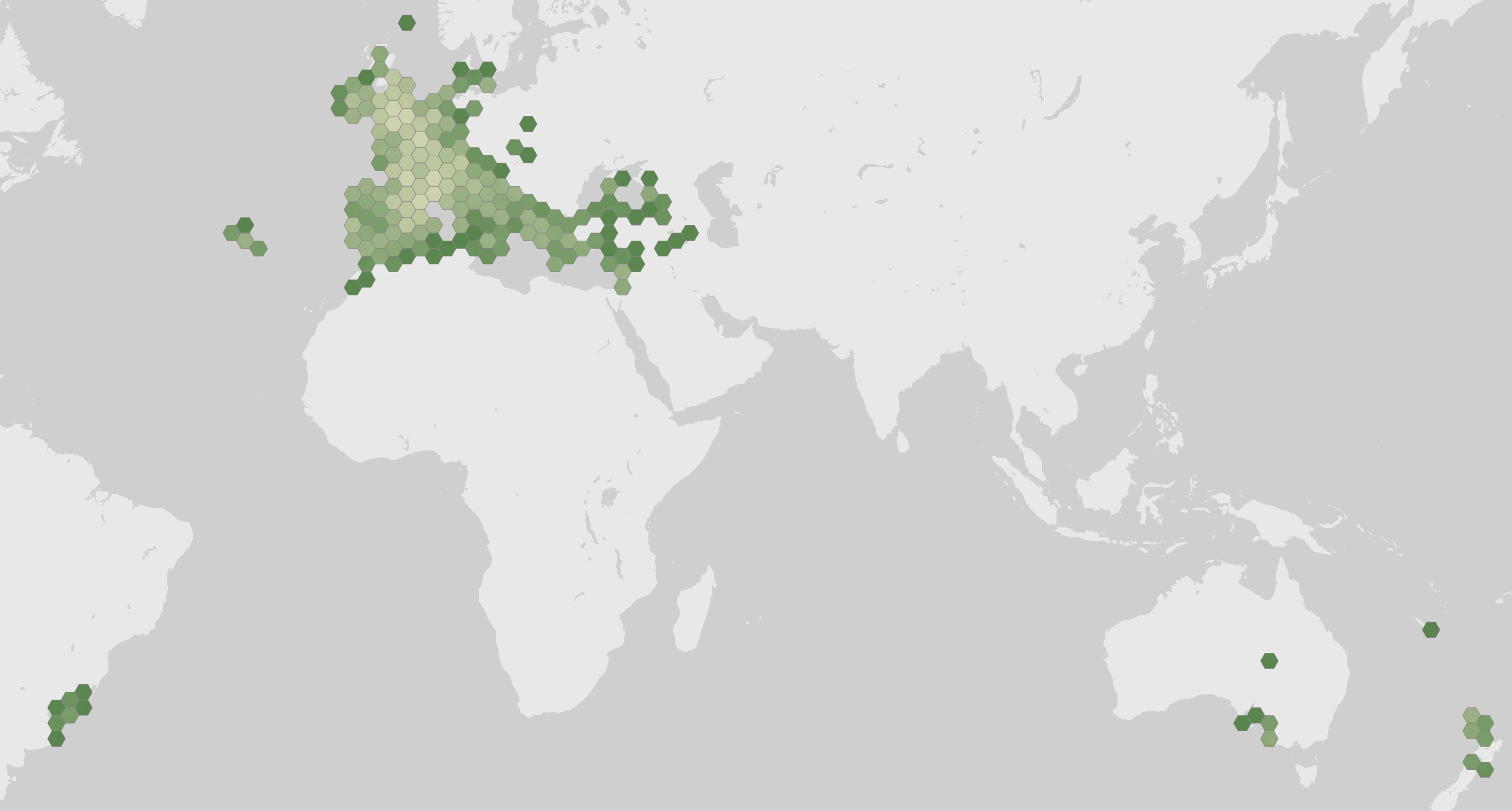
Yellow-wort (Blackstonia perfoliata) is a flowering plant of the gentian family, Gentianaceae. It grows mainly around the Mediterranean Basin and extends into northwestern Europe, including Britain and Ireland.
The plant is found on chalk and limestone turf and on dunes. Outside its native area, it has established in parts of Argentina, Uruguay, the Azores and the North Island of New Zealand.
Identification and Appearance
The most useful field mark is the pair of upper leaves, which are fused at their base so that each pair encircles the stem. The leaves are glaucous, meaning they have a bluish, waxy bloom, and they grow in opposite pairs with smooth edges.
The plant is slender and stiff. Its stems are erect and branch from the upper part, reaching 10–50 cm tall.
The flowers are bright yellow and stalked, borne in terminal clusters called cymes. Each flower measures 1–1.5 cm across. The calyx is divided into 6–10 narrow lobes, which are shorter than the corolla, and the petals number six to ten and form a short tube.
Inside each flower are six to ten stamens joined to the corolla, and a two-lobed stigma.
Distribution and Habitat
Yellow-wort is native from Europe to the Mediterranean and Iraq. Its native range includes Spain, Portugal, France, Italy, Greece, Turkey, Cyprus, Morocco, Algeria, Tunisia, Lebanon and Syria, and parts of central Europe such as Germany, Austria and Hungary. In northwestern Europe it occurs in Great Britain, Ireland, Belgium and the Netherlands.
It grows on chalk and limestone turf, where open grassland supports its low, branching habit. It also grows on coastal dunes.
Observations of the plant cluster in early summer, peaking in June and then in July. Few observations fall in the winter months.
Outside its native range, the plant is established in Argentina's northeast and northwest regions, the Azores, the North Island of New Zealand and Uruguay.
Growth and Form
Yellow-wort is an annual, so each plant completes its life cycle within a single year. It grows as an erect herb with stiff stems that branch, and it reaches 10–50 cm in height.
In Britain, the plant flowers from June to October. Its flowering period is long relative to its single-year life, so the stems keep producing flowers through the summer and into autumn.
Ecology and Relationships
Yellow-wort supports a range of insects. Moths are its main leaf-eating partners, and the moth Stenoptilia zophodactylus is the best-established among them. A second moth, Gynnidomorpha permixtana, feeds on the plant only occasionally.
Its flowers attract insects, especially bees and wasps of the order Hymenoptera. Among these, several sweat bees of the genus Lasioglossum and the bee Halictus tumulorum visit most often, alongside the hoverfly Episyrphus balteatus. Other flies, beetles and bugs visit only occasionally.
The plant is also host to the downy mildew Peronospora chlorae, a pathogen that affects its leaves.
Photos
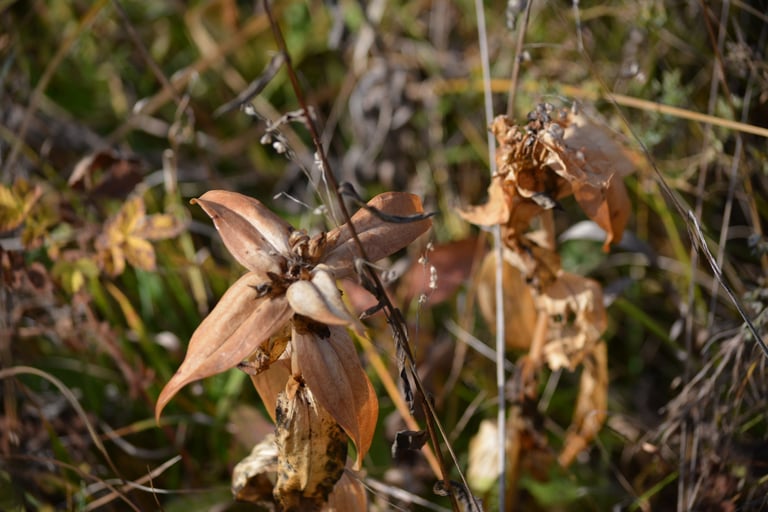
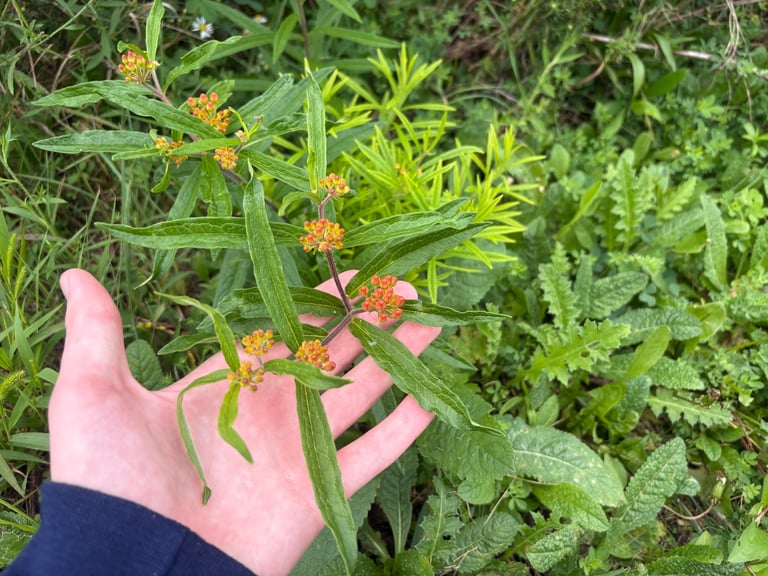
Photographs from via iNaturalist, licensed under CC0 1.0., by Catriona Hays Howson via iNaturalist, licensed under CC BY 4.0., by Jose Gutierrez Higa via iNaturalist, licensed under CC BY 4.0., by Angus Campbell via iNaturalist, licensed under CC BY 4.0., by Albert Rainbow via iNaturalist, licensed under CC BY 4.0., by Michel Langeveld via iNaturalist, licensed under CC BY 4.0., and by guywallbanks via iNaturalist, licensed under CC BY 4.0., credited on each photo.
Ecology and classification
Classification
- Phylum
- Tracheophyta
- Class
- Magnoliopsida
- Order
- Gentianales
- Family
- Gentianaceae
- Genus
- Blackstonia
- Species
- Blackstonia perfoliata
Sources
- GBIF Species names and classification
- iNaturalist Photos
- Wikidata Common names and conservation status
- Wikipedia Summary extract
- Plants of the World Online Native range, life form and climate (WCVP)
- GloBI What it eats, what eats it, parasites and pollinators
- trophiCH
- DoPI
- EuPPollNet