Gentiana lutea holds a special distinction in botany: it is the type species of the entire genus Gentiana, meaning every other gentian in the world is classified in reference to it.
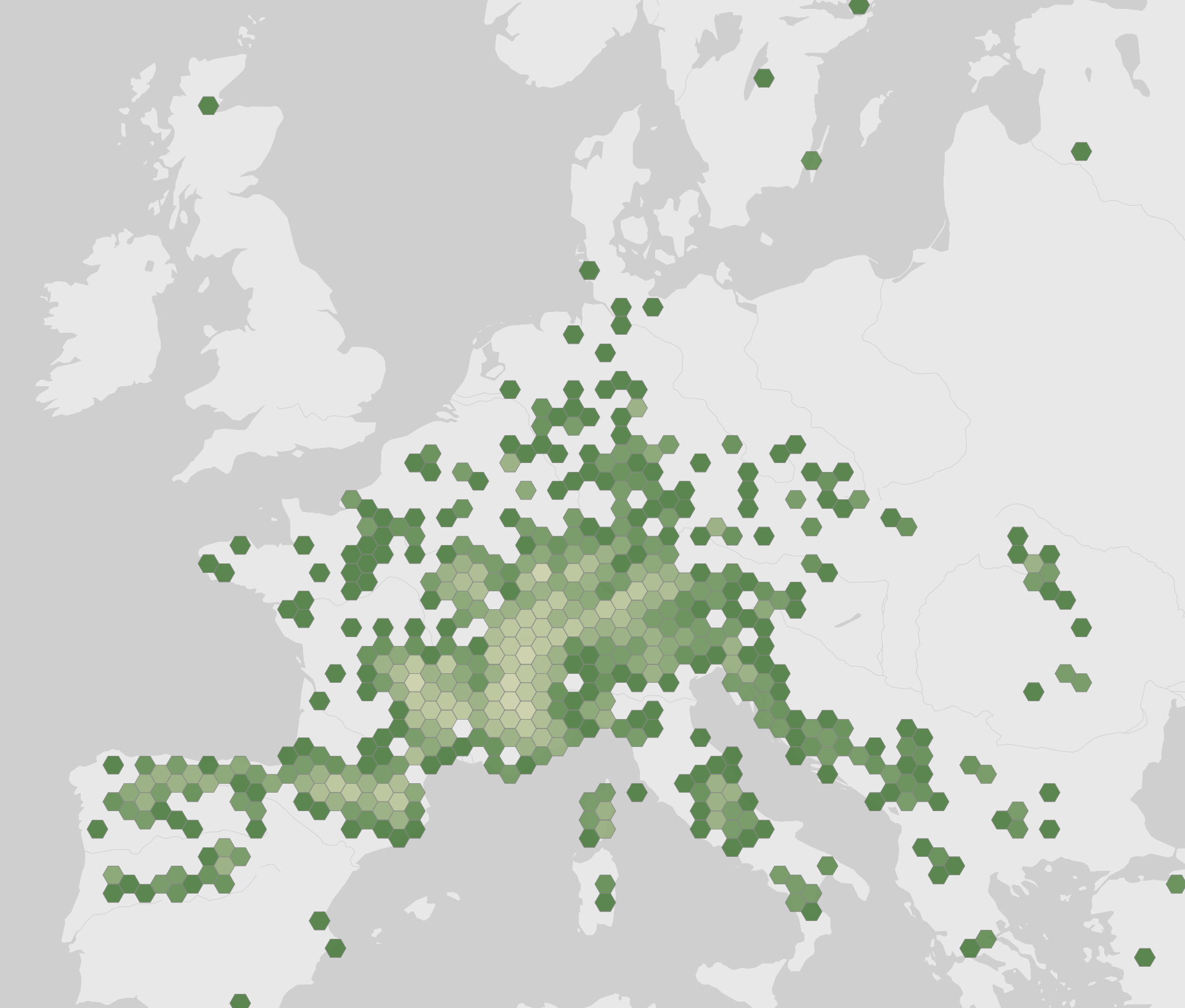
Known as the great yellow gentian, this perennial herb grows across the high mountain ranges of central and southern Europe, including the Alps, the Carpathians, the Pyrenees, the Apennines, and the mountains of the Balkan Peninsula. Its wide distribution across so many separate mountain systems, combined with its towering size among alpine wildflowers, makes it one of the more distinctive plants a hiker can encounter above the treeline.
Identification and Appearance
The clearest field mark is the flower structure: yellow blooms 18 to 24 millimeters long, with the corolla split almost to its base into five to seven narrow, spreading petals. These flowers cluster in whorls of three to ten together near the top of the stem, opening between June and August.
The plant itself is large for an alpine herb, reaching 1 to 2 meters (3.3 to 6.6 feet) in height. Its leaves are broad, ranging from lanceolate to elliptic in shape, glabrous (hairless), and sizable at 10 to 30 centimeters long and 4 to 15 centimeters wide. They grow in opposite pairs along the stem, giving the plant a structured, tiered look quite different from the low mats formed by many smaller gentian species.
No differences between sexes are noted, and the context does not distinguish separate seasonal forms beyond the June-to-August bloom period.
Distribution and Habitat
Gentiana lutea is native to the mountain ranges of central and southern Europe, occurring in the Alps, the Pyrenees, the Apennines, the mountains of the Balkan Peninsula, and the Carpathians, where it is described as scarce. It favors grassy alpine and sub-alpine pastures, typically on calcareous (lime-rich) soils, at elevations reaching up to 2,500 meters.
Monthly observation records show counts rising sharply from May onward, peaking in July at over 39,000 recorded observations, after climbing from around 7,700 in May and 24,600 in June. Counts fall off through August and September and remain low from October through March. This pattern lines up with the plant's June-to-August flowering window, when the tall yellow flower whorls make the plant far easier to spot and record; it should be read as a signal of seasonal visibility rather than a measure of population size or the plant's full range.
Uses and Human Relationships
The root of Gentiana lutea is intensely bitter, a trait shared by nearly every part of the plant's herbage, and this bitterness has defined most of its human uses. The dried underground root and rhizome, typically about 30 centimeters long and 2.5 centimeters thick (though sometimes reaching 90 centimeters), are harvested in autumn and have long served as a herbal bitter, an ingredient in proprietary medicines, and a flavoring in liqueurs such as Salers from the Cantal region and the Limousin specialty Avèze. In the 1860s, gentian root also appeared in veterinary pharmacopeia as a stomachic.
The bitterness itself comes from secoiridoid glycosides, chiefly amarogentin and gentiopicrin. Amarogentin ranks among the most bitter natural compounds known and is used as a scientific reference point for measuring bitterness in general.
Culturally, the plant carries symbolic weight: in the Middle Ages it stood in for the far costlier mandrake in incantations and rituals, and it became associated with power and strength. Its name honors Gentius, an Illyrian king once credited with discovering the herb's tonic properties, and the plant appears on the reverse of the Albanian 2000 lek banknote alongside a portrait of the king on the obverse. Because the species is endangered in some regions despite being secure overall, growers in the Auvergne area now cultivate it rather than harvest it from the wild, and some herbalists suggest the related Centaurium erythraea as a substitute where caution is warranted.
Fun Facts
- In medieval Europe, the plant was used as a cheaper substitute for mandrake in incantations and rituals, and it came to symbolize power and strength.
- Although Gentiana lutea grows across the Alps, Pyrenees, Apennines, and Balkan mountains, it is notably scarce in the Carpathians.
- Its bitter compound amarogentin is so intense that scientists use it as a benchmark for measuring bitterness in other substances.
Ecology
Habitat
- Mountain
- Grassland
Growth habit
- Herb