Vinca major can spread indefinitely along the ground, rooting as it goes until it forms a dense evergreen carpet. This flowering plant of the family Apocynaceae is native to the Mediterranean region, and gardeners know it as the greater periwinkle, bigleaf periwinkle, large periwinkle or blue periwinkle.
Growing up to 25 centimeters (10 inches) tall, it is a perennial that keeps its foliage through the year. Its natural range runs from southern Europe east to the western Caucasus and northeastern Turkey, where it grows in shaded and sunny spots alike.
It is widely planted as a ground cover in temperate gardens, and it has escaped cultivation in many other parts of the world. Its combination of glossy foliage, long flowering season and ability to fill difficult ground makes it a useful plant to know.
Identification and Appearance
The most reliable field mark is the leaf: glossy, dark green, leathery and opposite on the stem, with a fringe of fine hairs along the margin. The leaves are nearly round at the base of the stem and narrow to a point at the tip, measuring 3 to 9 centimeters (about 1 to 3.5 inches) long and 2 to 6 centimeters broad. Each leaf stalk is hairy and 1 to 2 centimeters long.
The flowers grow singly from the leaf joints. Each has five lobes, is violet-purple and measures 3 to 5 centimeters across. The green calyx at the base of each flower is 10 to 17 millimeters long and has hairy edges. Flowers appear from early spring into autumn.
The plant is trailing and vine-like, so it is usually recognized by its low, spreading habit rather than by an upright form. Its close relative Vinca minor is similar but smaller, with narrower leaves that are hairless.
Distribution and Habitat
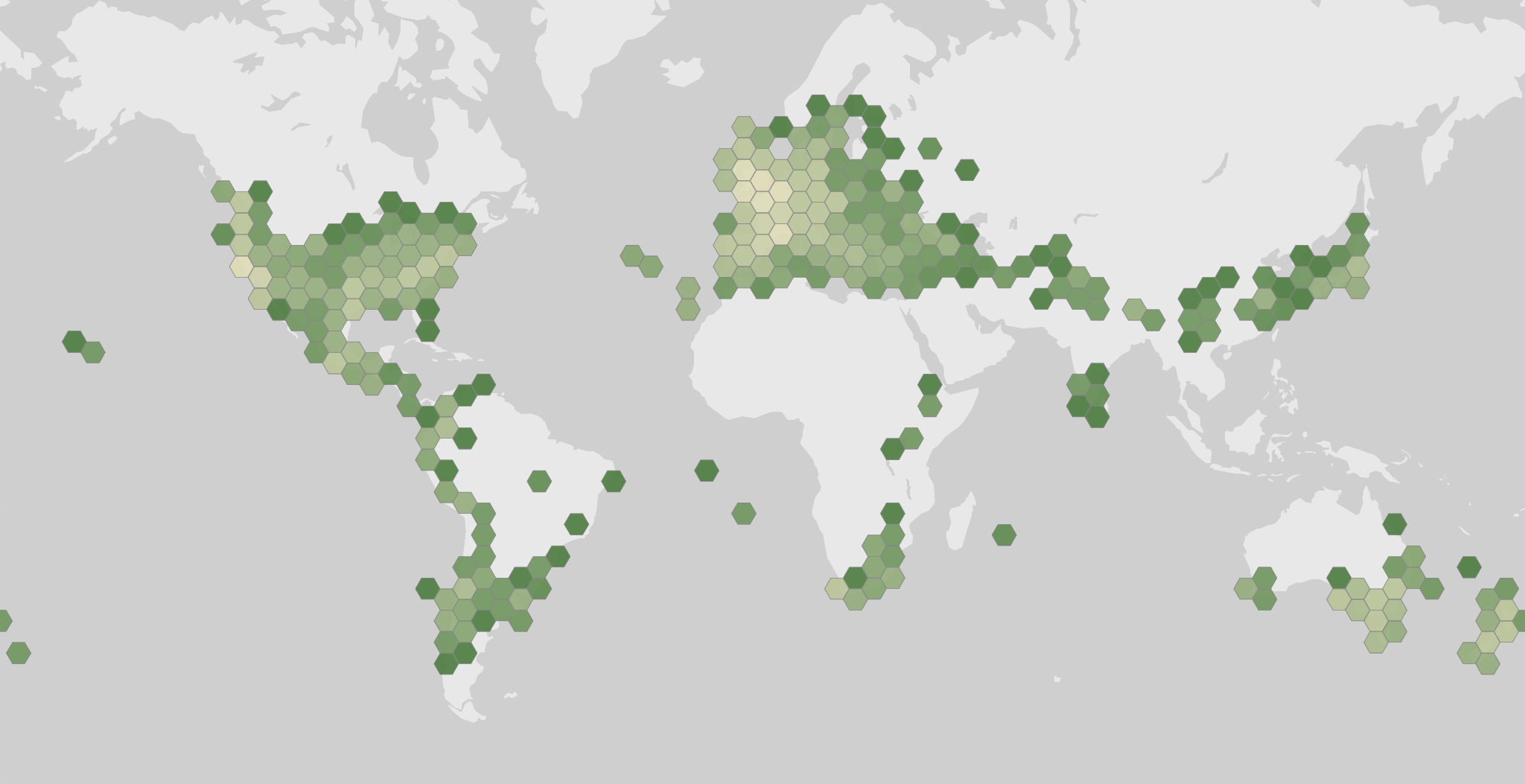
Vinca major is native to southern Europe, where it grows from Spain and southern France east to the Balkans. It also occurs in northeastern Turkey and the western Caucasus, and the native range includes Italy, Sardinia, Sicily, Crete, Bulgaria, Albania and Lebanon-Syria.
In its native range, it favors moist undergrowth, woodlands, hedgerows and banks along rivers. It grows from sea level up to about 800 meters (2,625 feet) above sea level.
The plant tolerates a wide range of light. It grows well in full sun and also thrives in deep shade, which helps explain why it can persist in many kinds of woodland edge and garden settings.
Outside its native range, it has become established in many parts of the world, including large areas of the United States, New Zealand, Chile, Argentina, Mexico and Great Britain. Sightings of the plant peak in spring.
Growth and Form
Vinca major is a perennial that trails along the ground. Its stems root where they touch the soil, so a single plant can spread into a dense mat. Individual plants can cover an area of 2 to 5 meters (about 6.5 to 16.5 feet) across.
The stems usually stand up to 25 centimeters (10 inches) high, and in some cases may reach 50 to 70 centimeters (20 to 28 inches). Because the foliage stays green all year, the cover remains in place through winter.
The plant is classed as a forb or herb, and it also grows with a vine habit. Its long, flexible stems allow it to climb or drape over low obstacles where space allows.
Ecology and Relationships
Birds are the most notable animals that feed on Vinca major. Songbirds, including the common redpoll and the skylark, are among the main eaters, and game birds, ducks and pigeons also take its plant material. Insects of the true bug order, Hemiptera, are another main group of feeders. Smaller groups of moths and butterflies, along with hoofed mammals and geese, also feed on it.
Bees are its most frequent visitors. Honeybees and several bumblebee species, including the large earth bumblebee, visit the violet flowers, along with solitary bees such as the hairy-footed flower bee. Hoverflies and other flies, along with moths and butterflies, visit less often. Visits by these insects do not confirm pollination.
The plant needs moist soil and a stable setting. Its presence in woodlands, hedgerows and riverbanks shows how it fits into the cover that these habitats provide for wildlife.
Uses and Human Relationships
Vinca major is a common ornamental plant in temperate gardens. Gardeners grow it for its evergreen foliage, its spring flowers and its value as a ground cover or trailing vine.
Many cultivars exist, differing in flower color from white to dark violet and in the patterns and colors of their variegated leaves. The cultivar 'Variegata' has received the Royal Horticultural Society's Award of Garden Merit.
The plant contains the alkaloids vinblastine, vincristine, vindesine and vinorelbine. These compounds are the reason the plant is often studied by researchers and chemists.
Photos
Photographs from via iNaturalist, licensed under CC0 1.0., by Shaun via iNaturalist, licensed under CC BY 4.0., by julmark via iNaturalist, licensed under CC BY 4.0., by Irina Mitine via iNaturalist, licensed under CC BY 4.0., by Tyler Anthony via iNaturalist, licensed under CC BY 4.0., by Elena Obradović via iNaturalist, licensed under CC BY 4.0., by Colin Meurk via iNaturalist, licensed under CC BY 4.0., by SatNavSaysStraightOn via iNaturalist, licensed under CC BY 4.0., by Rui Ribeiro via iNaturalist, licensed under CC BY 4.0., by jessicavazquez via iNaturalist, licensed under CC BY 4.0., by John Barkla via iNaturalist, licensed under CC BY 4.0., by jrcagle via iNaturalist, licensed under CC BY 4.0., by zebedeugalinha via iNaturalist, licensed under CC BY 4.0., by David Thompson via iNaturalist, licensed under CC BY 4.0., and by Carmen via iNaturalist, licensed under CC BY 4.0., credited on each photo.
Ecology and classification
Habitat
Growth habit
- Vine
Classification
- Phylum
- Tracheophyta
- Class
- Magnoliopsida
- Order
- Gentianales
- Family
- Apocynaceae
- Genus
- Vinca
- Species
- Vinca major
Sources
- GBIF Species names and classification
- iNaturalist Photos
- Wikidata Common names and conservation status
- Wikipedia Summary extract
- Encyclopedia of Life Habitat, diet and behavior traits
- Plants of the World Online Native range, life form and climate (WCVP)
- USDA Plants US plants: growth habit and growing conditions
- GloBI What it eats, what eats it, parasites and pollinators
- trophiCH
- DoPI
- EuPPollNet