A single Atlantic puffin fitted with a light-level geolocator in Maine covered 7,700 kilometers (4,800 miles) of open ocean in just eight months, flying north to the Labrador Sea before looping southeast to the mid-Atlantic and back to shore.
The Atlantic puffin (Fratercula arctica) is a seabird in the auk family, Alcidae, and the only puffin species native to the Atlantic Ocean. It breeds on cliffs and islands from Russia and Svalbard through Iceland, the Faroe Islands, Britain, Ireland, and Norway to Newfoundland, Labrador, Nova Scotia, and as far south as Maine and Brittany, spending the rest of the year far out at sea. The IUCN lists it as Vulnerable, a status driven by rapid declines across much of its European range.
With its clownish orange-and-black bill, upright stance on land, and near-total transformation into a strong-swimming diver at sea, the puffin lives two very different lives depending on the season: one social and coastal, the other solitary and pelagic.
Identification and Appearance
The Atlantic puffin's broad, triangular bill, banded in slate grey and orange-red and topped with a yellow, wrinkled rosette at the corner of the mouth, is its most recognizable feature and the source of its nickname, the "sea parrot."
It is a compact, thickset bird 28 to 30 cm (11 to 12 in) long, with short wings and a stubby tail, standing about 20 cm (8 in) tall on land. Its wingspan spans 47 to 63 cm (19 to 25 in). Males run slightly larger than females, though the sexes are colored alike.
The crown, nape, back, wings, and tail are glossy black, with a black collar wrapping the neck and throat. Large, lozenge-shaped pale grey patches cover the sides of the face, tapering almost to meet at the back of the neck, while the breast, belly, and undertail are white. Small horny plates of blue-grey skin above and below each eye give it an almost triangular-eyed look, and the legs and large webbed feet are bright orange with sharp black claws. After the breeding season, the bird sheds its ornamental bill plates and eye adornments in a partial molt, leaving a duller grey bill and darker face for winter, a plumage rarely seen by people because the birds are then far out at sea.
Juveniles resemble adults but are duller overall, with darker grey faces and yellowish-brown bills and legs. A young puffin's bill takes years to reach full adult proportions: with each successive year at sea it grows broader, develops a curved upper edge and a kink at the base, and gains paler face patches and brighter orange legs, so a bird several years old can still look visibly different from a full adult.
Distribution and Habitat
The Atlantic puffin breeds across a range exceeding 1,620,000 km² (625,000 sq mi) in the cold waters of the North Atlantic, with Europe holding more than 90% of the world population, an estimated 4.77 to 5.78 million breeding pairs. Iceland alone hosts about 60% of all Atlantic puffins, and the Westman Islands off its south coast support roughly half of the country's birds. Other major colonies lie on the north and west coasts of Norway, in the Faroe Islands, Shetland, and Orkney, west Greenland, and Newfoundland, where the Witless Bay Ecological Reserve holds the largest western Atlantic colony at more than 260,000 pairs.
Breeding colonies form on offshore islands and cliffs with grassy slopes at elevations up to 218 meters, where puffins excavate burrows 70 to 110 cm long, lined with feathers and grass, or take over existing rabbit burrows. Islands are favored over mainland sites largely because they keep ground predators such as foxes at bay.
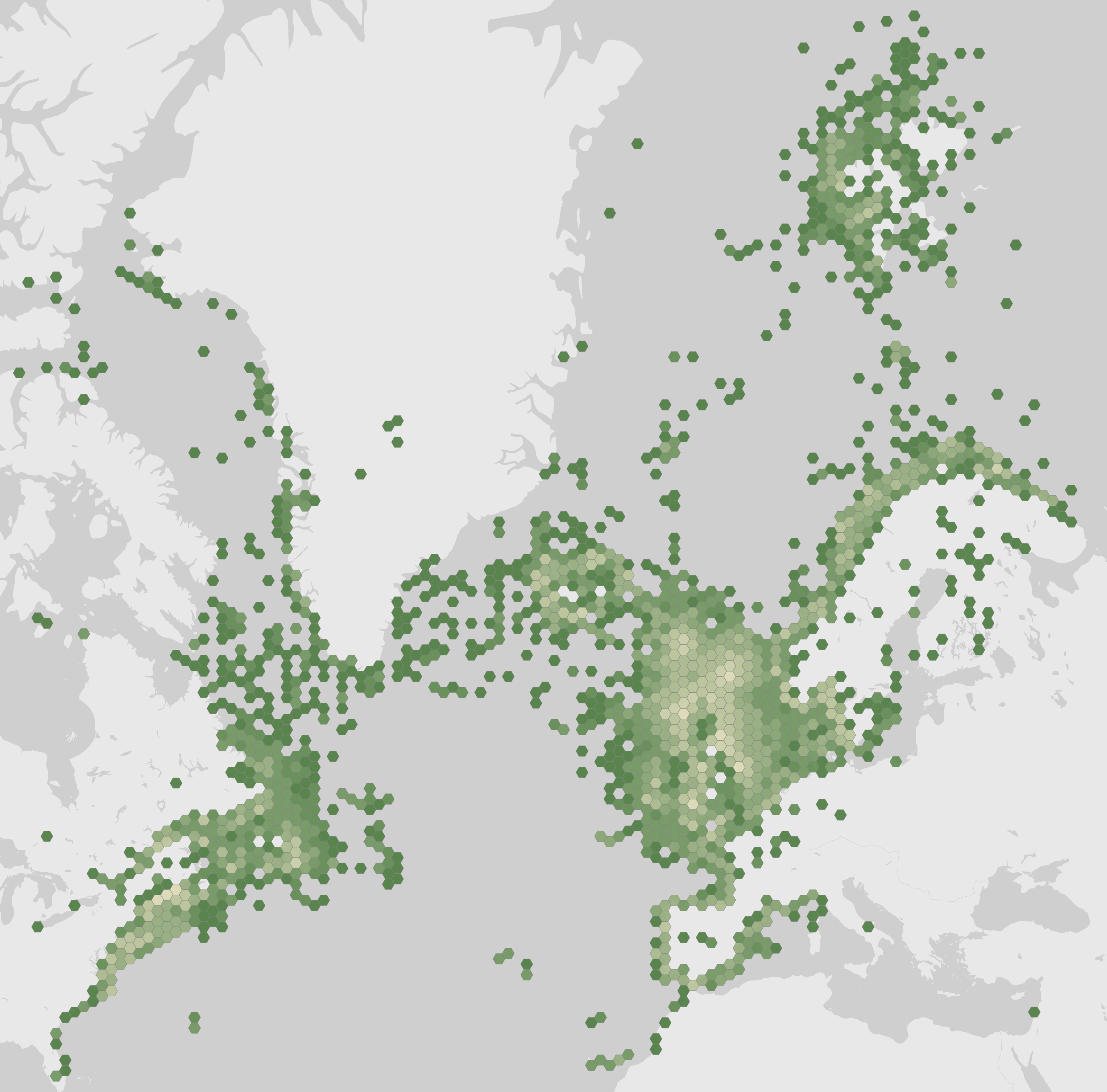
Outside the breeding season the birds disperse across the open North Atlantic and North Sea, sometimes into the Arctic Circle, wintering as far south as the Mediterranean Sea and North Carolina. This pelagic range covers 15 to 30 million km², so an individual bird has more than a square kilometer of ocean to itself and is seldom spotted at sea.
Monthly observation counts peak sharply in June and July, when tens of thousands of sightings are logged compared to only a few thousand in midwinter. This pattern reflects when puffins are visible and accessible on their breeding cliffs rather than any change in total population, since the birds simply become far harder to find once they scatter across the ocean for winter.
Behavior and Lifestyle
Atlantic puffins split their year between a solitary, pelagic existence and a highly social breeding season. At sea they are largely silent and keep to themselves, propelling through the water with powerful kicks of their webbed feet and staying oriented into the wind even while resting. Much of each day goes to preening and spreading oil from the preen gland to keep the down waterproof and insulating.
Their small wings, adapted for underwater swimming as well as flight, must beat several times a second to keep the bird airborne, and level flight reaches roughly 80 km/h (50 mph) at about 10 meters above the waves. Takeoff involves a running, wing-flapping start across the water, and landings are often an awkward crash into a wave crest or a belly flop onto calmer water. Between January and March, puffins molt all their flight feathers at once and lose the ability to fly for a month or two while still at sea.
In spring, adults return to the colony where they hatched, gathering offshore for a few days before coming ashore. Colonies are divided into subcolonies, and early arrivals claim the best burrows on grassy slopes near the cliff edge, where takeoff is easiest; latecomers and younger, first-time breeders are pushed to riskier, predator-exposed edges. A puffin defends a burrow territory averaging 1.75 m² using the "pelican walk," an exaggerated, stiff-legged strut with the head tucked and body erect that signals other birds to keep away, while a lowered head and cautious gait signals submission.
Breeding pairs make feeding trips as far as 66 km from the nest, though day trips made while chicks are small are usually shorter, 9 to 17 km, allowing a parent to return often to guard the burrow or relieve its mate.
Communication
Atlantic puffins communicate mainly through visual and tactile signals rather than vocal ones. Their calls are simple and used almost exclusively at the colony: a deep, growling sound resembling a chainsaw being revved, given from inside the burrow, while birds stay largely silent above ground and at sea except for occasional soft purring in flight.
Visual signals do most of the work of establishing territory and identity. An upright stance with fluffed chest feathers, a cocked tail, and an exaggerated slow walk with head jerking signals dominance and warns other puffins away from a burrow, while a lowered head and careful movement signals lower status. The bill's bright orange-and-slate coloring is itself a signal: brighter-billed males are thought to be more attractive to females, since both sexes can perceive the coloration.
Tactile contact, particularly the beak-to-beak "billing" display between mated pairs, reinforces the pair bond during courtship and continues, in reduced form, throughout the breeding season.
Hunting and Diet
Atlantic puffins hunt by diving, launching from the surface or from flight and swimming underwater using their wings for propulsion to chase down small fish. A single dive can end with a dozen fish held crosswise in the bill at once, gripped by backward-pointing spines on the tongue and palate that let the bird keep catching more without releasing its earlier catch.
Capelin (Mallotus villosus), sand lance (Ammodytes), sand eels (Hyperoplus), and herring (Clupea harengus) make up the bulk of the diet, supplemented occasionally by crustaceans, particularly when feeding chicks. Parents feed nestlings roughly forty times a day, delivering larger loads of fish than they consume themselves.
The reliance on a narrow set of small schooling fish makes breeding success sensitive to local food abundance; a positive link between food supply and breeding success has been documented, and shortages, such as those tied to shifting fish populations off Maine, can force parents to bring back prey too large for chicks to swallow, leading to starvation.
The puffin's ability to drink seawater supports these long hunting trips, letting it stay at sea without needing fresh water during journeys that can range tens of kilometers from the nest.
Nesting and Breeding
Courtship centers on billing, in which paired puffins face each other, wag their heads side to side, and rattle their bills together; this display renews the pair bond after months apart at sea and continues, less intensely, throughout the season. Puffins are monogamous, generally reusing the same burrow and partner year after year, likely from fidelity to the nest site rather than mate recognition itself.
Breeding begins in late spring, though egg-laying starts as early as April at southern colonies and rarely before June in Greenland. Pairs take 12 to 14 days to reunite, mate, and lay a single white egg, sometimes cooperatively excavating or renovating a burrow 70 to 110 cm deep beforehand. The egg is large for the bird's size, averaging 61 by 42 mm and about 62 g, and a replacement may be laid if the first is lost early enough in the season.
Both parents share incubation using bare, blood-rich brood patches on their undersides, with the female typically incubating more while the male focuses on guarding the burrow entrance from predators and intruders. Incubation lasts 39 to 45 days. Chicks hatch covered in black down, weighing 39 to 45 g, already able to stand, and are fed whole fish delivered beak-to-beak at first and later simply dropped beside them, gaining about 10 g a day.
Fledging takes 38 to 50 days, after which the young puffin leaves the burrow alone, usually at night, and heads out to sea with no further parental investment. It will not return to land for two or more years, typically coming back to breed for the first time at 3 to 6 years old.
Population and Ecological Role
Puffins occupy a high position in the marine food web as specialist fish predators, feeding heavily on capelin, herring, and sand eels while themselves serving as prey for seals, large fish, and, at the colony, great black-backed gulls and great skuas. Smaller gulls and skuas act as kleptoparasites, chasing fish-laden puffins and stealing eggs or chicks that stray near burrow entrances rather than attacking healthy adults.
The birds also carry a range of parasites, including feather mites (Dermanyssus gallinae), fleas of the family Ceratophyllidae, and the tick Ixodes uriae, abundant in both chicks and adults across colonies.
Globally the species remains numerous, with an estimated 12 to 14 million adults in 2018, and Iceland's colonies of around five million pairs make the puffin that country's most numerous bird. Locally, though, trends vary widely: Icelandic, Norwegian, Faroese, and Greenlandic populations have all seen sharp declines since 2000, UK colonies that grew through the late 20th century have reversed course, and some sites, such as Craigleith in Scotland, have collapsed from tens of thousands of pairs to a few thousand.
Conservation and Threats
The IUCN uplisted the Atlantic puffin from Least Concern to Vulnerable in 2015 after a review found rapid, ongoing declines across its European range, which holds more than 90% of the world population. The species is protected under the US Migratory Bird Act, though it has no special status under CITES or the US Federal List.
Threats include plastic ingestion, bioaccumulation of pollutants such as mercury and arsenic from a fish-heavy diet, entanglement and drowning in fishing nets, and predation by introduced rats, cats, dogs, and foxes on nesting islands. Climate change compounds these pressures by pushing prey fish farther from shore, beyond the puffins' foraging stamina, and by warming sea surface temperatures that alter the abundance of young herring and other prey the previous year.
Local recoveries show that intervention can work: after rats were eliminated from Lundy Island, where puffin numbers had crashed from 3,500 pairs in 1939 to just 10 pairs by 2000, a chick was confirmed raised there again in 2005 for the first time in three decades. Iceland's Westman Islands population, nearly wiped out by overharvesting around 1900, recovered under a 30-year hunting ban and now supports sustainable harvest, though renewed declines since 2000 have prompted fresh calls for restrictions.
The 2013 Farne Islands census recorded nearly 40,000 pairs, a modest recovery after a poor, flood-affected season, but modeling suggests Europe's population could fall 50 to 79% between 2000 and 2065 if current trends continue.
Conservation status
- LC
- NT
- VU
- EN
- CR
Vulnerable
Cultural Significance
Coastal communities historically harvested Atlantic puffins and their fledglings for food, a practice once significant enough to threaten some colonies, such as Iceland's Westman Islands population around 1900, before regulated, sustainable harvest replaced open hunting.
Today the species draws ecotourism worth far more than any harvest: Maine's puffin-watching tours were estimated to generate $4 billion in revenue in 2012, and similar tour industries operate in Iceland, the Hebrides, and Newfoundland, with organizations such as the National Audubon Society's Project Puffin Visitor Center in Rockland, Maine, offering viewing and education, including live colony cams from Seal Island National Wildlife Refuge.
Because it feeds high in the marine food chain and accumulates heavy metals such as mercury and arsenic from its fish diet, the Atlantic puffin is also studied as a bioindicator of ocean pollution, with beached-bird surveys and chemical analysis of feathers and eggs used to track contamination and, in some cases, provide evidence in pollution prosecutions.
Fun Facts
- The genus name Fratercula means "little friar" in Latin, a reference to the bird's black-and-white plumage, which early naturalists likened to a monk's robes.
- A tracked bird once covered 7,700 km (4,800 mi) of open ocean in eight months, journeying from the Labrador Sea to the mid-Atlantic and back.
- Puffins are among the longer-lived small seabirds, with a recorded lifespan of up to 45 years.
- During the annual molt, puffins shed all their flight feathers at once rather than gradually, grounding them at sea for a month or two.
- A puffin can hold about a dozen small fish crosswise in its bill at one time thanks to backward-facing spines on its tongue and palate.
- Only about 1.5% of oiled auks found dead on Atlantic beaches are puffins, though many more are believed to die unseen far out at sea.
Ecology
Habitat
- Marine
- Coastal
- Grassland
Behavior
- Predator
- Territorial
- Social
- Migratory
Diet
- Piscivore
Photos
SourcesGBIFiNaturalistWikidataWikipediaEncyclopedia of LifeAnimal Diversity WebAnAge