During the breeding season, a male northern lapwing throws himself into wild, tumbling aerobatics over his territory, calling constantly as he twists and dives through the air. This display, paired with the bird's wheezy "pee-wit" call, gave the species its most common nickname, peewit.
Vanellus vanellus is a wader in the plover family Charadriidae, found across temperate Eurosiberia from agricultural lowlands to upland pastures. Once abundant, it is now classified as Near Threatened, a status driven largely by changes in the farmland it depends on. Its combination of striking looks, theatrical flight, and long history alongside people makes it one of the more recognizable birds of the European countryside.
Identification and Appearance
The single best field mark is the long, thin crest curling up from the back of the head, a feature unique among Europe's common waders. Adults measure 28 to 33 centimeters in length with a wingspan of 67 to 87 centimeters and weigh between 128 and 330 grams, giving them a stocky, rounded silhouette with notably short legs for a shorebird.
Plumage is dominated by bold black and white, but the back carries an iridescent green sheen that can flash bronze or purple in good light. Males show a longer crest along with a solidly black crown, throat, and breast that stand out sharply against an otherwise white face. Females and juveniles carry shorter crests and less crisply defined head markings, though their overall pattern is similar.
In flight, the northern lapwing's rounded, almost paddle-shaped wings and slow, floppy wingbeats set it apart from sharper-winged plovers and sandpipers, especially during the male's tumbling display flight.
Distribution and Habitat
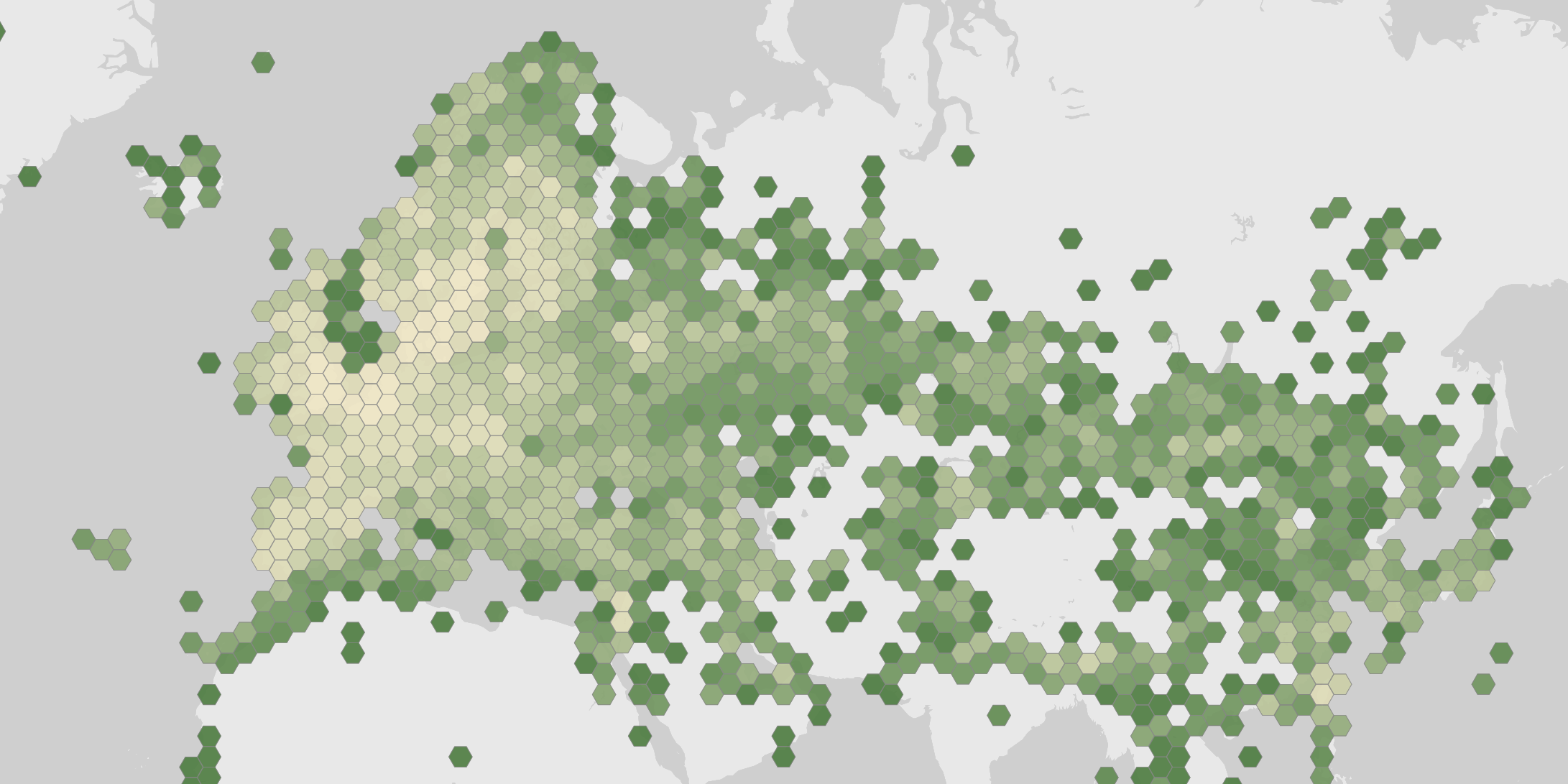
The northern lapwing breeds across temperate Eurosiberia, favoring wet grasslands, meadows, and short-swarded pastures where grazing cattle keep vegetation low enough for nesting. Breeding birds need swards under 10 centimeters tall with little tussock growth, and they depend on moist soil rich in surface and subsurface invertebrates for foraging. Nonbreeding populations shift to open pastures, damp grasslands, irrigated land, and riverbanks for roosting, typically at elevations between 200 and 1,000 meters, averaging around 400 meters.
Monthly observation data show a pronounced rise in records from February through May, peaking around April, consistent with birds returning to breeding grounds and becoming more visible during display and nesting activity; numbers taper through the second half of the year. These figures reflect presence, not abundance, and do not capture the species' full range or true population size.
Western European lowland populations tend to stay resident year-round, while birds from more easterly and northerly parts of the range are strongly migratory, wintering as far south as North Africa, northern India, Nepal, Bhutan, and parts of China.
Behavior and Lifestyle
Northern lapwings are diurnal, largely solitary outside the breeding season, and strongly territorial when nesting. Ground-nesting and precocial, they defend both nest and chicks fiercely against intruders as large as horses and cattle. Females direct notable aggression at rival females competing for a mate's parental help, escalating from a hunched, ruffled-feather run, to ground attacks of pecking and kicking, to diving aerial strikes; males rarely show this behavior.
Most populations are highly migratory, traveling mainly by day in large flocks between breeding grounds and wintering areas as far as North Africa and South Asia. Western lowland breeders, by contrast, often stay put year-round. In winter the species gathers into huge flocks on open arable land and mud-flats, frequently feeding alongside golden plovers and black-headed gulls; the gulls sometimes steal food from the lapwings but also offer some protection from predators.
A distinctive foraging trick is "worm charming," in which a bird repeatedly taps or beats the ground with one leg to drive earthworms to the surface. Like golden plovers, northern lapwings prefer to feed at night under moonlight, adding an unusual nocturnal dimension to an otherwise daytime-oriented bird.
Communication
Communication centers on the song-flight, a fixed sequence of aerial maneuvers paired with a matching vocal sequence. These displays begin just before sunrise as short, incomplete bursts, build to full hour-long performances, fade, then recur around midday and again near sunset.
The lapwing's vocal repertoire is built for specific situations: territorial song calls, contact-alarm calls given in chorus as birds leave the nest, alarm-threat calls when danger is spotted on the ground, all-clear calls that regroup hidden young, mating calls sometimes paired with a hunched run or scraping display from the male, and distraction calls used with a deceptive display when a threat becomes severe.
Beyond sound, the birds rely on visual signals such as the crouching and posturing seen in female-to-female confrontations, making communication a mix of acoustic, visual, tactile, and chemical channels.
Hunting and Diet
Northern lapwings feed mainly on invertebrates, taking earthworms, leatherjackets, and other insects from soil and stubble, supplemented by seeds, other plant material, and occasional small fish. Sugar beet stubbles are a favored foraging ground, while pastures generally offer far higher earthworm densities than arable land, which provides fewer feeding opportunities.
Diet shifts with life stage: earthworms and leatherjackets are especially critical for chicks because they are energy-rich and easy to locate compared to other prey. Adults exploit the same worm-charming technique described in their broader foraging behavior, tapping the ground to draw worms upward, and they forage as diurnal feeders, though moonlit nights also see active feeding.
Nesting and Breeding
Breeding runs from April to July, with pairs typically monogamous, though the species can also show promiscuous or cooperative breeding arrangements. Birds return to breeding grounds as early as January, usually settling within 50 kilometers of their natal area rather than the exact site used the previous year. Females reach sexual maturity and can begin breeding at one year old, and pair-bonds often form between individuals of similar age.
Nests are simple ground scrapes in short vegetation on arable land, pasture, moor, or wetland. A single clutch of four eggs is the norm, laid at a rate of roughly one egg every day and a half. Because predators frequently destroy eggs before a clutch is finished, females will lay replacement eggs and incubate whatever remains, and full replacement clutches are common after a failed attempt. Incubation lasts around 25 days, with hatching occurring anywhere from 22 to 28 days after laying.
Chicks are precocial, and the family abandons the nest almost immediately after hatching to move the brood to a separate feeding site where the young can find their own food. Both parents generally share care, though one may desert before the chicks fledge; typically females spend more time incubating and tending young while males focus on defending the nest, though these roles occasionally reverse.
Population and Ecological Role
No detailed figures on population size or ecosystem impact are documented for the northern lapwing beyond its role as prey. As a locally significant predator of invertebrates, it can influence insect and worm populations in the farmland and wetland habitats it occupies. In turn, the species itself serves as prey within these ecosystems, tying it into local food webs on both sides.
Conservation and Threats
The northern lapwing is listed as Near Threatened, reflecting population declines driven mainly by agricultural change. Historic drops came from overuse of land, wetland drainage, and egg collection, while current breeding productivity suffers from intensive management of grasslands and wetlands, including the loss of rough grassland, conversion to arable or improved pasture, fewer mixed farms, and a shift from spring-sown to autumn-sown crops that leaves fields unsuitable for nesting. Spring cultivation on arable fields directly destroys clutches, and introduced mammalian predators add further pressure on eggs and chicks, both day and night.
Migratory populations face additional threats along the Baltic coast from petroleum pollution, shrub overgrowth linked to changed land management, and land abandonment. In the Middle East, large numbers are lost to overhunting during winter migration, and in Armenia, habitat loss and hunting are both implicated in ongoing declines, though the exact impacts there remain under study. In England and Wales, national surveys recorded population declines between 1987 and 1998, prompting Red List status in the United Kingdom since 2009.
The species is covered by the Agreement on the Conservation of African-Eurasian Migratory Waterbirds (AEWA), and conservation efforts increasingly focus on restoring wet grassland by reintroducing water to drained land.
Cultural Significance
Plover's eggs, including those of the northern lapwing, were an expensive delicacy in Victorian Europe and appear in Evelyn Waugh's Brideshead Revisited, set among British aristocratic society of the 1920s to 1940s. In the Netherlands, particularly Friesland, a cultural-historical tradition centers on finding the first peewit egg of the year, known as het eerste kievietsei; egg collection is now prohibited across the European Union, and since 2006 the Frisian search has been permitted only between March 1 and April 9, with harvesting itself forbidden.
The species holds official status in Ireland, having been declared the Republic's national bird by the Irish Wildlife Conservancy in 1990; in Irish it is called pilibín, or "little Philip," reportedly a reference to King Philip II of Spain. Beyond symbolism, the bird still has practical human uses: it is hunted commercially and recreationally as a food source in countries including Iran, France, Italy, Greece, and Spain.
Fun Facts
- The genus name Vanellus comes from Latin vannus, a winnowing fan for grain, likely inspired by the sound of the bird's wings in flight.
- Carl Linnaeus first described the species in 1758 as Tringa vanellus before it was later placed in its own genus.
- Lapwings practice "worm charming," tapping the ground with one foot to trick earthworms into surfacing.
- In the Netherlands, hunting for the year's first peewit egg is a decades-old cultural competition, though actually collecting the egg is now against the law.
- Ireland named the northern lapwing its national bird in 1990, and its Irish name, pilibín, is said to nod to King Philip II of Spain.
Photos
Photographs from via iNaturalist, licensed under CC0 1.0., by Clare Edwards via iNaturalist, licensed under CC BY 4.0., by Albert Rainbow via iNaturalist, licensed under CC BY 4.0., by jhatfield via iNaturalist, licensed under CC BY 4.0., by andygpos via iNaturalist, licensed under CC BY 4.0., by S. Menéndez via iNaturalist, licensed under CC BY 4.0., by Дмитрий Кошелев via iNaturalist, licensed under CC BY 4.0., by Mourad Harzallah via iNaturalist, licensed under CC BY 4.0., by Rich Agar via iNaturalist, licensed under CC BY 4.0., and by Jess Hughes via iNaturalist, licensed under CC BY 4.0., credited on each photo.
Ecology and classification
Behavior
- Predator
- Territorial
- Diurnal
- Migratory
Diet
- Omnivore
Classification
- Phylum
- Chordata
- Class
- Aves
- Order
- Charadriiformes
- Family
- Charadriidae
- Genus
- Vanellus
- Species
- Vanellus vanellus
Sources
- GBIF Species names and classification
- iNaturalist Photos
- Wikidata Common names and conservation status
- Wikipedia Summary extract
- Animal Diversity Web Animal habitat, behavior and diet
- AnAge Longevity