The Australian pelican carries the longest bill of any living bird, with a record specimen measured at 50 centimeters. That single feature, combined with a body that can stretch to nearly 1.9 meters in total length, makes it one of the most instantly recognizable waterbirds on the continent.
This large waterbird belongs to the pelican family, Pelecanidae, and ranges across the inland and coastal waters of Australia and New Guinea, with smaller populations reaching Fiji, parts of Indonesia, and occasional vagrants turning up in New Zealand. The IUCN lists it as Least Concern, reflecting a wide range and a large, if fluctuating, population.
What makes the species worth a closer look is its opportunism: a bird equally capable of methodical fish-spearing, cooperative group hunting, and outright scavenging, all while covering enormous distances across a landscape where water can vanish or reappear almost overnight.
Identification and Appearance
The single most useful field mark is the enormous pale pink bill, unmatched in size by any other bird and paired with a stretchable throat pouch that can turn shades of blue, pink, or scarlet during courtship. Outside the breeding season, the bill and eye-ring fade to pale yellow and the pouch turns a duller pink.
The body is predominantly white, set off by black flight feathers along the primaries and a white panel on the upper wing that forms a distinctive white V across the rump. Adults measure 152 to 188 centimeters in total length, largely due to the bill, and carry a wingspan of 2.3 to 2.6 meters. Weight typically falls between 4.5 and 7.7 kilograms, though large individuals can reach 13 kilograms, making this the second-heaviest Australian flying bird on average after the brolga.
Sexes differ mainly in bill size: females are noticeably smaller overall, with bills that can measure as little as 34.6 centimeters at maturity compared to the much larger bills of males. Juveniles resemble adults but show brown where adults show black, and their white wing patch is reduced.
Because its range does not overlap with most other pelican species, the Australian pelican has no close look-alikes to confuse it with in the field; its combination of size, bill, and black-and-white pattern is essentially unique within its range.
Distribution and Habitat
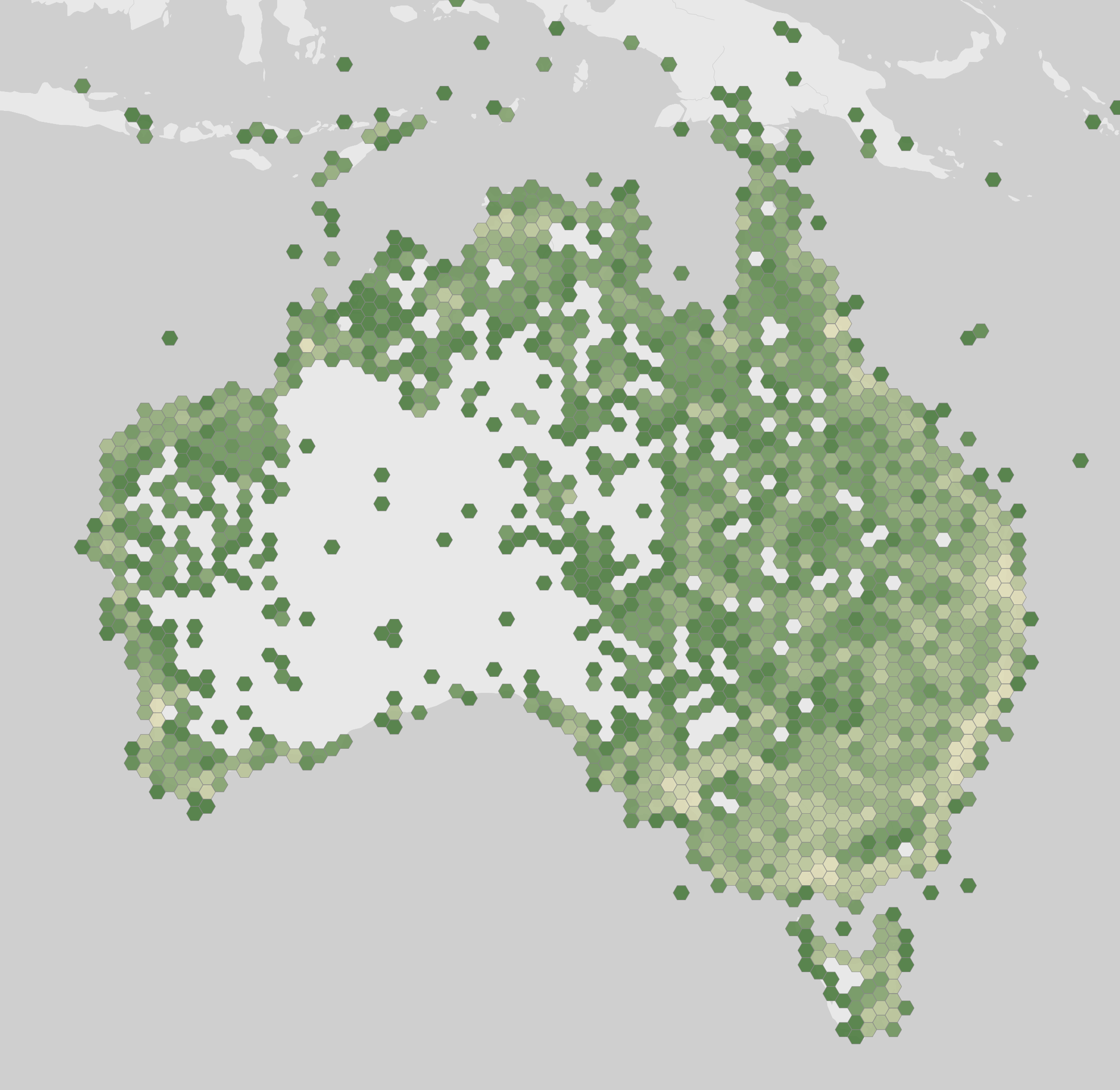
The species occupies a very large range across mainland Australia and Tasmania, with regular populations also in New Guinea and smaller, more sporadic ones in Fiji and parts of Indonesia. Vagrant individuals have reached Christmas Island, Vanuatu, Palau, and New Zealand, where subfossil bones first found in the 20th century were once mistaken for a distinct extinct species before being shown to belong to the same Australian population.
Habitat needs are simple: open water with a reliable fish supply, and little else matters. Australian pelicans use large lakes, reservoirs, billabongs, rivers, estuaries, swamps, temporarily flooded arid-zone basins, farmland drainage channels, salt evaporation ponds, and coastal lagoons alike. The surrounding landscape, whether forest, grassland, desert, or urban parkland, is largely irrelevant as long as fish-rich open water is present, though the birds prefer low-disturbance sites while breeding.
Movement follows food rather than any fixed schedule or season. Drought often triggers mass dispersal: when Australia's normally dry Lake Eyre filled between 1974 and 1976, pelicans abandoned coastal cities almost entirely, only to disperse again in flocks of thousands once the lake dried out. A population irruption in 1978 carried Australian pelicans as far as Sulawesi and Java.
Monthly observation counts show a rise from a low near 43,700 in May to a peak above 77,000 in October, before easing back through the rest of the year. Because these figures reflect presence records rather than true abundance, the pattern should be read as a hint of stronger seasonal detectability, most likely tied to breeding-season movement, rather than a precise measure of population size.
Behavior and Lifestyle
Australian pelicans are highly social, diurnal birds that gather in groups sometimes numbering in the thousands and breed in colonies that can hold up to 40,000 individuals. Life is organized around the search for fish-rich water, which can mean settling into a stable lake for months or abandoning a site entirely within days of it drying out.
Flight is powerful but unhurried; the birds pull their heads back against their shoulders in the air and often ride thermals to glide rather than flap, conserving energy over long distances. Individuals have been recorded staying airborne for as long as 24 hours while searching for new feeding grounds, a reflection of how unpredictable Australia's inland waters can be.
Their movement pattern is nomadic rather than migratory in the strict sense: rather than following a set route between fixed seasons, pelicans track rainfall and water availability across a very large home range, sometimes covering huge distances almost overnight. Wind can even carry them to unexpected new sites.
This mobility, paired with colonial breeding, means that the appearance or disappearance of a colony often says more about recent rainfall somewhere else in the country than about local conditions.
Communication
Visual signals dominate Australian pelican communication, especially the coordinated use of wings, neck, bill, and pouch during courtship displays, where color changes in the bare skin around the eyes and bill add extra emphasis to posture and movement.
Vocal communication plays a smaller role in adults, who rarely call and, when they do, produce hissing, blowing, groaning, grunting, or bill-clattering sounds rather than elaborate songs. Young birds are far more vocal, loudly begging for food, a behavior that helps parents locate and feed their chicks within crowded creches.
Beyond sight and sound, the species also relies on tactile and chemical cues to sense its surroundings, consistent with the sensory range typical of birds generally.
Hunting and Diet
Australian pelicans locate and capture prey mainly by tipping forward and thrusting their long bill underwater, a bill-thrusting technique shared with other pelican species. They also scoop food from shallow water while swimming or flying low over the surface, and occasionally plunge into the water from about a meter up. When hunting in groups, flocks work together to corral fish into shallow or confined areas, making them easier for the whole group to capture.
Fish make up the bulk of the diet, typically ranging from 60 to 247 millimeters long and weighing 17 to 320 grams. Crustaceans such as freshwater crayfish and shrimp form a smaller part of the intake, alongside amphibians, small reptiles, and small mammals.
The species is described as an opportunistic feeder, meaning it does not rely on fish alone when conditions demand otherwise. It scavenges readily and will pirate food from other animals, and during periods of scarce food it has been known to prey on the young of gulls and ducklings, showing how flexible its feeding strategy can become under pressure.
Nesting and Breeding
Courtship begins when the local breeding population gathers at a colony site, where a large group splits into smaller units of one female and several competing males. The female leads her group of suitors on courtship walks, swims, and flights while the males display, and subordinate males gradually drop away until, by the ritual's end, usually just one male remains paired with her.
Once paired, the two select a nesting site together; the male performs a ritual display that may be followed by mating, with copulation lasting 6 to 22 seconds and repeated several times over multiple hours. Nesting is communal, often on islands or in sheltered areas near lakes or the sea, and the nest itself is typically no more than a shallow scrape in earth or sand, sometimes lined with grass; more elaborate platforms have been built at Lake Alexandrina in South Australia.
Clutches usually contain two chalky white, elliptical eggs around 90 by 59 millimeters, though clutch size can range from one to three or occasionally four. Both parents share incubation, cradling the eggs on their feet for 32 to 35 days. Chicks hatch naked and helpless, quickly growing grey down; in nests with more than one chick, the larger sibling is fed more and often outcompetes the other, which can die of starvation or siblicide.
Chicks are fed regurgitated liquid for the first two weeks, then fish and invertebrates for the following two months. Around 25 days of age they join creches of up to 100 chicks, fledging near two to three months old but not reaching full independence from parental feeding until about four months. Sexual maturity follows at three to four years of age.
Population and Ecological Role
Global population size is estimated at between 100,000 and 1,000,000 individuals, with a trend described as fluctuating rather than steadily rising or falling, in keeping with the species' dependence on unpredictable rainfall and water levels across Australia.
Ecologically, the species acts as a seed disperser: pelicans eat fish that have themselves fed on aquatic vegetation, and as the birds move between water bodies, plant propagules pass through their digestive systems and are deposited in new locations, sometimes helping recolonize wetlands that had lost their plant life. The same mechanism, however, can spread exotic plant species between sites.
The species also serves as a host for parasitic nematodes, including Contracaecum pyripapillatum and Contracaecum multipapillatum, linking it into the wider food web beyond its role as predator and disperser.
Conservation and Threats
The Australian pelican is assessed as Least Concern, based on a very large range, a large population of 100,000 to 1,000,000 individuals, and a trend that is fluctuating rather than declining. This is not a species facing global extinction risk under current assessment.
The main pressure on the species has historically been persecution by people who saw pelicans as competitors with commercial and recreational fishing, sometimes leading to destroyed nesting colonies. Disturbance is a particular concern during breeding: colonies are sensitive to human activity near nest sites, even though pelicans elsewhere readily approach people at spots like Monkey Mia in Western Australia or The Entrance in New South Wales to beg for handouts.
The species is legally protected and shows no clear signs of harm from pollution. It has adapted well to artificial water bodies such as reservoirs, provided these lack regular boat traffic, and because open-water recreation has affected its habitat less than more heavily vegetated wetlands elsewhere in Australia, the species has fared better than many other wetland birds.
Conservation status
- LC
- NT
- VU
- EN
- CR
Least Concern
Cultural Significance
Pelicans as a group carry a long history of cultural meaning, appearing in mythology and in Christian and heraldic iconography, and the very name pelican traces back to the Ancient Greek pelekan, itself derived from pelekys, meaning axe, a word once applied to both pelicans and woodpeckers for their bill shape.
For Aboriginal Australians, the Australian pelican holds specific mythological significance; the Yandruwandha people of the Coongie Lakes region harvested it for food, embedding the bird directly into local subsistence and story alongside its symbolic role.
More broadly, pelicans have served as symbols of mutual aid and love of one's fellow beings in Christian tradition, while on a practical level, pelican guano has been used as fertilizer, giving the birds an indirect but tangible benefit to agricultural economies.
Fun Facts
- The Australian pelican's bill can reach 50 centimeters, the longest of any living bird.
- Individuals have been recorded staying airborne for up to 24 hours while searching for food.
- Breeding colonies can hold as many as 40,000 birds at a single site.
- Newly fledged chicks gather into creches of up to 100 young before rejoining their parents.
- The word pelican comes from the Ancient Greek pelekys, meaning axe, originally used for both pelicans and woodpeckers.
- By weight, it ranks as the second-heaviest Australian flying bird on average, behind only the brolga.
- Pelican droppings help disperse aquatic plant seeds between wetlands, sometimes reseeding areas that had lost their vegetation.
Ecology
Habitat
- Wetland
- Marine
- Coastal
- Freshwater
Behavior
- Predator
- Social
- Diurnal
- Scavenger
Diet
- Piscivore
Photos
SourcesGBIFiNaturalistWikidataWikipediaEncyclopedia of LifeAnimal Diversity WebAnAge