The bare-faced ibis stands out among wading birds for having a completely featherless, reddish face, a trait that gives it both its common name and its alternative name, the whispering ibis.
This dark-plumaged bird belongs to the family Threskiornithidae and is the only species in the monotypic genus Phimosus. It ranges widely across South America and carries an IUCN status of Least Concern. Its social habits, close nesting associations with other ibis species, and reliance on wetland habitats make it a distinctive presence in the open wet landscapes it calls home.
Identification and Appearance
The bare-faced ibis is best recognized by its bare, reddish facial skin, a trait no feathered ibis in its range shares. Its plumage is dark brown to blackish overall, giving it a somber, uniform appearance at a distance.
The bird measures between 45 and 50 centimeters in total length and weighs around 0.559 kilograms. Its long, decurved bill is pinkish to reddish brown, paired with pink legs that contrast against the darker body.
Sexual differences are subtle but present: males carry a proportionally larger bill than females relative to body size, though this difference is not extreme and sexual selection pressures appear modest compared to other ibis species.
Distribution and Habitat
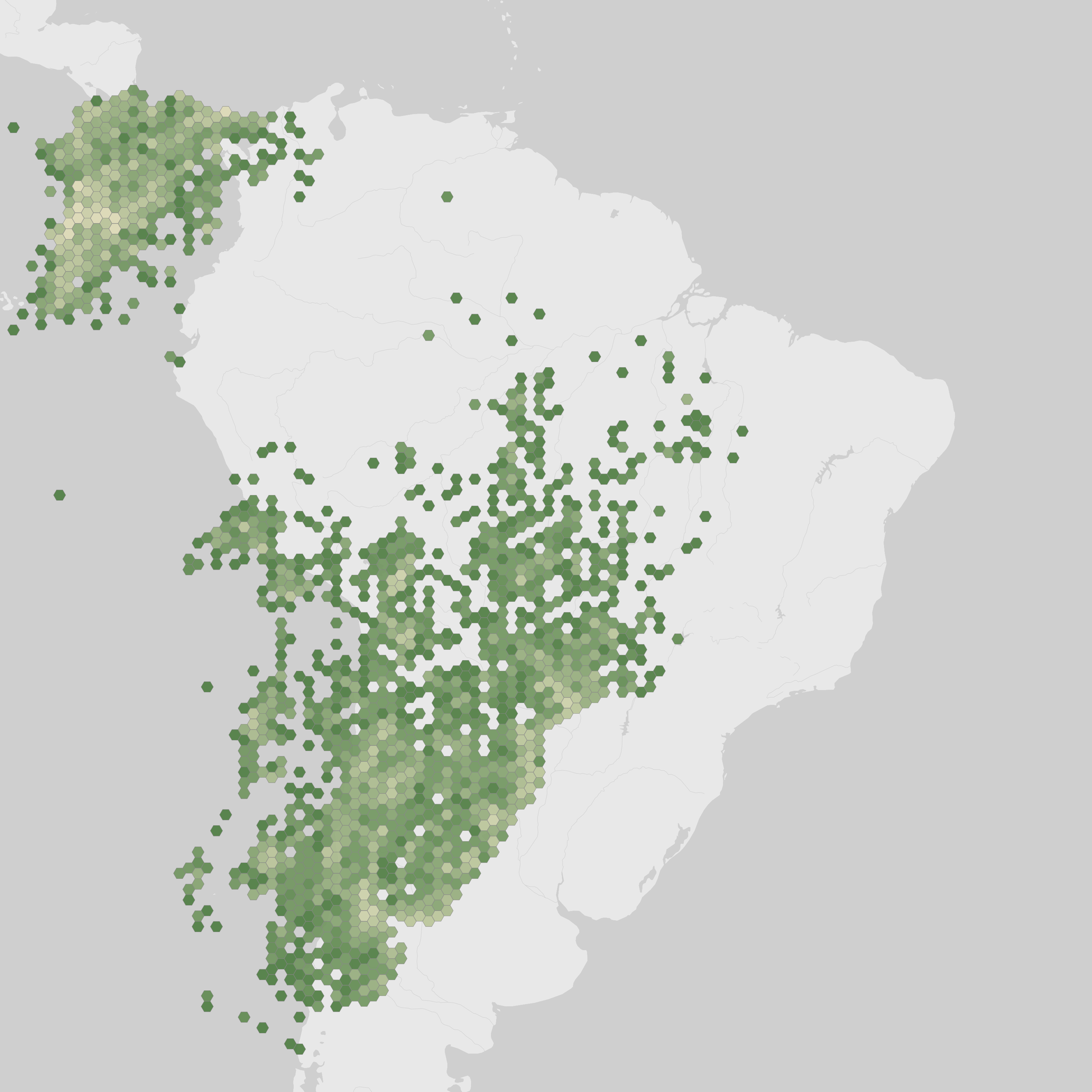
The bare-faced ibis occupies a broad range across South America, found in Argentina, Bolivia, Brazil, Colombia, Ecuador, Guyana, Paraguay, Suriname, Uruguay, and Venezuela, spanning an estimated range of 6,590,000 square kilometers.
It favors open, wet habitats: wet meadows, savannas, marshes, and rice fields. The species is typically found near sea level, though it has been recorded at higher elevations in Venezuela and Colombia.
Monthly observation records show birds present throughout the year, with some months showing higher observation numbers than others, though these counts reflect presence rather than actual population size or abundance.
Behavior and Lifestyle
The bare-faced ibis is a highly social bird, usually seen in large flocks composed of its own species or mixed with other ibis, and occasionally alongside domestic animals. Individuals nest in close proximity to one another, with neighboring nests sometimes as little as 100 meters apart.
Despite this crowding, the species shows little territorial aggression toward other ibis. Conflict is generally limited to occasional food robbery from another ibis or animal rather than sustained hostility. Nesting behavior is notably less aggressive compared with other ibis species, and the birds will even share nesting sites with other species entirely.
The species is partially migratory and terrestrial in its general lifestyle, moving between foraging grounds as conditions change across its wide range.
Hunting and Diet
The bare-faced ibis forages by probing soil and the edges of standing water, acting as an aquatic predator that hunts small invertebrates hidden in mud and shallow wetlands. Its long decurved bill is well suited to this probing style of feeding.
Its diet consists mainly of insects, worms, clams, and other small invertebrates, all of which it locates by working through soft ground and water margins rather than by chasing more mobile prey.
Nesting and Breeding
Bare-faced ibises breed in small colonies alongside their own species, with the breeding season running from August to December. Courtship and nest-building lead to platform nests built in trees or shrubs, often close to neighboring nests.
A clutch typically contains 1 to 8 eggs, pale green to blue in color. Incubation lasts 21 to 23 days and is shared by both the male and female, reflecting the relatively cooperative, low-aggression nesting style typical of the species.
Fun Facts
- The bare-faced ibis is the only species in its genus, Phimosus, making it taxonomically unique within the ibis family.
- It is sometimes called the whispering ibis, an alternate common name alongside bare-faced ibis.
- The species has been recorded living alongside other birds such as the smooth-billed ani, Chaco chachalaca, and red-and-green macaw in shared habitats.
Photos
Photographs from via iNaturalist, licensed under CC0 1.0., by Amber M. King via iNaturalist, licensed under CC BY 4.0., by Josh Noseworthy via iNaturalist, licensed under CC BY 4.0., by William Stephens via iNaturalist, licensed under CC BY 4.0., by PampaSorro via iNaturalist, licensed under CC BY 4.0., by Nicolas Olejnik via iNaturalist, licensed under CC BY 4.0., by Roger A. Morales-Flores via iNaturalist, licensed under CC BY 4.0., by avocat via iNaturalist, licensed under CC BY 4.0., and by Joaquín Krasuk via iNaturalist, licensed under CC BY 4.0., credited on each photo.
Ecology and classification
Classification
- Phylum
- Chordata
- Class
- Aves
- Order
- Pelecaniformes
- Family
- Threskiornithidae
- Genus
- Phimosus
- Species
- Phimosus infuscatus