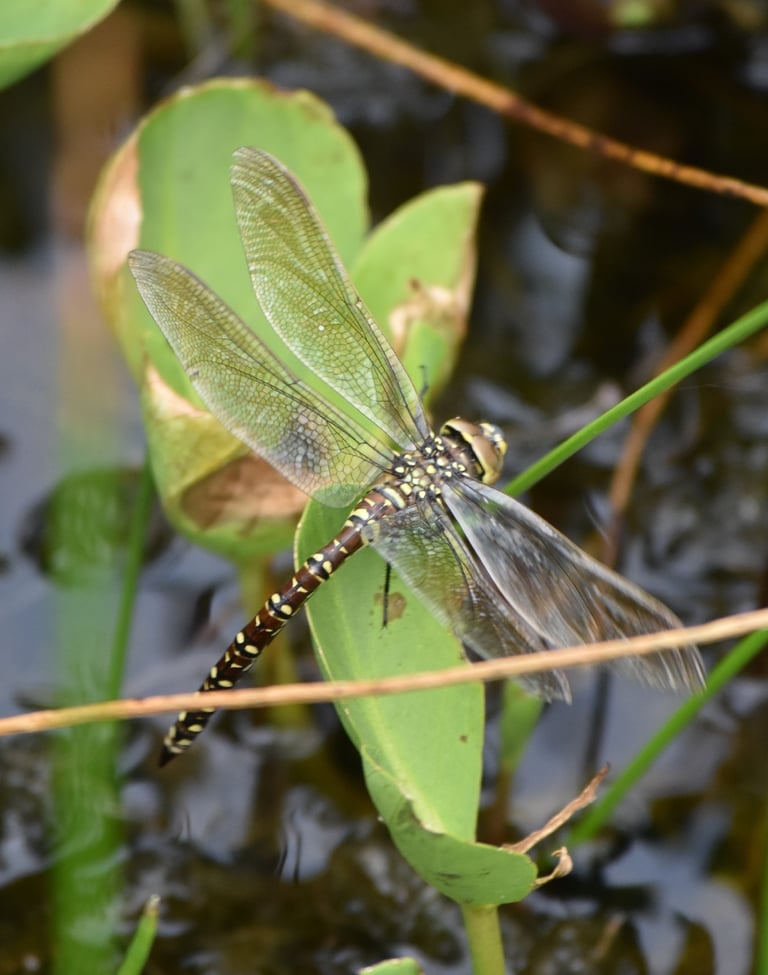
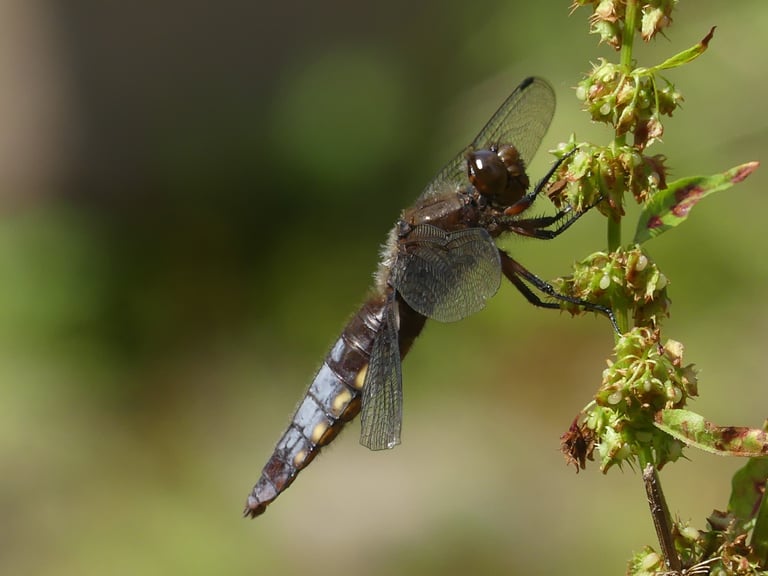
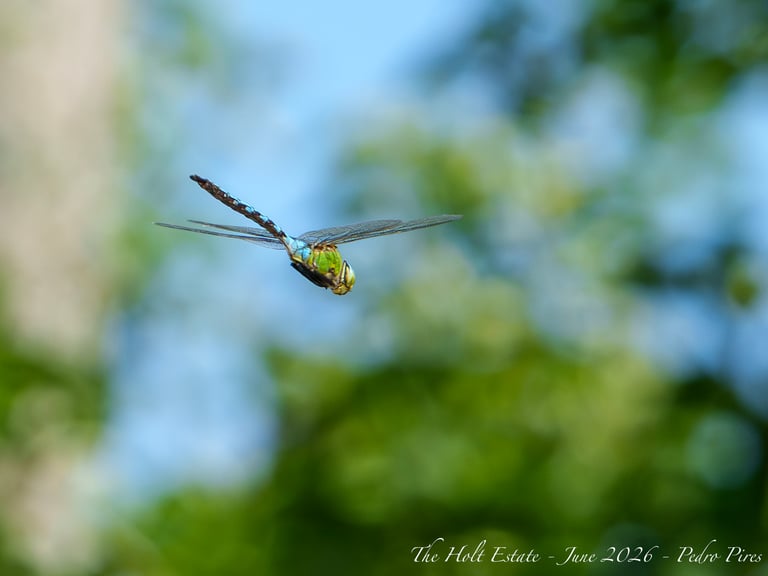
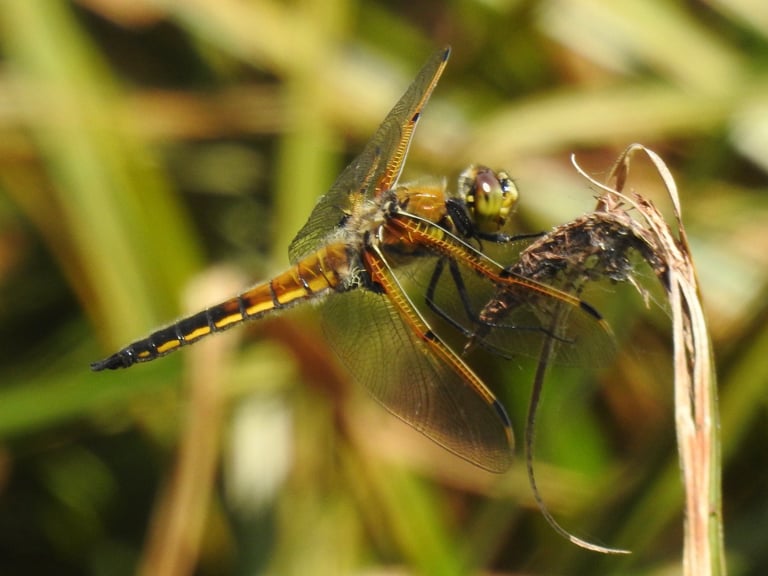
Male beautiful demoiselles fight intense aerial battles to defend tiny territories along stream banks, and the winners tend to have stronger immune systems and larger fat reserves than the losers.
The beautiful demoiselle (Calopteryx virgo) is a damselfly in the family Calopterygidae, found across Europe, North Africa, and Western Asia. It is classified as Least Concern by the IUCN, though it favors clean, fast-flowing streams and is absent from cities and heavily farmed land.
Its combination of butterfly-like flight, strongly colored wings, and fierce territorial contests between males makes it one of the more conspicuous and well-studied damselflies of its range.
Identification and Appearance
The single most useful field mark is the wing color: males have wings that are almost entirely and densely pigmented with a dark, metallic blue-green sheen, more extensively colored than other Calopteryx species in its range. Immature males start with plain brown wings, which turn metallic blue only as they mature.
Adults reach a body length of 49 to 54 millimeters, with a hindwing length of 31 to 37 millimeters. They are large, dark damselflies with small, lateral, hemispherical eyes, two similarly shaped pairs of wings, and a slender abdomen threaded with a dense network of veins.
The species shows marked sexual dimorphism. Males have metallic blue-green bodies and blue-green eyes to match their heavily pigmented wings. Females instead have dark brown iridescent wings marked with a white patch near the tip called a pseudopterostigma, along with a metallic green body tipped in bronze at the end of the abdomen.
The beautiful demoiselle closely resembles the banded demoiselle (Calopteryx splendens), another damselfly with colored wings found in Britain, but its wings are far more extensively pigmented. The stick-shaped larvae, which grow to 3.5–4.6 millimeters in their final stage and weigh about 4 milligrams, can be told apart from banded demoiselle larvae by the bristles on their abdominal gills.
Distribution and Habitat
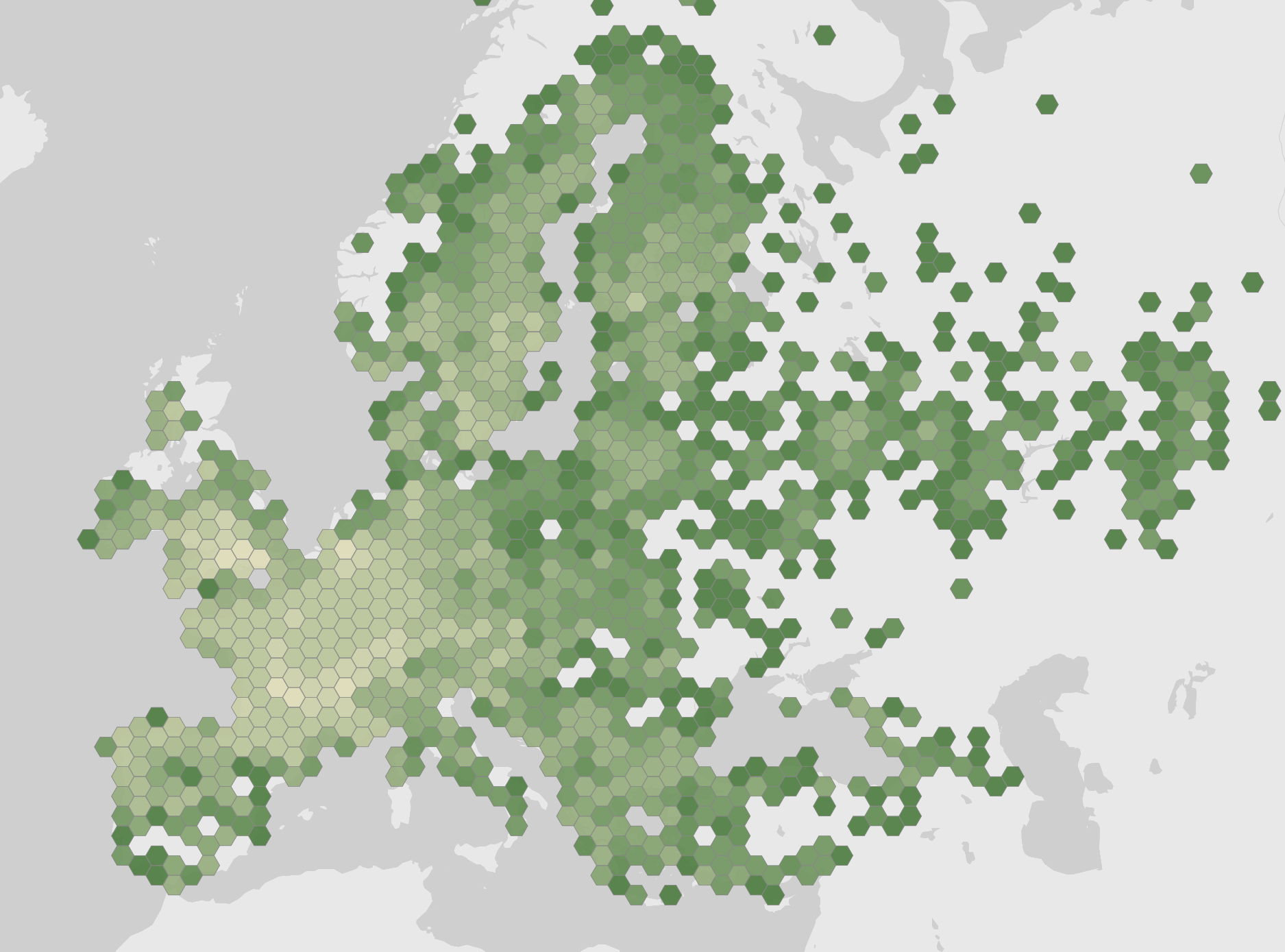
The beautiful demoiselle ranges across nearly all of Europe, absent only from the southwestern Iberian Peninsula, the Balearic Islands, Sardinia, Sicily, and Iceland. Its range reaches farther north than the banded demoiselle's, extending to the Arctic Ocean, while southern populations occur as far as Morocco and Algeria. It is mostly a lowland species, regularly recorded up to 980 meters and occasionally to 1,200 meters in the Alps.
Adults and larvae alike depend on small to medium-sized streams and creeks with cool water and moderate to fast flow, usually running through or near forests. The water must not be nutrient-rich, and larvae need submerged plant stems and leaves, such as waterweed or water crowfoot, to cling to in the current. Because of this, the species is rare on barren banks or smooth stone riverbeds, and only rarely found in still water.
Oxygen levels and water temperature are critical: larvae are highly sensitive to oxygen deficiency and do poorly in sediment- or sludge-laden waters. The optimal summer water temperature sits between 13 and 18 degrees Celsius, with injuries to larvae and reduced egg hatchability observed above 22 degrees Celsius.
Adults use forest clearings and rest on trees, shrubs, and tall herbaceous plants such as large nettle, occasionally venturing to the banks of larger ponds, which is unusual for the genus. Breeding habitat mirrors larval habitat: cool, shady, moderately flowing meadow and pasture streams with natural bank vegetation that also serves as a windbreak, since the species' broad wings make it easily blown off course.
Behavior and Lifestyle
Adults emerge from late April through September, with most emergence concentrated from late May to late June, and the whole process stretching unevenly to mid-July. Newly emerged damselflies stay near their hatching site for about ten days while their wings develop full color, before returning to the water to begin mating. Adults live only one season, surviving about 40 to 50 days.
Males are strongly territorial, perching on bankside vegetation overhanging the water to defend sites with good oviposition substrate and increased flow, essential to attracting females. Defense relies mainly on threatening displays, wing-spreading, and visible posturing rather than direct combat, though aggression intensifies sharply when few males are competing for space and eases when many are present. A signature display called "wing lapping," a quick downward flap followed by a slow lift, is thought to serve as communication, though it may also help with thermoregulation.
Males stay within a small home range of just 20 to 100 meters from their breeding, hunting, and resting sites, arriving at the water between 7 and 9 a.m. in Central Europe. Females roam far more widely, covering up to 6 kilometers a day while searching for suitable nesting sites, and both sexes hunt, court, mate, and lay eggs through the warm midday hours before returning to the same sunlit vegetation each night.
Hunting and Diet
As a predator, the beautiful demoiselle hunts small flying and aquatic insects, with both sexes taking prey during the warm midday hours alongside courting and mating activity. Recorded prey include small midges such as species of Corynoneura, a genus of non-biting midges frequently caught by this damselfly.
Hunting takes place from the same sunlit perches males use for territorial display, giving them ready access to insects passing near the water's surface and surrounding vegetation.
Reproduction and Life Cycle
Courtship begins when a female flies over the water searching for a nesting site and passes through a male's territory. The male performs acrobatic displays exclusive to courtship, flashing the brighter underside of the last three abdominal segments at the female before leading her toward a nesting site.
After circling the site once, the male hovers and waits for the female to land, a sign of her willingness to mate. The pair then forms a "mating wheel," copulating for anywhere from 40 seconds to 5 minutes. Afterward, the male releases the female, who rests briefly with her abdomen drooping before following him to the nesting site.
Eggs are laid directly into the stems of aquatic plants at or just below the water's surface, with the female able to submerge for up to 90 minutes at a time. Unusually among damselflies, she climbs upside down onto the plant stem and stabs her eggs in nearly vertically using her ovipositor, laying up to 300 eggs at a session. The male stands guard above, fending off rival males while she lays. Both sexes mate repeatedly each day over several weeks until death, and eggs hatch roughly 14 days after laying into stick-shaped larvae that take two years to develop, overwintering in mud or slime along the way.
Conservation and Threats
The beautiful demoiselle is classified as Least Concern by the IUCN, but this global assessment masks serious regional concern: Germany's Red Data Book lists it as endangered or even in danger of extinction in some states, and it is similarly threatened in Austria, Switzerland, and other Central European countries. The species is stenoecious, meaning it has very narrow ecological requirements, and its larvae can only thrive in natural waters with little human influence, so it is largely absent from cities, industrial areas, and intensively farmed regions.
The primary threat is eutrophication from household and agricultural wastewater, which triggers algal blooms that deplete oxygen and alter the aquatic vegetation females need for egg-laying. Algae and dirt particles also clog the gills of larvae, restricting respiration, while the resulting weed growth and silting further degrade streams.
Even unpolluted waters can become unsuitable if fast-growing plants such as meadowsweet, stinging nettle, or Himalayan balsam overgrow the banks, or if trees close up the canopy and block sunlight the damselflies need.
Cultural Significance
The common name Beautiful Demoiselle given to Calopteryx virgo reflects a long-standing human tendency to see grace and delicacy in this damselfly's slender, glinting form.
Its scientific name, virgo, links it to older symbolic associations with purity and refined beauty, themes that have long been attached to the word in folklore and language more broadly.
Fun Facts
- The genus name Calopteryx comes from the Greek for "beautiful wings," while the species name "virgo" is Latin for virgin, referencing the delicate appearance of the body.
- Winners of male territorial fights tend to have stronger immune systems, measured by how well they encapsulate a foreign object inserted under the skin, showing a link between energy reserves and both disease resistance and fighting ability.
Photos
Photographs from via iNaturalist, licensed under CC0 1.0., by Xosé Veiras via iNaturalist, licensed under CC BY 4.0., by Demian Hiß via iNaturalist, licensed under CC BY 4.0., by Charlie Barber via iNaturalist, licensed under CC BY 4.0., by geoffWCNR via iNaturalist, licensed under CC BY 4.0., by Nico Hernandez via iNaturalist, licensed under CC BY 4.0., by Tracy Gould via iNaturalist, licensed under CC BY 4.0., by Jean-Silouane Rebours via iNaturalist, licensed under CC BY 4.0., and by Christoph Moning via iNaturalist, licensed under CC BY 4.0., credited on each photo.
Ecology and classification
Classification
- Phylum
- Arthropoda
- Class
- Insecta
- Order
- Odonata
- Family
- Calopterygidae
- Genus
- Calopteryx
- Species
- Calopteryx virgo
Sources
- GBIF Species names and classification
- iNaturalist Photos
- Wikidata Common names and conservation status
- Wikipedia Summary extract
- Encyclopedia of Life Habitat, diet and behavior traits
- GloBI What it eats, what eats it, parasites and pollinators
- trophiCH