The male Libellula depressa turns a powdery pale blue as it matures, a coating called pruinosity that covers the abdomen's original brown color entirely. This transformation, combined with a body shape unlike any other dragonfly sharing its range, makes the broad-bodied chaser one of the most instantly recognizable dragonflies in Europe and central Asia.
It belongs to the family Libellulidae within the order Odonata, and the IUCN lists it as Least Concern. Its combination of bold coloring, pioneering habits at new ponds, and fast, territorial flight make it a rewarding species to watch at almost any still-water site within its range.
Identification and Appearance
The single most useful field mark is the abdomen itself: broad, flattened, and unlike the slender build of most other dragonflies in the region. Both sexes share this shape, measuring 39 to 48 millimeters in total body length with a wingspan of roughly 70 millimeters.
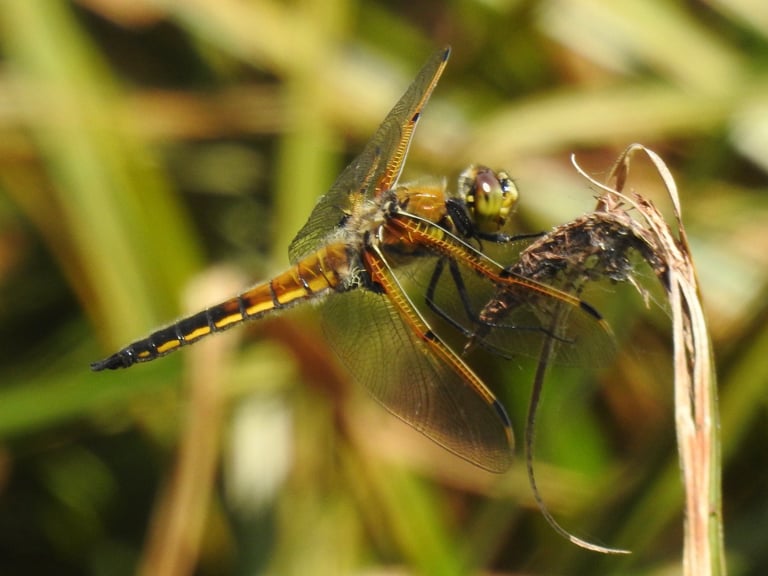
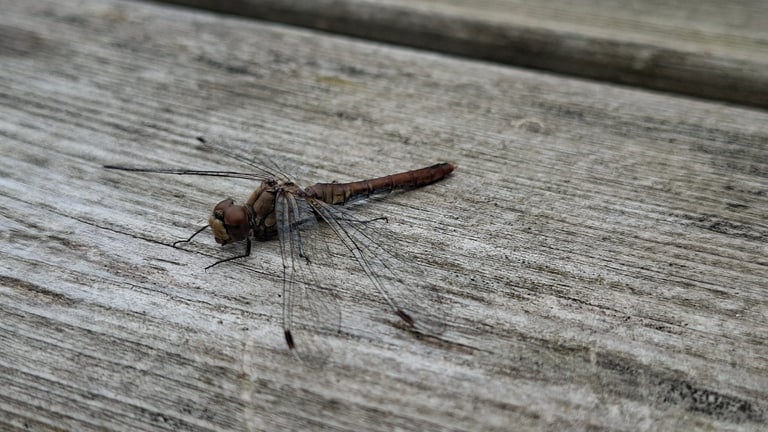
In young adults and females, the abdomen is brown with yellow patches running down each side. As males mature, a blue pruinosity spreads across the brown background until it dominates the abdomen's color entirely, while females retain the brown-and-yellow pattern throughout life. Both sexes show broad antehumeral stripes on the thorax.
The wings carry a distinctive dark patch at the base of both the fore and hind pairs, visible on any perched or flying individual. This four-patch wing pattern, paired with the flattened abdomen, is diagnostic.
Libellula depressa is described as very distinctive and is not easily confused with any other dragonfly found within its range, making it one of the more approachable species for field identification.
Distribution and Habitat
Libellula depressa ranges across central and southern Europe, central Asia, and the Middle East. In the British Isles it extends through England and Wales into southern Scotland, a range expansion northward that has taken place in recent decades; historically the species was absent from Scotland. It also reaches southern Sweden and southern Finland, and occurs on Mediterranean islands including Corsica, Sardinia, Sicily, and Menorca. The species is absent from Ireland and North Africa.
It favors still-water lakes and ponds, hunting small insects over open water. Notably, it is often the first dragonfly to colonize newly created ponds, alongside its presence at longer-established, well-vegetated waters. Adults are highly mobile and range well away from water during a post-emergence maturation period, and the species is also migratory.
Monthly presence records show a sharp seasonal pattern, rising from low numbers in winter and early spring to a pronounced peak in May and June before declining through summer and autumn. These are presence observations rather than a measure of abundance or a complete picture of the species' range, but the pattern is consistent with a spring-to-early-summer flight period concentrated activity.

Behavior and Lifestyle
Adults fly from April to September, with peak activity in May and June, and their flight is fast, marked by darting and diving maneuvers above the water surface. Males are strongly territorial, defending favored stretches of pond margin and repeatedly returning to a preferred sunlit perch between patrols.
Rival males, and indeed other dragonfly species encountered nearby, are met with aggression as the resident male defends its territory. When a female enters a male's territory, he flies up and grabs her, and mating takes place on the wing but lasts less than a minute before the pair separates.
After mating, the female searches for a stretch of open water with submerged vegetation, then oviposits in flight, hovering just above the surface and dipping the tip of her abdomen into the water repeatedly. Eggs hatch within four to five weeks, and the resulting larvae spend one to two years developing in the pond, lying buried in silt and detritus at the bottom with only the head and eyes exposed.
Once adults emerge, they leave the water and undergo a maturation period of 10 to 14 days before returning to breed, during which time they range widely and feed away from the pond.
Fun Facts
- The scientific name depressa refers directly to the dragonfly's flattened, broad abdomen, the feature that gives the species both its common and Latin names.
- Historical synonyms for the species include Libellula depressa taurica and Libellula sylvia, names that appear in older taxonomic records before the current classification was settled.
- Males are often the first dragonflies to appear at a freshly dug pond, arriving to claim territory before the water has had time to develop much vegetation.
Photos
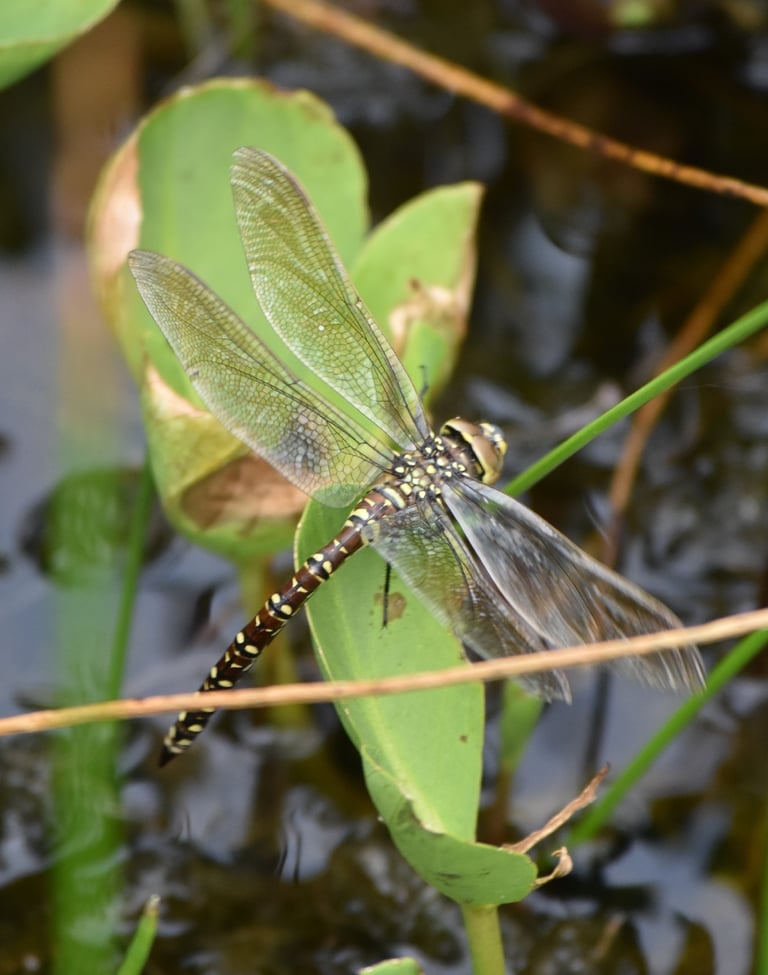
Photographs from via iNaturalist, licensed under CC0 1.0., by Leonard Worthington via iNaturalist, licensed under CC BY 4.0., by Demian Hiß via iNaturalist, licensed under CC BY 4.0., by Leon Haag-Fank via iNaturalist, licensed under CC BY 4.0., and by harry beaman via iNaturalist, licensed under CC BY 4.0., credited on each photo.
Ecology and classification
Classification
- Phylum
- Arthropoda
- Class
- Insecta
- Order
- Odonata
- Family
- Libellulidae
- Genus
- Libellula
- Species
- Libellula depressa
Sources
- GBIF Species names and classification
- iNaturalist Photos
- Wikidata Common names and conservation status
- Wikipedia Summary extract