The Libellula quadrimaculata goes by two different names depending on where you stand: Europeans call it the four-spotted chaser, while in North America it is known as the four-spotted skimmer.
This dragonfly belongs to the family Libellulidae within the order Odonata, and it is currently assessed as Least Concern, meaning it faces no significant global threat. Its broad range and distinctive markings make it one of the more recognizable chasers wherever ponds and slow water occur.
Identification and Appearance
The four dark spots along the leading edge of the wings give this dragonfly its name and are the easiest way to identify it in flight or at rest. Combined with an overall brown body coloration, this pattern makes Libellula quadrimaculata fairly easy to pick out among perched dragonflies.
Despite this distinctive marking, it can still be confused with other Chaser dragonflies that share a similar brown body and wing shape. Observers should look closely at the wing spots themselves, since related species in the same genus can show variation in spotting that requires a careful side-by-side comparison rather than a quick glance.
Distribution and Habitat
The four-spotted chaser favors still or slow-moving fresh water, turning up most often around ponds, vernal pools, and slow-flowing rivers. These standing and gently moving waters provide the floating vegetation and open margins the species depends on throughout its active season.
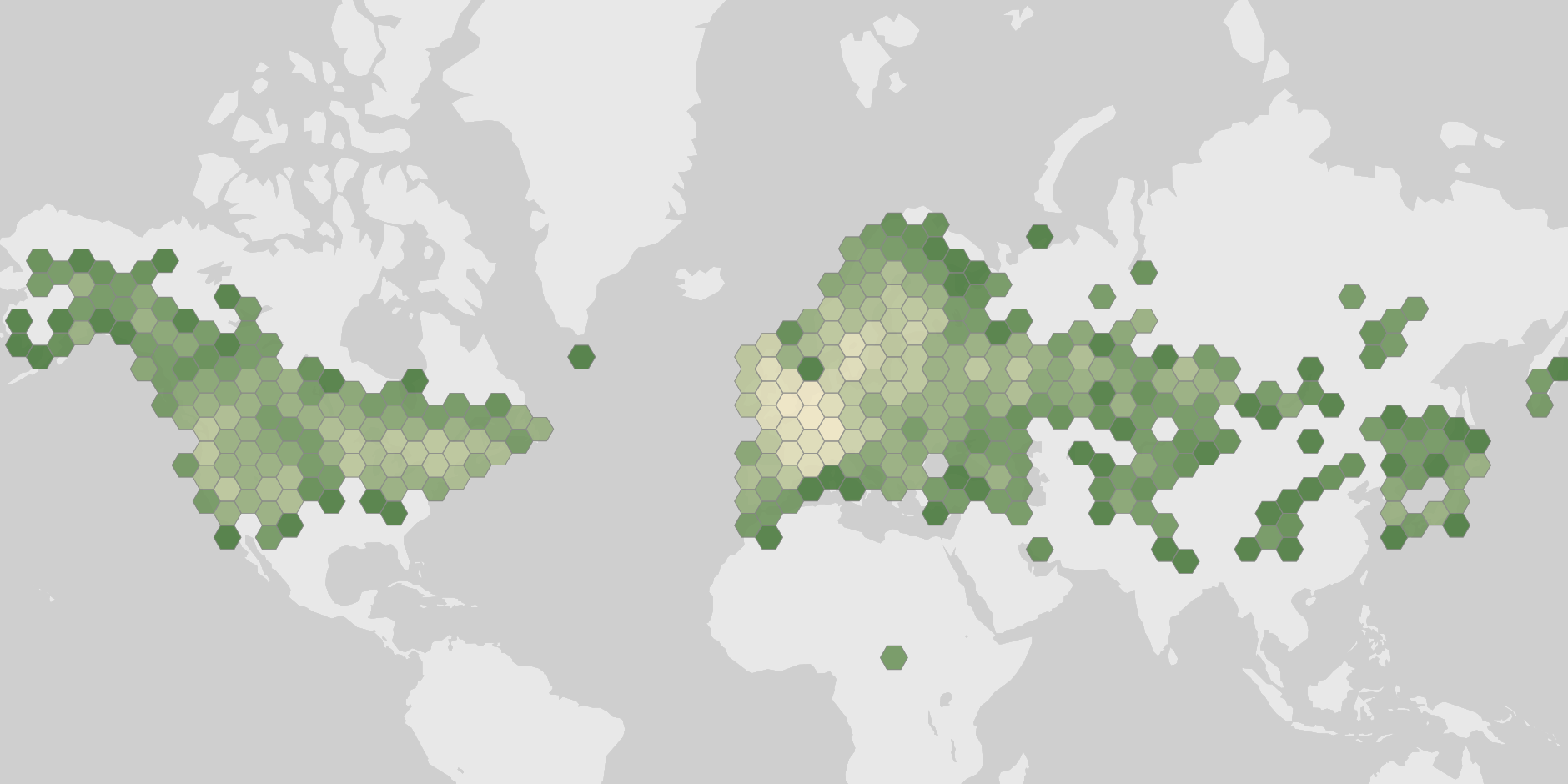
Monthly observation data show a sharp seasonal pattern, with sightings climbing from a handful in early spring to a peak of nearly 200,000 in June before tapering off through the summer and falling to low numbers by autumn and winter. This lines up with reports that the species is most common in June and July, though the observation counts reflect presence rather than true abundance or the full extent of its range.
The pattern suggests strong seasonal activity tied to warmer months across its wide range spanning Europe, Asia, and North America, with adults becoming scarce outside this window rather than disappearing from the landscape entirely.
Behavior and Lifestyle
Male four-spotted chasers are highly aggressive and defend territory around ponds and pools, chasing off rival males that intrude on their patch. Rather than roaming widely, a male tends to settle on a favored perch and return to it repeatedly while patrolling for both threats and mates.
These perches are chosen with a specific view of the sky: males favor a patch away from the sun, where light is lower in overall radiation but richer in ultraviolet and blue-violet wavelengths. This suits the blue- and UV-sensitive fovea of their eyes, letting them spot flying insects silhouetted against the sky with great precision.
Both sexes are strong, near-constant fliers, and mating itself happens in mid-air rather than on a perch or amid vegetation, a trait shared by many other chasers but still notable for how little time this species spends stationary. Females return to the water to lay eggs directly onto floating vegetation.
Compared to the Broad-bodied Chaser, four-spotted chasers are described as easier to approach, making them a more forgiving subject for anyone trying to watch dragonfly behavior up close.
Population and Ecological Role
Within its pond and slow-river habitats, the four-spotted chaser sits in the middle of a food web rather than at its top. The larger emperor dragonfly, Anax imperator, hunts this species, and the green tiger beetle, Cicindela campestris, is another predator that takes it.
This predation pressure from a bigger dragonfly and a ground-hunting beetle places the four-spotted chaser as prey within its wetland community, even as it plays its own predatory role among smaller insects sharing the same ponds and rivers.
Fun Facts
- The species carries two common names depending on the continent: four-spotted chaser in Europe and four-spotted skimmer in North America.
- It belongs to the family Libellulidae within the order Odonata, placing it among the true skimmer dragonflies.
- Its range stretches across three continents, spanning Europe, Asia, and North America.
Conservation status
- LC
- NT
- VU
- EN
- CR
Least Concern
Ecology
Habitat
- Wetland
- Freshwater
Behavior
- Territorial
- Aggressive