The silver birch is one of the first trees to take root on bare, disturbed ground, colonizing burned land, cleared forest, and abandoned plots before almost any other tree can establish itself there. This pioneering habit, paired with its light, wind-borne seeds, has let the species spread across an enormous range.
Betula pendula, commonly called the silver birch, is a deciduous tree in the family Betulaceae. It grows natively across Europe, Morocco, temperate Asia, and into Canada and Alaska, reaching into Siberia, China, and the mountains of Turkey, the Caucasus, and Iran. The IUCN lists it as a species of Least Concern.
Beyond its ecological role, the tree carries deep cultural weight, serving as Finland's national tree and a recurring symbol of purity and renewal across northern European folklore. Its papery white bark and the huge web of insects, fungi, and birds that depend on it make it one of the more quietly important trees of the temperate north.
Identification and Appearance
The single best field mark is the bark: golden-brown on young stems, it turns white as papery tissue develops and peels away in flakes, eventually becoming dark, thick, and deeply fissured on old trunks. The silver birch typically stands 15 to 25 meters tall, exceptionally up to 31 meters, with a slender trunk usually less than 40 centimeters in diameter.
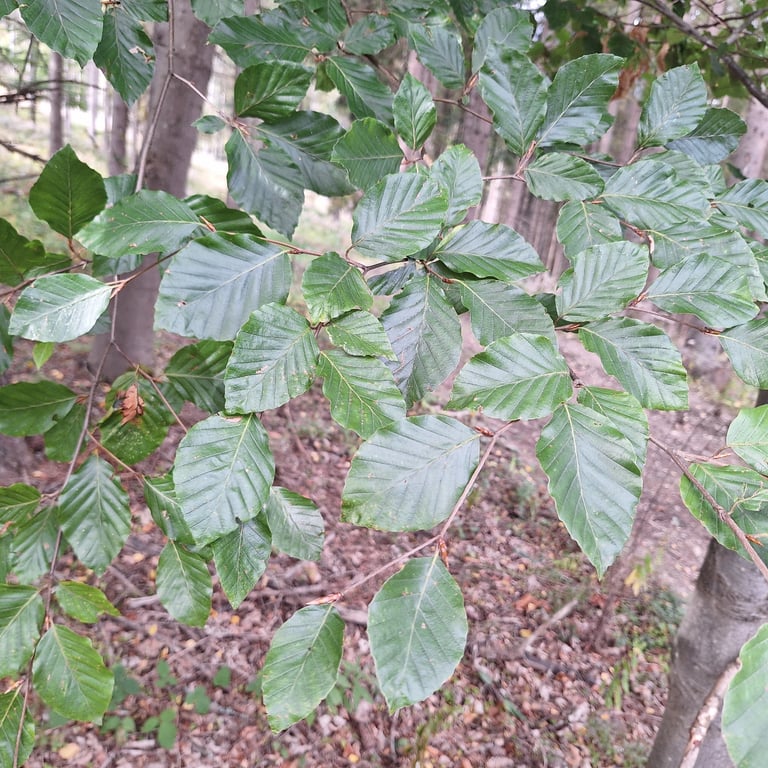
The tree has a graceful, open form with slender, hairless twigs that are often pendulous, giving the species its name. Young branches carry whitish resin warts, and the small, sticky buds grow in a sympodial pattern, meaning the terminal bud dies back and growth continues from a lateral bud. The leaves are triangular, 3 to 7 centimeters long, with broad wedge-shaped bases, pointed tips, and coarsely double-toothed margins; they are pale to medium green, turning yellow early in autumn.
The species is monoecious, bearing separate male and female catkins on the same tree. Immature male catkins persist through winter, while female catkins appear in spring alongside the new leaves. By midsummer the male catkins release pollen, one catkin producing an average of 1.66 million grains, and the pendulous female catkins ripen into cylindrical clusters 2 to 4 centimeters long packed with tiny winged seeds.
Silver birch is easily confused with the downy birch (Betula pubescens), but the two are simple to tell apart: downy birch has hairy leaves and young shoots, while silver birch is hairless throughout, and its leaf base meets the stalk at a right angle rather than the rounded base typical of downy birch. The two species do occasionally hybridize despite their genetic differences.
Distribution and Habitat
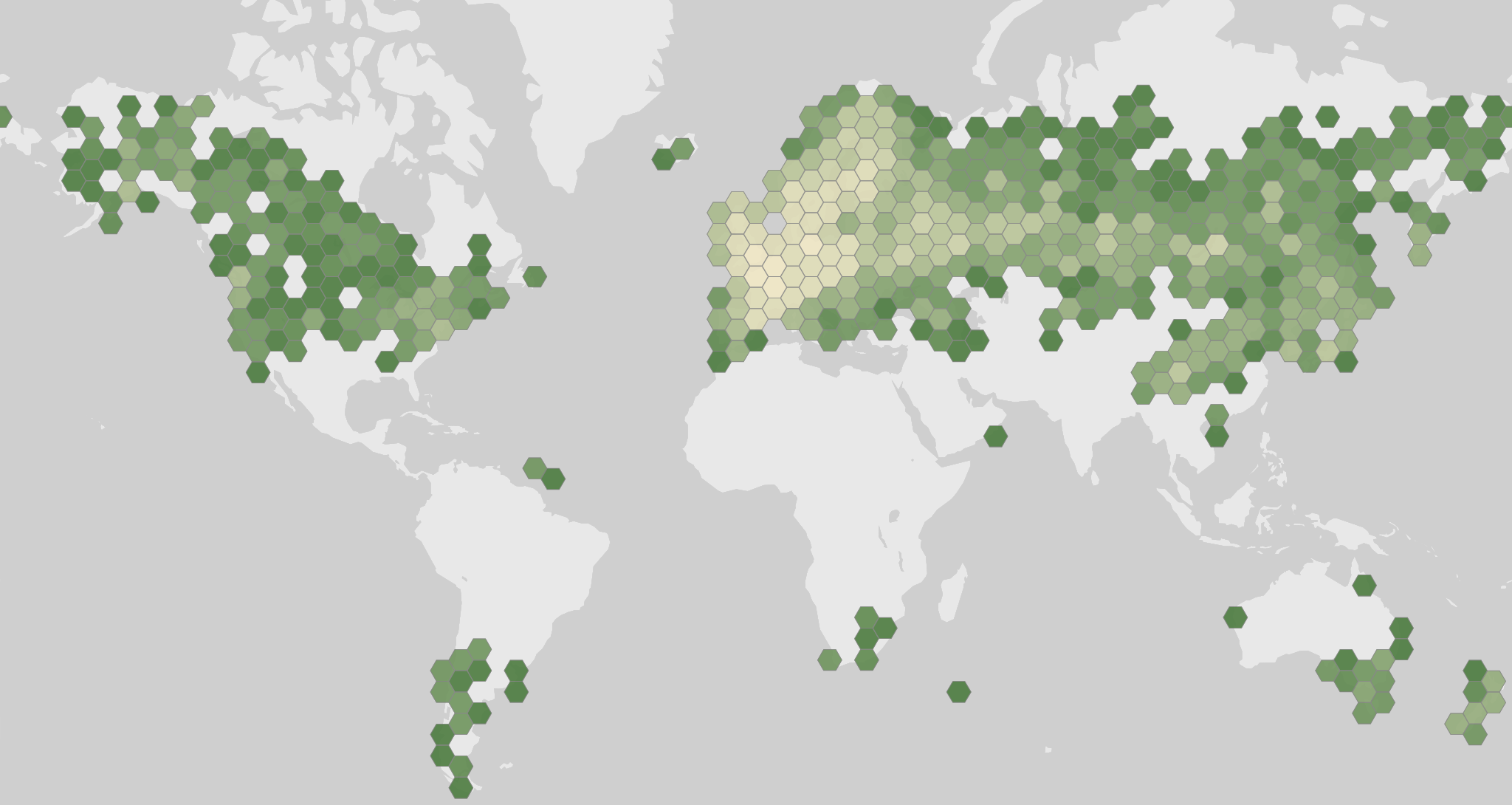
Silver birch grows naturally from western Europe eastward across Kazakhstan and the Sakha Republic in Siberia to Mongolia and Xinjiang in China, and south to the mountains of the Caucasus, northern Iran, Iraq, and Turkey. It is also native to northern Morocco, where, as in southern Europe, it survives only at higher elevations; across the southern edge of its range it is largely confined to mountainous country.
The species favors open, sunlit ground with dry, acidic soils, and turns up on heathland, mountainsides, and rocky crags as well as in temperate broad-leaved forests between roughly 500 and 2,300 meters elevation. It also readily settles into abandoned plantings, roadsides, and the edges of bogs at lower elevations from sea level to about 350 meters, and its tolerance of pollution makes it a common choice for industrial and exposed urban sites.
Monthly observation counts peak sharply from June through August, with the highest tallies in July, before dropping off through autumn and winter. This pattern likely tracks when the tree is most conspicuous and actively observed rather than any real shift in where it grows, since these figures reflect presence records rather than population size.
Humans have introduced the species well beyond its native range, most notably to North America, where it is known as the European white birch. It has become naturalized and is considered invasive in the states of Kentucky, Maryland, Washington, and Wisconsin, as well as in parts of Canada.
Ecology and Relationships
The silver birch's open, light canopy lets sunlight reach the forest floor, supporting an understory of mosses, grasses, and flowering plants such as primrose, violet, bluebell, wood anemone, and wood sorrel, along with low shrubs like blaeberry and cowberry. This layered habitat in turn draws birds including the chaffinch, tree pipit, willow warbler, nightingale, robin, woodcock, redpoll, and green woodpecker.
The tree forms a mutualistic mycorrhizal relationship with fungi, most notably Amanita muscaria, along with Leccinum scabrum and Cantharellus cibarius, a partnership especially important on acidic or nutrient-poor soils. Soil microfauna add to this exchange by extending fungal hyphal networks that improve nutrient uptake. Less benignly, the fungus Taphrina betulina causes the tangled twig clusters known as witch's brooms, and Fomitopsis betulina commonly kills old trees outright, after which fallen branches decay rapidly on the forest floor.
Few trees support as much insect life: in Germany, nearly 500 insect species have been recorded on silver and downy birch combined, including 106 beetles and 105 moths and butterflies, with 133 species feeding almost exclusively on birch. Planted trees can suffer from birch dieback disease, which spread through many 1990s plantings in Scotland by 2000, while naturally regenerated trees appear less vulnerable. In North America, the bronze birch borer attacks the species, which has no natural resistance to this introduced pest.
Uses and Human Relationships
Across northern Europe, birch has long symbolized birth, purity, love, and renewal. Irish mythology uses birch to fashion the bed in the love story of Diarmuid and Gráinne, Slavic tradition ties it to purity and the arrival of spring, and early Celtic custom burned bundles of birch twigs to drive out the old year's spirits, a practice echoed today in the birch besom broom still used to "purify" gardens.
The silver birch is Finland's national tree, and bundles of its fragrant young boughs, called vihta or vasta, are used to gently beat the skin while bathing in a sauna. Its pale wood, tinged with light reddish-brown heartwood, goes into furniture, plywood, veneer, parquet, skis, and kitchen utensils, and it burns well as firewood, though quickly. Bark has served as roofing shingles, tanning material, and the source of a waterproof resin glue, while thin peeling sheets and dead twigs make excellent, easily lit tinder even when damp; bark stripping was once so widespread that Carl Linnaeus voiced concern for the survival of birch woodlands.
In spring the rising sap, containing about 1% sugar, is tapped and drunk fresh, concentrated, or fermented into a wine, much like maple syrup elsewhere. The bark's outer layer holds up to 20% betulin, and extracts from Betula pendula and the closely related Betula pubescens are used in a European-approved treatment for epidermolysis bullosa, while a standardized birch pollen extract sold as Itulatek is used in Canada to test for and manage allergic reactions to birch, alder, and hazel pollen. Ornamental cultivars such as 'Carelica' (curly birch, prized for its burled wood), 'Purpurea' (dark purple leaves), 'Tristis', and 'Youngii' are grown for garden and landscape use, several holding the Royal Horticultural Society's Award of Garden Merit.
Conservation and Threats
The IUCN lists Betula pendula as a species of Least Concern, reflecting its wide native range across Europe, North Africa, and temperate Asia and its ability to colonize disturbed ground readily. This status means the species faces no immediate risk of extinction across its range as a whole.
The taxonomic history includes some past confusion: the synonym Betula oycowiensis was once listed separately as Vulnerable but is now treated as part of B. pendula subsp. pendula, and B. szaferi, once considered extinct in the wild, is now understood to be a weak-growing, heavy-fruiting form of B. pendula carrying a mutant gene rather than a distinct threatened species.
Historically, heavy bark stripping for tanning and other uses was widespread enough that Carl Linnaeus expressed concern for the survival of birch woodlands, though no ongoing large-scale threat is documented for the species today.
Conservation status
- LC
- NT
- VU
- EN
- CR
Least Concern
Fun Facts
- Finland's national tree, the silver birch lends its fragrant young boughs, called vihta or vasta, to the traditional practice of gently beating the skin while bathing in a sauna.
- The Finnish cultivar 'Carelica', known as visakoivu or curly birch, produces wood that is burled throughout and prized for wood-carving and decorative veneer.
- Spring sap tapped from the trunk contains about 1% sugar and can be drunk fresh, concentrated, or fermented into a wine, much like maple syrup.
- The outer bark contains up to 20% betulin, a compound that has drawn interest in laboratory research into its biological properties.
- Concern over excessive bark stripping for tanning was significant enough that Carl Linnaeus himself worried about the survival of birch woodlands.
- Across Irish, Slavic, and Celtic traditions alike, birch recurs as a symbol of purity, renewal, and the return of spring.
Ecology
Habitat
- Wetland
- Forest
- Mountain
- Disturbed Ground
Growth habit
- Tree