One European beech growing at the Valle Cervara site in Italy has stood for more than 500 years, making it among the oldest known individuals of any tree in the Northern Hemisphere.
Fagus sylvatica, known as the European beech or common beech, is a large deciduous tree of the beech family with smooth, silvery-grey bark and a large leaf canopy. It is native across much of Europe, thriving in humid climates from Scandinavia to the Mediterranean mountains, and is classified as Least Concern.
Few European trees combine such a wide native range with such a strong hold on both wild forests and cultivated landscapes. Its cultural history, ancient stands, and role as a dominant hardwood make it one of the continent's most recognizable trees.
Identification and Appearance
The most useful field mark is the tree's smooth, silvery-grey bark, which stays largely unbroken even on old trunks, unlike the deeply furrowed bark of many other large hardwoods. Mature European beeches typically reach 25 to 35 meters in height with trunk diameters up to 1.5 meters, though exceptional forest-grown individuals can reach 50 meters tall with trunks 3 meters across. A ten-year-old sapling stands only about 4 meters tall, and trees need roughly 30 years to reach full maturity.
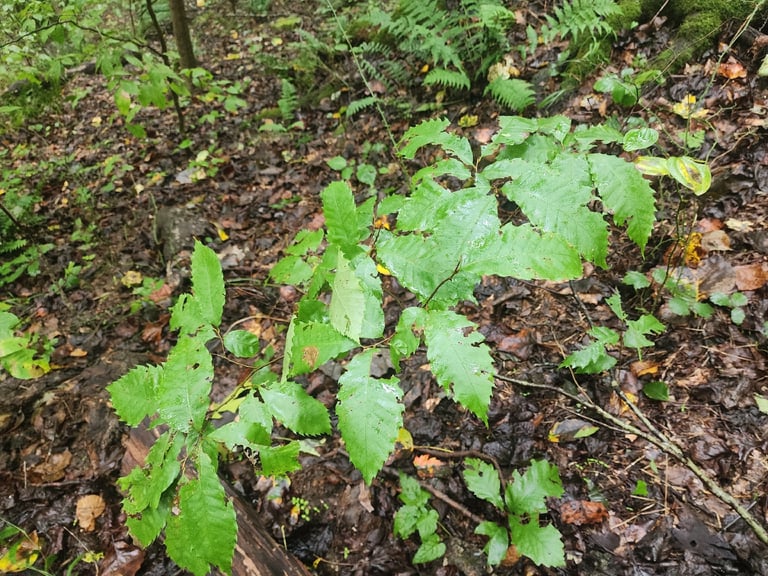
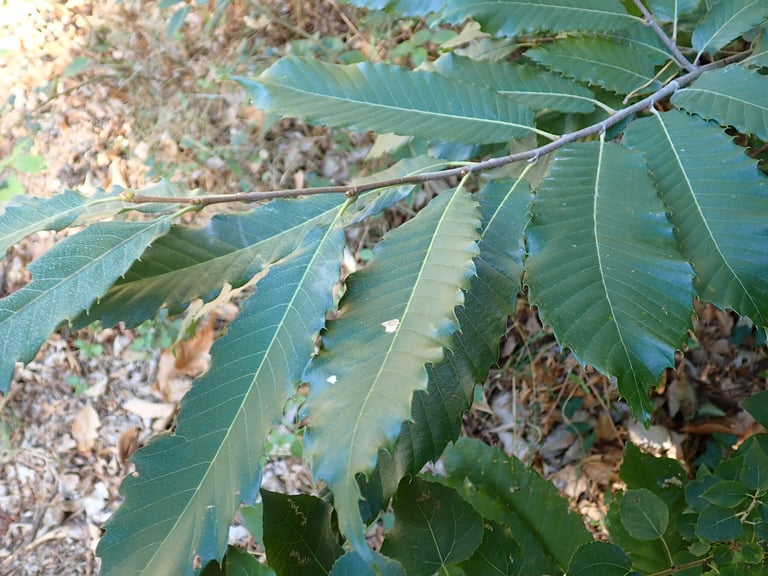
The leaves are alternate, simple, and 5 to 10 centimeters long, with a slightly crenate margin and 6 to 7 veins on each side—a detail that separates F. sylvatica from the related Fagus orientalis, which has 7 to 10 veins per side. Buds are long and slender, 15 to 30 millimeters long, and noticeably thicker where they contain flower buds. A distinctive trait is marcescence: leaves, especially on saplings, hedges, and lower branches of mature trees, often stay attached through winter instead of dropping in autumn.
The species is monoecious, with small male catkins typical of the Fagales order and separate female flowers that develop into triangular beechnuts 15 to 20 millimeters long, paired within a spiny cupule. Heavy seed crops tend to follow a hot, dry summer, though rarely in two consecutive years, and trees rarely produce a substantial nut crop before age 30.
Growth form shifts strongly with setting: in dense forest, trees grow tall and slender with branches held high on the trunk, while open-grown individuals are shorter, often around 20 meters, but stockier, with a broader crown and thicker trunk.
Distribution and Habitat
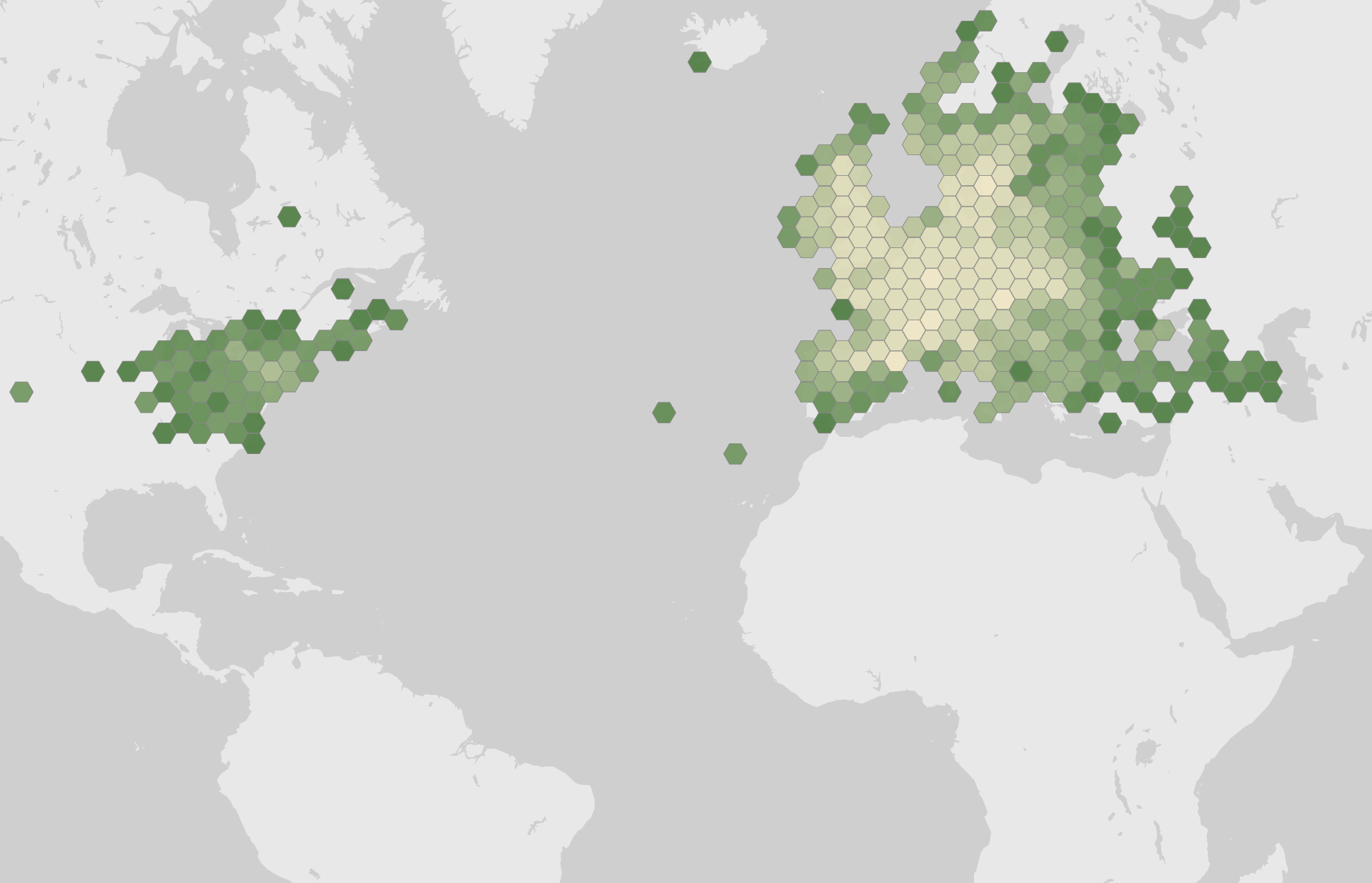
The European beech's native range stretches from Sweden, Norway, and Denmark in the north through Germany, Poland, Switzerland, Bulgaria, western Ukraine, and Romania, west to France and southern England, and south to Spain, Italy, and northwest Turkey, where it grades into the related Fagus orientalis. In the Balkans it hybridizes with oriental beech to form Fagus × taurica. Around the Mediterranean and in Sicily, it is confined to mountain forests between 600 and 1,800 meters elevation.
The tree favors chalky or limestone-rich soils and well-drained slopes over low-lying, waterlogged ground, and it needs a humid atmosphere with rainfall spread through the year. It tolerates harsh winter cold but is vulnerable to late spring frosts. Its status as native in parts of its range is debated: in southern England it is considered indigenous, while northern English populations and much of the Norwegian beech population appear to result from early human introduction, possibly by Stone Age foragers who used the nuts for food.
Within its range the species can be locally dominant. It makes up about 10 percent of French forests and is the most abundant hardwood in Austrian, German, and Swiss woodlands. In southern Britain it dominates over oak and elm south of a line running roughly from north Suffolk to Cardigan. The largest surviving old-growth beech forests, Uholka-Shyrokyi Luh in Ukraine and Izvoarele Nerei in Romania's Semenic-Cheile Carașului National Park, contain trees older than 350 years, with some in Uholka-Shyrokyi Luh exceeding 500 years.
Monthly observation records show a strong seasonal pattern, rising from around 76,000 in January to a peak near 196,000 in July before falling back below 27,000 by December. This pattern most likely reflects when the leafed-out tree is easiest for observers to notice and record, rather than any change in the tree's actual abundance.
Ecology and Relationships
The European beech has a shallow, even superficial root system, with large roots spreading widely rather than driving deep into the soil. It depends heavily on ectomycorrhizal partnerships with fungi, including numerous Russula species, Laccaria amethystina, and Ramaria flavosaponaria, along with Tomentella species and Cenococcum geophilum recorded in Danish and Spanish beech forests; these fungal partners improve the tree's uptake of water and nutrients.
Because its leaves and shoots develop in a fixed, predetermined pattern and its canopy has a larger leaf area than other European hardwoods, the species is comparatively sensitive to drought, sometimes responding to a dry summer by dropping leaves early. Stress from drought, poor soil, branch breakage, or pathogens can trigger false heartwood, or "red heart," a defensive wood change that depletes nitrogen-containing compounds in the trunk and raises the risk of catastrophic trunk failure. The fungus Biscogniauxia nummularia, known as beech tarcrust, is a primary pathogen causing strip-canker and wood rot, and is present on affected trees year-round.
In the largest surviving old-growth beech forests of Ukraine and Romania, these woodlands provide habitat for some of Europe's largest predators, including brown bears, grey wolves, and lynx.
Uses and Human Relationships
European beech is widely planted as an ornamental tree in parks and large gardens across temperate regions, and in North America it is often preferred over the native Fagus grandifolia because it matures roughly a decade faster. The Longwood Mall in Brookline, Massachusetts, a 2.5-acre park planted before 1850, holds one of the largest and oldest stands of European beech in the United States. Since the early 19th century, horticultural selection has produced numerous cultivars, including copper or purple beech (a mutation traced to a single tree found in 1690 in Thuringia, Germany, that is the ancestor of an estimated 99 percent of copper beeches worldwide), fern-leaf beech, dwarf beech, weeping beech, the columnar Dawyck beech, and golden beech.
The timber is fine-grained, easy to work, steam, dye, and glue, with a density of about 720 kilograms per cubic meter. It resists compression and splitting and is used for furniture, parquet flooring, staircases, mallets, and workbench tops, though it rots quickly outdoors unless treated, traditionally with a tar distilled from its own bark, as used on railway sleepers. Its high cellulose content also suits it for paper pulp and for spinning into the modal textile fiber, and it ranks among the preferred firewoods for fireplaces.
In Celtic mythology, Fagus was the god of beech trees, and the tree was credited with medicinal properties; its leaves were reportedly boiled into a poultice used to relieve swellings. The beech was also linked to wisdom and knowledge in Celtic tradition, and in Gallo-Roman religion, Fagus is known from four inscriptions found in the Hautes-Pyrénées.
Fun Facts
- The name Fagus is thought to derive from a root meaning "growing in the forest," tying the tree to its long history as a food source: beechnuts fed prehistoric communities across Europe.
- The tree's smooth bark was once used as an early writing surface by various cultures, a practice echoed in later legends describing beech as a "book tree" tied to the passing down of wisdom and history.
Conservation status
- LC
- NT
- VU
- EN
- CR
Least Concern
Ecology
Habitat
- Forest
- Mountain
Growth habit
- Tree