The American chestnut once formed such dense stands across the eastern United States that, as the old saying goes, a squirrel could travel from New England to Georgia without ever touching the ground, moving branch to branch through unbroken chestnut canopy. Today that same species is listed as Critically Endangered.
Castanea dentata is a large, fast-growing deciduous hardwood in the beech family (Fagaceae), native to eastern North America. Like all species in its genus, it produces burred fruit containing edible nuts. Its story of near-total collapse, and the ongoing efforts to understand and reverse it, make it one of the most closely watched tree species in North American conservation.
Identification and Appearance
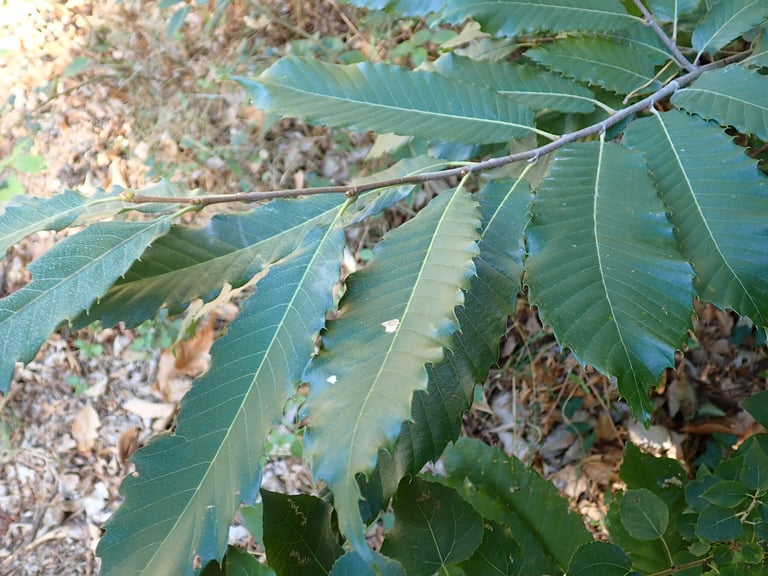
The most reliable field mark is the leaf: long, narrow, and lined with large, widely spaced saw-teeth, a shape reflected in the species name dentata, Latin for "toothed." Leaves measure 14 to 20 centimeters (5.5 to 8 inches) long and 7 to 10 centimeters (3 to 4 inches) wide, slightly shorter and broader than those of the closely related European sweet chestnut (C. sativa).
Historically the species reached great size. Pre-blight records describe trees up to 30 meters (100 feet) tall with trunks as wide as 4 meters (13 feet) in diameter, and a single surviving specimen in Maine has reached 35 meters (115 feet). Post-blight claims of even larger historical trees are generally considered exaggerated, the product of nostalgia and confusion between circumference and diameter measurements rather than genuine record sizes.
The tree is monoecious and usually protandrous, bearing many small, pale green to nearly white male flowers along catkins 6 to 8 inches long, with female flowers near the catkin base close to the twig. Burrs typically enclose three nuts, each lined in tan velvet, distinguishing the species from the Allegheny chinquapin (C. pumila), which produces only one nut per burr and is considerably smaller overall.
Several introduced relatives can be confused with the American chestnut. The European sweet chestnut has hairy twig tips, unlike the hairless twigs of C. dentata, while the Japanese chestnut (C. crenata) has narrower leaves with small, sharply pointed teeth and hairy undersides, and is notably more blight-resistant than the American species.
Distribution and Habitat
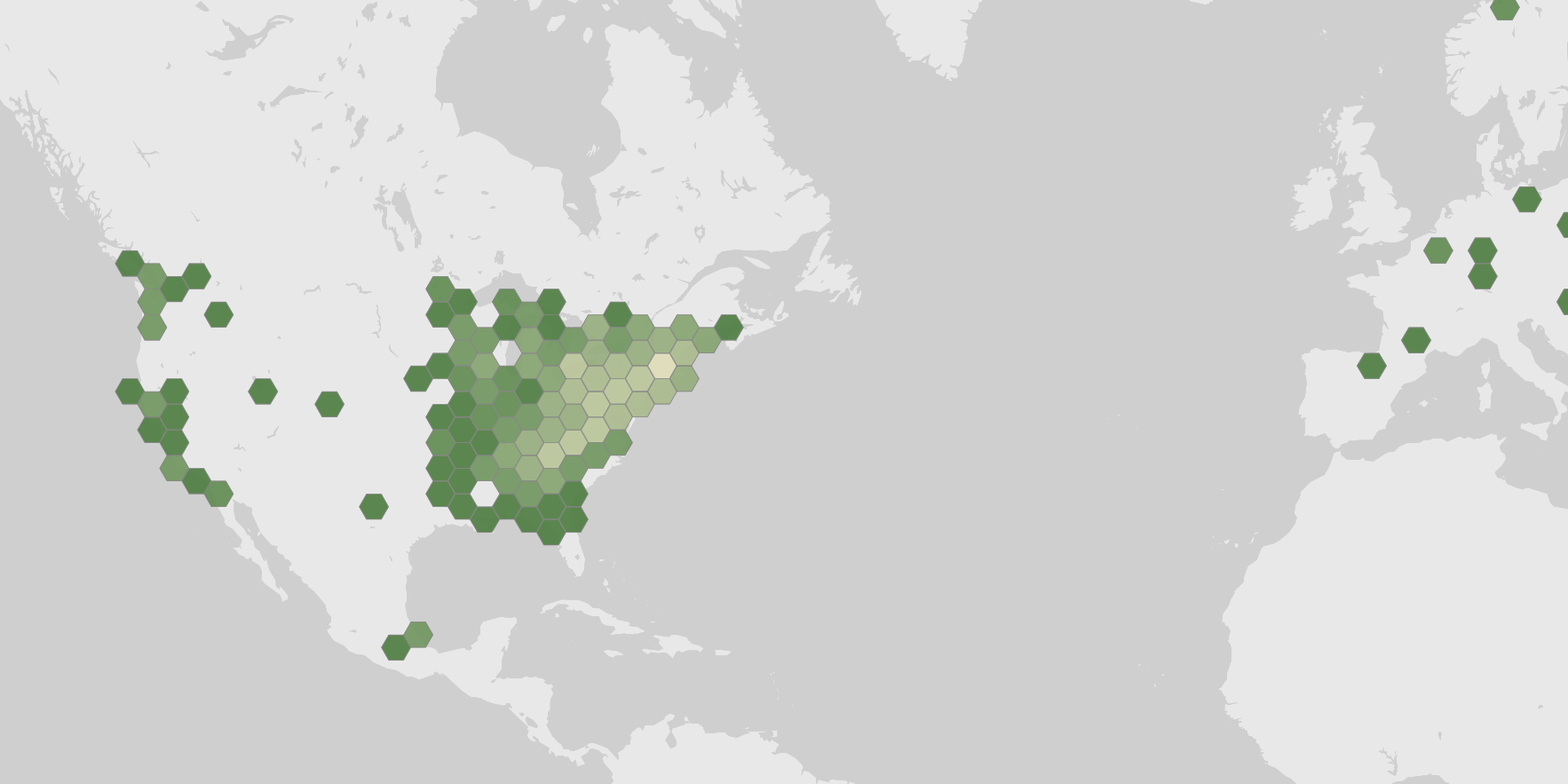
Historical range placed the American chestnut across eastern North America, where it once dominated the canopy of Appalachian oak-chestnut forests in the central and southern part of its range. Monthly presence-observation data show a strong seasonal pattern, with reported sightings rising sharply from a low in the winter months to a pronounced peak in June and remaining elevated through July and August before falling off again by late autumn.
This pattern most likely reflects when the tree is easiest to observe and record, particularly during leaf-out and the growing season, rather than any true seasonal movement, since chestnuts are stationary trees. As with all such records, these figures represent presence observations only, not measures of abundance, population size, or the species' complete native range.
Ecology and Relationships
Before the twentieth century, the American chestnut was a dominant tree of the eastern deciduous forest, contributing to the canopy density that gave rise to the image of a squirrel crossing from New England to Georgia on chestnut branches alone. That dominance collapsed after chestnut blight, caused by the Asian bark fungus Cryphonectria parasitica, arrived in North America via imported Japanese chestnut trees in the late nineteenth century.
First identified in 1904 at what is now the Bronx Zoo, the airborne fungus spread at roughly 80 kilometers (50 miles) per year, girdling and killing more than three billion American chestnut trees within a few decades. Asian chestnut species had co-evolved with the pathogen and developed strong resistance, but the American chestnut and the Allegheny chinquapin had almost none.
The blight kills only the above-ground portion of the tree, so many individuals persist by resprouting from surviving root systems. These stump sprouts rarely grow taller than 6 meters (20 feet) before blight reinfects the new stem, a cycle that has prevented the species from re-establishing and led to its classification as functionally extinct across its native range, even though it has not disappeared outright.
Uses and Human Relationships
The wood of the American chestnut was prized commercially for being straight-grained, strong, easy to saw and split, and resistant to decay thanks to its high tannin content. It was used for furniture, split-rail fences, shingles, home construction, flooring, piers, plywood, paper pulp, and telephone poles, and tannins extracted from the bark went into leather tanning. An 1888 issue of Orchard and Garden rated the American nut as "superior in quality to any found in Europe."
Because large living trees are no longer available for milling, much chestnut wood now used in furniture is reclaimed from historic barns. A distinctive category known as "wormy" chestnut, sawn from long-dead, blight-killed trees and marked by insect damage, has become fashionable for its rustic character.
The tree also carries deep cultural symbolism. To early Christians, chestnuts represented chastity, hidden virtue, and honesty, as well as fertility, and in Greek mythology children were said to be found in the hollow of an old chestnut tree before the stork took on that role. The species appears in American literature as well, including Washington Irving's "The Legend of Sleepy Hollow" and Nathaniel Hawthorne's A Wonder-Book for Girls and Boys.
Conservation and Threats
The American chestnut is classified as Critically Endangered, and survival of the species for more than a decade within its native range is now considered almost impossible. The chestnut blight remains the primary threat: the fungus can persist on oak trees, which it does not harm, while nearby chestnuts succumb within about a year, and the many old stumps and "living stools" scattered through eastern woodlands may still harbor active pathogens.
The species is already considered extirpated from Florida and Illinois. Outside its blight-affected native range, large trees survive in pockets of the blight-free West, where settlers carried seeds in the nineteenth century; notable planted specimens grow in Sherwood, Oregon, and the tree thrives as far north as Revelstoke, British Columbia, where drier, less humid summers discourage the fungus.
The collapse of the species has had ripple effects through the food web. Of roughly 60 insect species that fed on the American chestnut, seven depended on it entirely, and some, such as the American chestnut moth, are now extinct or reduced to remnant populations.
Conservation status
- LC
- NT
- VU
- EN
- CR
Critically Endangered
Fun Facts
- A single surviving American chestnut in Maine has reached 35 meters (115 feet) tall, taller than most pre-blight records for the species.
- Chestnut burrs are typically about the size of a fist and almost always enclose exactly three nuts, though not all three are always fully formed.
- In Greek mythology, children were said to be found in the hollow of an old chestnut tree, a role later taken over by the stork in folklore.
- Early Christians associated chestnuts with chastity, hidden virtue, honesty, and fertility.
- Some post-blight accounts of unusually large historical American chestnuts are now thought to be exaggerated, arising from nostalgia and from mistaking old circumference measurements for diameter.
Ecology
Habitat
- Forest
- Mountain
Growth habit
- Tree