Few trees carry as much ecological weight as Quercus robur, a species long prized for its role in supporting a wide diversity of herbivorous insects, acorn-eating mammals and birds, and fungi across its native range.
Known also as the pedunculate oak or European oak, this member of the beech and oak family, Fagaceae, is a large deciduous tree native to most of Europe and western Asia, now widely cultivated in other temperate regions. It carries a global conservation status of Least Concern, reflecting its broad range and continued abundance. Beyond its size and longevity, what makes this species worth knowing is its outsized role in the ecosystems it inhabits, a value recognized wherever it grows.
Identification and Appearance
The clearest way to identify Quercus robur is by its leaves: they have a distinctive cordate, auricled base and a very short petiole, typically only 2–3 mm long, features that separate it from its closest relative, the sessile oak.
This is a large deciduous tree, typically reaching up to 20 meters in height but sometimes growing as tall as 40 meters, with a single stout trunk usually up to 4 meters in girth and occasionally exceeding 10 meters, or even 14 meters in old pollarded specimens. The crown is spreading and unevenly domed, often carrying massive lower branches, while the bark is grayish-brown with closely grooved vertical plates. Large burrs frequently appear on the trunk, sprouting clusters of small shoots, and older, pollarded trees tend to outlive and outgrow their unpollarded counterparts.
The leaves themselves are arranged alternately, broadly oblong or ovate, 10–12 cm long by 7–8 cm wide, with 3–6 rounded lobes cut no more than halfway to the midrib. They are dark green above and paler below, largely hairless, and often speckled with small spangle galls by autumn. In spring, typically early May in Northern Europe, the tree produces wind-pollinated flowers: narrow male catkins 2–4 cm long in small bunches, and tiny brown female flowers with dark red stigmas at the tips of new shoots. The resulting acorns, 1.5–4 cm long and ovoid with a pointed tip, ripen from whitish-green to brown and then black, borne in clusters of two or three on a long stalk 4–8 cm in length and held in a distinctive shallow cup.
Quercus robur is most often confused with sessile oak, but it can be told apart by its auricled leaf base, very short petiole, long-stalked acorn clusters, and the absence of star-shaped hairs beneath the leaf; the two species do hybridize where their ranges overlap, producing Quercus × rosacea. Turkey oak is a rarer source of confusion, distinguished by whiskered winter buds, leaf lobes cut more than halfway to the midrib, and differently shaped acorn cups.
Distribution and Habitat
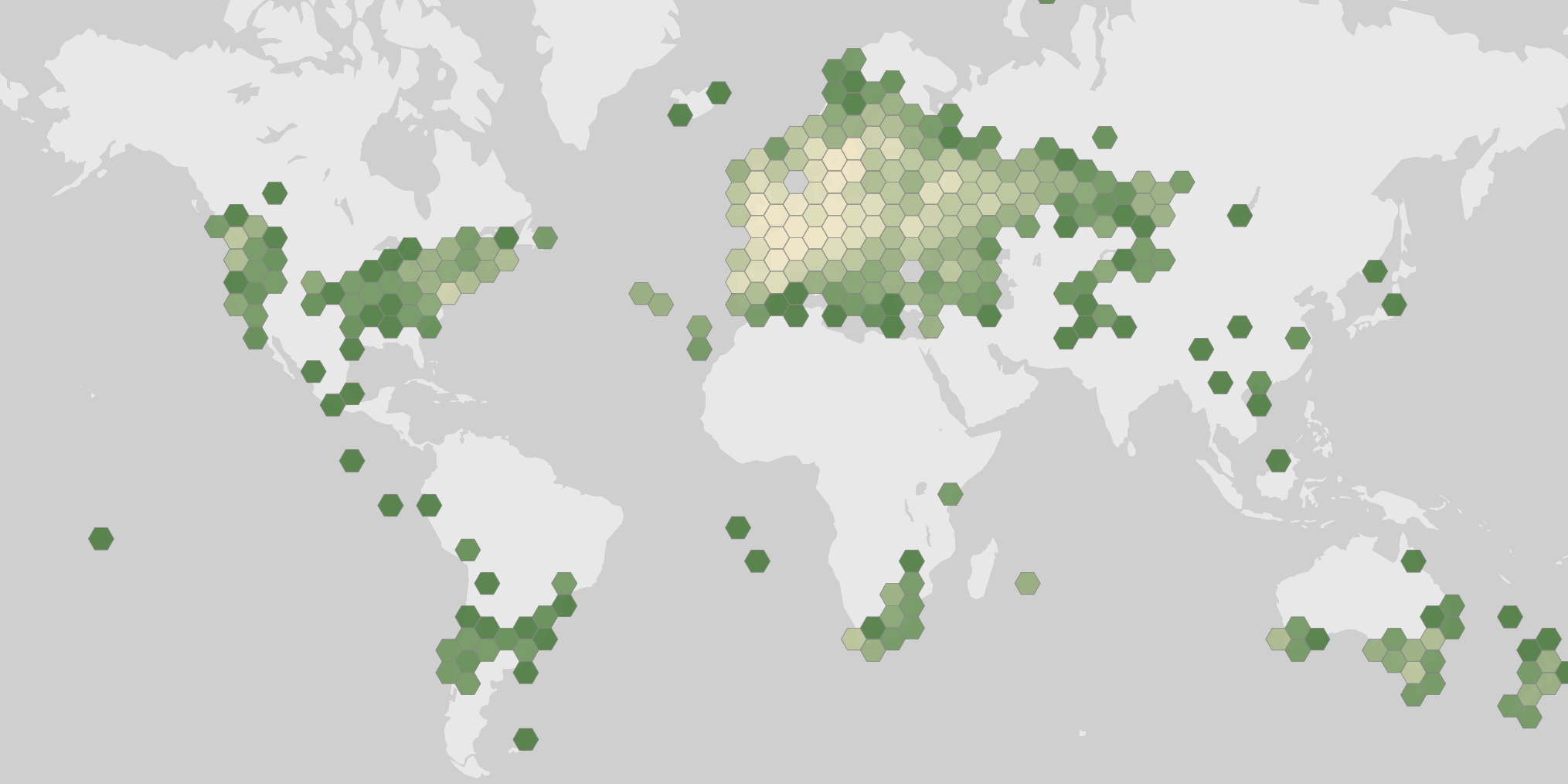
Pedunculate oak occurs across most of Europe and western Asia, and has been widely planted in other temperate regions, including parts of China such as Beijing, Shandong, and Xinjiang, where it grows only as a cultivated tree. Within its native range it favors lowland sites with near-neutral soil, thriving in high-canopy woodland, coppice, and wood pasture, and it is commonly planted in hedgerows.
The species is uncommon on thin, well-drained chalk or limestone soils but tolerates intermittent flooding, appearing along the margins of swamps, rivers, and ponds. It typically grows at elevations from sea level up to 1,000 meters, along roadsides, in pastures, and at forest margins as well as within closed woodland. Its Ellenberg indicator values point to a preference for bright light, moderate temperature and moisture, and a wide tolerance of soil nutrient levels, with very low tolerance for salinity.
Monthly observation data show a strong seasonal pattern, with reported sightings rising sharply from a low in December and January to a pronounced peak between May and August, before declining again through autumn. This pattern most likely reflects when the tree is easiest to notice and identify, in leaf and often bearing catkins or acorns, rather than any true change in how many trees are present, since these are presence records and not a measure of population size or complete range.
Uses and Human Relationships
For centuries, people have turned to Quercus robur for timber, food, and symbolism alike. Its heartwood is long-lasting and durable, prized for interior work and furniture, with a density around 720 kg per cubic meter and growth rings marked by distinct wide bands of dark and light brown wood. Despite their high tannin content, which makes them bitter, the acorns can be roasted and ground into a coffee substitute, a use recorded across several cultures that regarded acorns as an early human food source.
The tree's cultural weight runs deep. In Celtic lore it was linked to the worship of the Celtic Jupiter, connected to fairies, spirits, and protective magic in Irish mythology, while ancient Greeks, Romans, and Norse peoples associated oaks with their thunder gods, Zeus, Jupiter, and Thor respectively. In Scandinavia the oak was known as the "thunderstorm tree," and a Finnish myth describes a great World Oak whose felling released the Milky Way. Gauls considered some oaks sacred, cutting mistletoe from their branches, and struck trees were sometimes turned into places of worship, such as the Chêne chapelle in France.
National and civic symbolism runs through many countries: the oak is Serbia's national symbol and appeared on the coat of arms of the former Socialist Republic of Serbia, while in England it became a national emblem after the future King Charles II hid in the Royal Oak at Boscobel House in 1650, an event still marked by Oak Apple Day on May 29. Oak timber built Royal Navy warships, giving rise to the phrase "The Wooden Walls of Old England" and the naval march "Heart of Oak," and oak leaves appear on coins from Croatia, Germany, and Britain. Place names such as Oakley and Eyke in England, and the city of Derry in Northern Ireland (from the Irish word for oak grove), preserve the tree's long association with human settlement.
Fun Facts
- Some individual pedunculate oaks are reported to live for more than 1,000 years, a lifespan that has made the species a lasting symbol of strength, endurance, and longevity across European cultures.
- Acorns have been described as "man's first food" in the legends of several cultures, reflecting a long history of human reliance on the tree for food as well as building material and healing traditions.
- In Irish mythology, the pedunculate oak was tied to fairies, spirits, and the otherworld, and was said to be used in spells cast for protection against enemies.
Conservation status
- LC
- NT
- VU
- EN
- CR
Least Concern
Ecology
Habitat
- Wetland
- Forest
- Woodland
- Freshwater
Growth habit
- Tree