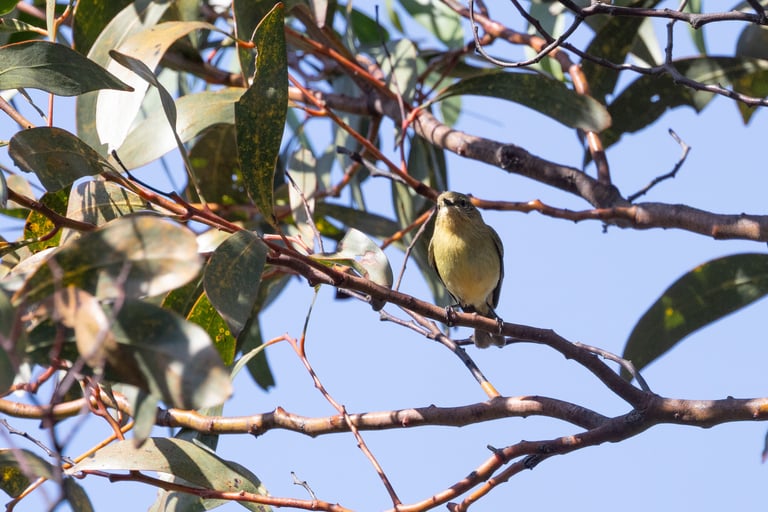
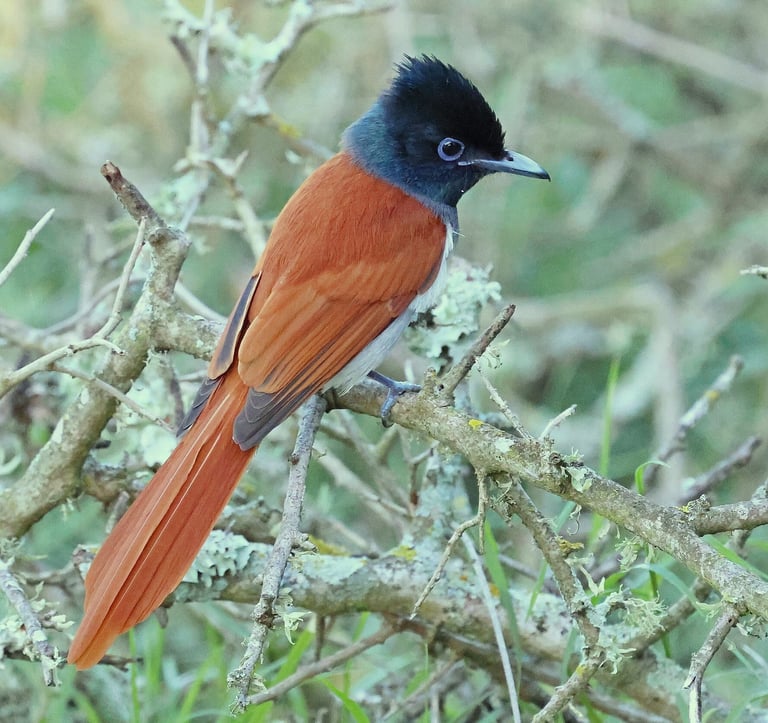
The red tips on the wing feathers of this bird look like drops of sealing wax, which is how it got its English name. The Bohemian waxwing (Bombycilla garrulus) is a starling-sized passerine that breeds in the northern forests of Eurasia and North America.
Adults weigh about , and the longest known age for the species is , a record often set in captivity. The breeding range covers about , and the IUCN lists the species as Least Concern.
It shares its range with the cedar and Japanese waxwings, but its larger size and bolder wing pattern set it apart. Its movements, which follow the fruit crop from year to year, make it one of the most mobile songbirds of the northern winter.
Identification and Appearance
The most useful field mark is the wing pattern. Adults show a bright yellow stripe on the closed wing, white 'fishhook' marks on the flight feathers, and a row of red wax tips on the secondaries. The yellow band at the end of the tail sits above a broad black border.
The bird measures 19 to 23 cm from bill to tail, with a wingspan of 32 to 35.5 cm. It is short-tailed and mainly brownish-gray, with a conspicuous pointed crest. The rich chestnut lower belly and cinnamon tones around the face add to its color.
Males have a sharply defined black throat and a black mask through the eye. Their yellow tail tip measures 6 to 11 mm across and they carry 6 to 8 red wax tips. Females look very similar but have a narrower yellow tail band of 4 to 8 mm, a less defined throat edge and 5 to 7 red tips.
First-winter birds lack the white tick mark on the primary tips and show fewer red tips. Juveniles, seen mainly on the far northern breeding grounds, are duller, with streaky whitish underparts and a smaller face mask. The cedar waxwing is smaller, browner above and lacks the white and yellow wing marks, while the Japanese waxwing has a red tail band.
Distribution and Habitat
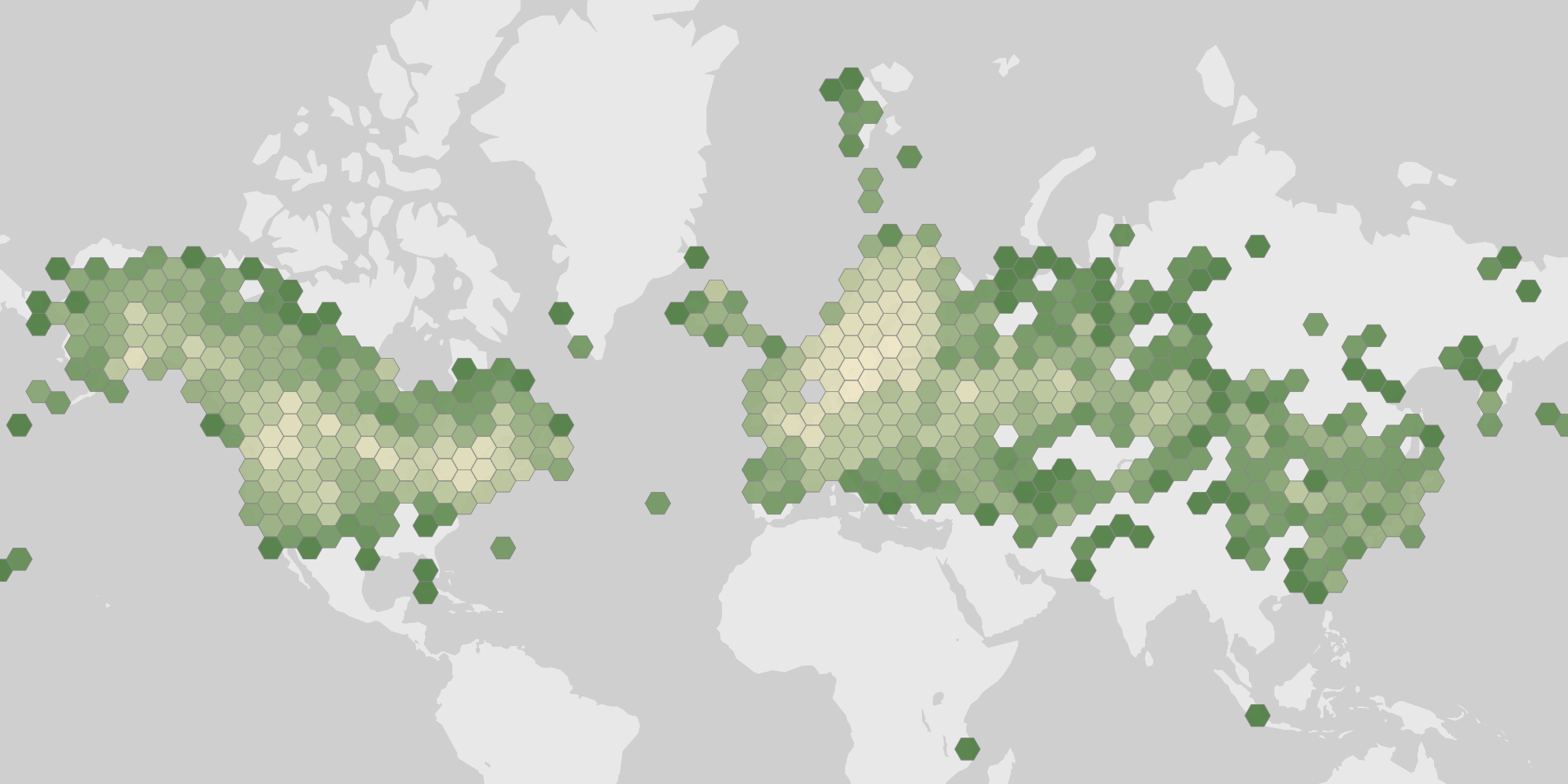
The species has a circumpolar breeding range across northern Eurasia and North America. In Eurasia it nests just short of the treeline, with most birds breeding between 60 and 67 degrees north and some reaching 70 degrees north in Scandinavia. The North American subspecies breeds in the northwest and north central parts of the continent, extending south into the Rocky Mountains.
The species is migratory. Birds leave the breeding grounds beginning in September in the north, and Eurasian birds winter from eastern Britain through central Europe to Japan. North American breeders winter mainly in southeastern Canada and the northeastern and north central United States. Wintering sites often change from one year to the next.
In some winters, flocks irrupt far south of their usual range when the fruit crop fails. In the winter of 2004 to 2005, more than half a million birds were counted in Germany alone. One flock seen in 1908 was 60 to 90 m wide and took two to three minutes to pass overhead.
Breeding habitat is mature conifer forest, often spruce, with lakes and peat swamps nearby for feeding on insects. Outside the breeding season, the birds use a wide range of habitats wherever fruit such as rowan is available, including parks, gardens and hedgerows. Presence observations cluster in late autumn and winter, though this reflects where birds are seen rather than their abundance.
Behavior and Lifestyle
Bohemian waxwings spend most of their time in the canopy. They flutter from perch to perch in shrubs and trees and rarely walk on the ground. Daily routines include preening, scratching the head with a foot while one wing is partly extended, and bathing in shallow puddles left by rain.
Outside the breeding season, the birds travel in flocks. Most flocks hold between 50 and 300 birds, though some have exceeded 3,000. Flocks share food through gift-passing, in which a bird hands fruit to a flock mate. Their calls help keep the flock together, and calling grows louder just before the flock takes off.
The species is not territorial. Males guard their mates during courtship and may snap their bills at rivals, but this is the only aggression noted in the species. Nests are often clustered where fruiting shrubs and trees are most abundant.
Communication
Bohemian waxwings communicate mainly by voice. The social call is a high, rapid trill, and it is generally lower in pitch than the call of the cedar waxwing. A longer, descending whistle serves as a disturbance call during nest building and incubation.
Mates use softer, higher contact calls when they are close to each other. Courtship calls cover a very wide range of frequencies and are given by both partners during nest building. Females keep up courtship calls while feeding and sitting on the nest.
Chicks also give a quiet trill to their parents. Visual displays and touch play a role in pair bonding and courtship feeding.
Recordings
song · Canada · Doug Hynes · CC BY-SA
Diet and Feeding Habits
Fruit forms the core of the diet, and the birds depend on sugary berries through the winter. In North America, favorite fruits include juniper and mountain ash. Their large liver helps turn sugar into energy, and they can process the alcohol produced when sugary fruit ferments.
In late spring and early summer, insects make up a larger share of the diet. Midges and mosquitoes are especially important, forming about 37% of the food in that period. Insects are also favored during the nesting season, when the birds feed them to their young.
When preferred foods are scarce, the birds take flowers and tree sap. Their plant partners are mainly species of the orders Rosales and Dipsacales, and the birds swallow the fruit whole and pass the seeds, which makes them important seed dispersers.
Nesting and Breeding
Courtship begins in winter and spring flocks. Pairs perch close together and hop toward each other until they nearly touch bills, passing food back and forth several times. Males with the most red wax on their wing tips are preferred by females, and older males usually carry the most. The pair bond is monogamous.
The breeding season follows the ripening of summer fruit and falls later than in most birds, even later than in the cedar waxwing. Birds return to the breeding grounds in April or early May in the north, and most nest from mid-June to July. Both sexes build a cup of thin twigs lined with grass, moss, fur or lichen, usually 1.3 to 15 m above the ground near the trunk of a pine or shrub.
A typical clutch holds four to six glossy eggs, pale blue-gray with black dots and wavy lines. The eggs measure about 24 mm by 18 mm. The female alone incubates them for 13 to 14 days while her mate feeds her, and both parents feed the chicks. The young are naked and altricial, with bright red mouths, and they leave the nest at 15 to 17 days, barely able to fly. The parents keep feeding them for up to two weeks after fledging.
One brood a year is normal. Breeding densities are usually below ten birds per square kilometer, although up to 35.6 birds per square kilometer have been found in Russia.
Population and Ecological Role
The global population is estimated at more than three million birds, and their numbers are large across a vast breeding area. Their importance as seed dispersers lies in the fruiting trees and shrubs they feed on, which they help spread across the north.
Many predators take them. Eurasian sparrowhawks, merlins and falcons hunt the birds, especially winter flocks, while snakes, lizards and small mammals such as dormice prey on eggs and nestlings. When alarmed, the birds freeze with bill and neck pointing up, and if that fails they fly off calling loudly.
The birds are infected with blood parasites, including Trypanosoma and Leucocytozoon, and carry mites, though worm infections are generally low.
Conservation and Threats
The IUCN lists the Bohemian waxwing as Least Concern. Its large numbers and vast breeding range keep it well above the thresholds for vulnerability, even though one assessment noted a slow decline as of 2013.
The main threats are collisions with windows and cars, and poisoning from pesticides. Road salt eaten while drinking can also kill the birds. Because the woodlands it uses lie far north of major human settlements, long-term threats are considered limited.
Populations are reported to be increasing in parts of the United States, where shrubland has been conserved. The species is protected under the US Migratory Bird Act.
Cultural Significance
Bohemian waxwings draw bird watchers, who seek out the big winter flocks that irrupt into towns and gardens. Their seed dispersal of fruiting trees and shrubs is also valued as a natural service.
Photos
Photographs from via iNaturalist, licensed under CC0 1.0., by Евгений Маринкин via iNaturalist, licensed under CC BY 4.0., by Анна Васильченко via iNaturalist, licensed under CC BY 4.0., by Ксения Волянская via iNaturalist, licensed under CC BY 4.0., by Allison Gray via iNaturalist, licensed under CC BY 4.0., by Марат Адиев via iNaturalist, licensed under CC BY 4.0., by Edoardo Nardelli via iNaturalist, licensed under CC BY 4.0., by Kate Senatskaya via iNaturalist, licensed under CC BY 4.0., by maria_is via iNaturalist, licensed under CC BY 4.0., by Алёна Осипова via iNaturalist, licensed under CC BY 4.0., and by Сергей Неклюдов via iNaturalist, licensed under CC BY 4.0., credited on each photo.
Ecology and classification
Classification
- Phylum
- Chordata
- Class
- Aves
- Order
- Passeriformes
- Family
- Bombycillidae
- Genus
- Bombycilla
- Species
- Bombycilla garrulus
Sources
- GBIF Species names and classification
- iNaturalist Photos
- Wikidata Common names and conservation status
- Wikipedia Summary extract
- Xeno-canto Audio recordings
- Animal Diversity Web Animal habitat, behavior and diet
- AnAge Longevity
- AVONET Bird mass, habitat, migration, diet and range size
- GloBI What it eats, what eats it, parasites and pollinators
- trophiCH
- HWML Parasite Collection
- TETRA-EU