The bronzed drongo (Dicrurus aeneus) is a small Indomalayan bird that hunts flying insects in the shaded understory of forest canopies, darting out from favorite perches to snatch prey in midair before returning to the same spot.
It belongs to the drongo family, Dicruridae, within the order Passeriformes, and is a resident species found across forests of the Indian subcontinent and Southeast Asia. Its conservation status is Least Concern. What makes it worth a closer look is how closely it resembles its larger relatives while showing distinct differences in tail shape and feather gloss, subtle clues that separate it from the rest of the drongo group.
Identification and Appearance
The most useful field mark is its small, compact build combined with a slender, deeply forked tail whose outer feathers flare outward slightly, distinguishing it from the larger black drongo. Adults weigh only about 0.026 kilograms, among the smallest of the drongos.
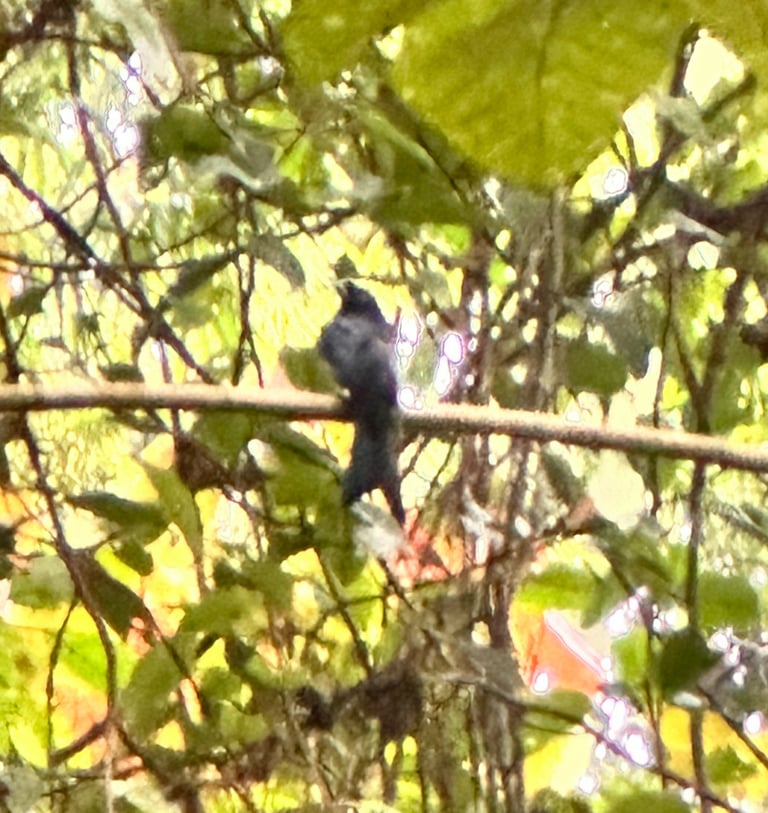
The plumage shows a strong metallic gloss with a spangled appearance across the head, neck and breast, while the lores appear velvety and the ear coverts are duller than the rest of the head. This spangled sheen is more pronounced than in the black drongo, giving the bronzed drongo its glittering look in good light.
Immature birds differ from adults in having axillaries tipped in white, and young birds overall appear duller and brownish with less spangling than adults.
Across its range, the species shows some geographic variation: the nominate race occurs from India to the northern Malay Peninsula, with southern Indian birds closely matching the malayensis form of Burma in size, suggesting the variation may be clinal. The Taiwanese population, treated as the subspecies braunianus, lives in the island's interior mountains, while malayensis extends from Selangor south into Sumatra and Borneo.
Distribution and Habitat
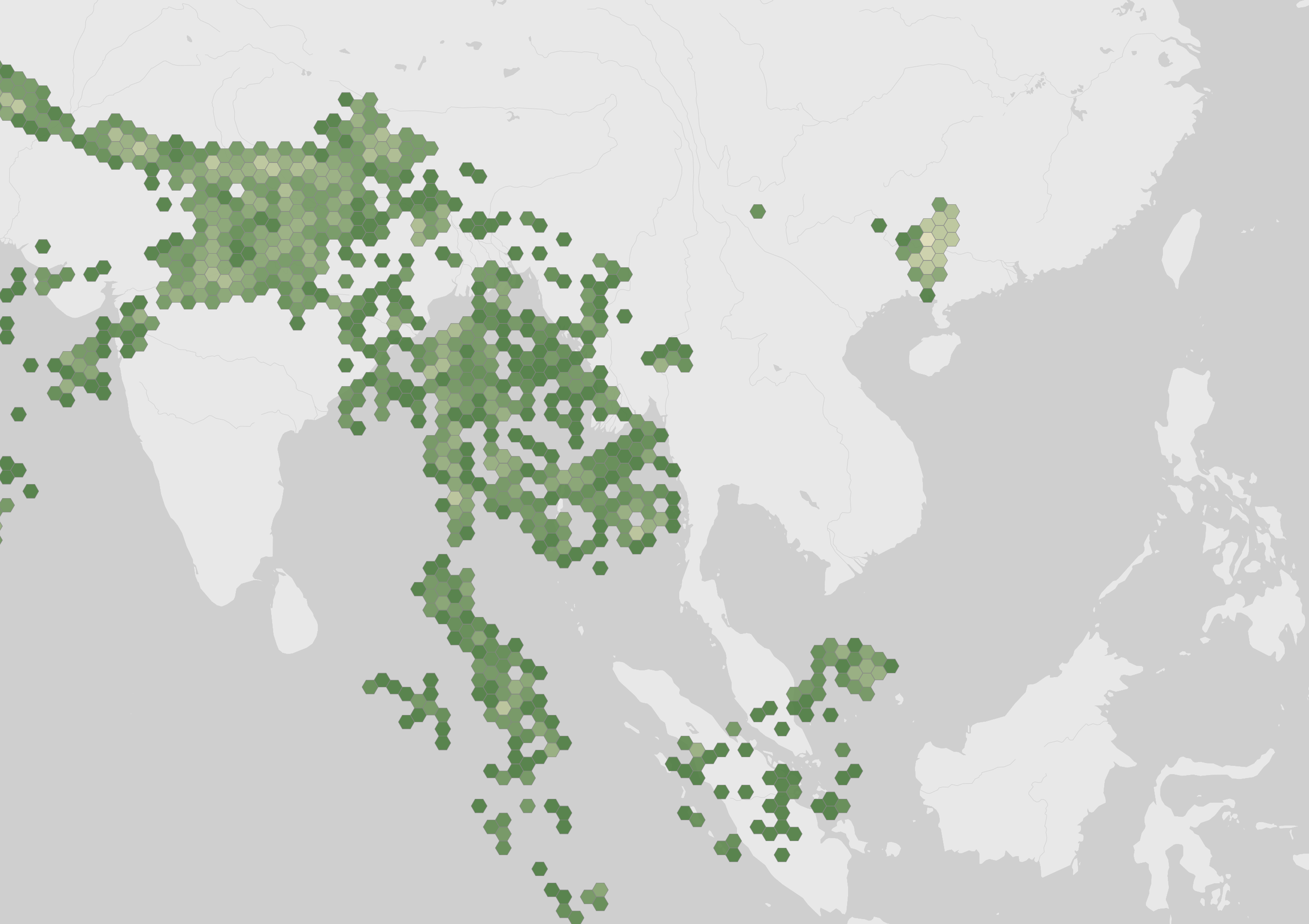
The bronzed drongo occupies a broad range stretching from the Western and Eastern Ghats of India and the lower Himalayas of western Uttaranchal eastward through Indochina and Hainan, and on into the Malay Peninsula, Sumatra and northern Borneo, spanning an estimated 4,640,000 square kilometers.
It is found almost exclusively in moist broadleaved forest, favoring dense forest cover rather than open or disturbed habitats. The species is described as exclusively forest-dwelling, rarely if ever venturing beyond these wooded environments.
Observation records show more sightings in the first months of the year and again toward the year's end, with a dip in the middle months, which may reflect seasonal presence or visibility rather than actual changes in numbers, since these figures reflect observation effort rather than a complete population count.
Behavior and Lifestyle
Bronzed drongos are typically encountered alone or in small groups of two to three, actively foraging for insects beneath the forest canopy through aerial sallies from favored perches. They will sometimes join mixed-species foraging flocks, taking advantage of insects flushed by other birds.
They are sedentary, remaining resident within their forest habitat year-round rather than migrating. Despite their small size of about 24 centimeters, they are notably aggressive and fearless, willing to attack much larger species that threaten their nest or young.
Their breeding season runs from February to July, during which they build a cobweb-covered cup nest in a tree that often appears whitish from the webbing.
Recordings
alarm call, call · Taiwan · Scott Lin · CC BY-SA
call · India · Jalmesh Karapurkar · CC BY
Fun Facts
- The bronzed drongo is one of the smaller members of the drongo group, distinguished from relatives like the black drongo by its more compact size and deeper tail fork.
- Its range spans an unusually wide stretch of Asia, from the Himalayas of northwestern India through southern China, Hainan, and Taiwan, down through the Malay Peninsula to Sumatra and Borneo.
- The species captures insects specifically in the shaded, dim light beneath the forest canopy, a specialized foraging niche compared to more open-country relatives.
Photos
Photographs from via iNaturalist, licensed under CC0 1.0., by 雲一百香果 via iNaturalist, licensed under CC BY 4.0., by rajesh rocky via iNaturalist, licensed under CC BY 4.0., by Gerard Chartier via iNaturalist, licensed under CC BY 4.0., by Tim via iNaturalist, licensed under CC BY 4.0., by sunnyjosef via iNaturalist, licensed under CC BY 4.0., by Srivatsan Ramkumar via iNaturalist, licensed under CC BY 4.0., by Ashwin via iNaturalist, licensed under CC BY 4.0., by Nathan Ruser via iNaturalist, licensed under CC BY 4.0., by 祐 via iNaturalist, licensed under CC BY 4.0., by Jannis Ackermann via iNaturalist, licensed under CC BY 4.0., and by Ashwin A via iNaturalist, licensed under CC BY 4.0., credited on each photo.
Ecology and classification
Classification
- Phylum
- Chordata
- Class
- Aves
- Order
- Passeriformes
- Family
- Dicruridae
- Genus
- Dicrurus
- Species
- Dicrurus aeneus
Sources
- GBIF Species names and classification
- iNaturalist Photos
- Wikidata Common names and conservation status
- Wikipedia Summary extract
- Xeno-canto Audio recordings
- AVONET Bird mass, habitat, migration, diet and range size