The greater racket-tailed drongo is famous for a trick rare among birds: it mimics the alarm calls of other species with enough precision to trigger real panic, then steals the insect prey abandoned in the confusion.
This medium-sized Asian bird belongs to the drongo family, Dicruridae, and is classified as Least Concern by the IUCN. It ranges across forested parts of South and Southeast Asia, where its loud, varied calls and elongated, racket-tipped tail make it one of the more conspicuous birds of the canopy. Its wide distribution and strong regional variation have also made it a textbook example of how isolation can drive the evolution of new forms.
Identification and Appearance
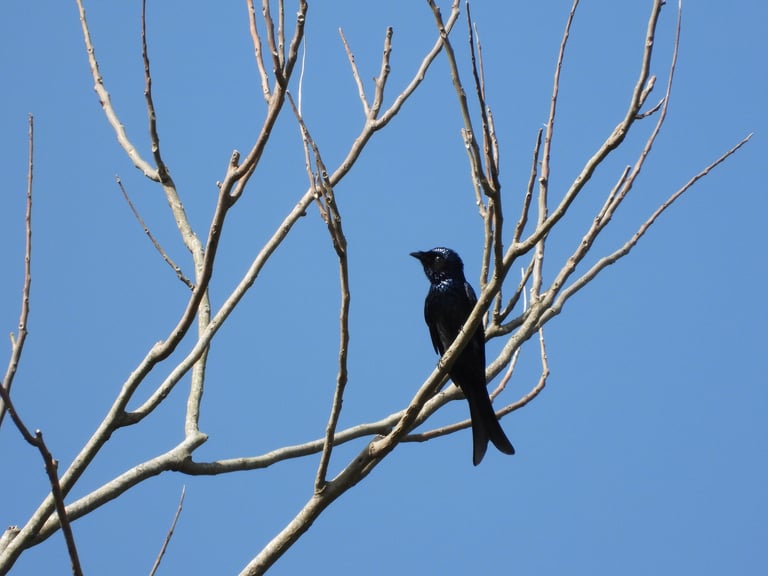
The single best clue to this species is its tail: two long outer feathers end in twisted, bare shafts that flare into small webbed 'rackets,' producing a silhouette that in flight looks like two large bees chasing a black bird. A crest of curled feathers rises from above the bill and along the crown, though its length varies strongly between populations.
At roughly 86 grams, it is the largest drongo across most of its Asian range. The plumage is wholly glossy black, with the sheen and details of the crest and neck hackles differing by subspecies: the Himalayan form grandis is the largest, with long glossy neck hackles; the Andaman form otiosus has short hackles and a much reduced crest; the Nicobar form nicobariensis carries a longer frontal crest but smaller hackles. Southeast Asian island populations such as brachyphorus and banguey can lack a crest altogether, and banguey even has frontal feathers that arch forward.
Young birds are duller and can lack a crest entirely, while adults in molt may temporarily lose their elongated tail streamers. In the eastern Himalayas it can be confused with the lesser racket-tailed drongo, but that species has flat rackets and almost no crest. The Sri Lankan form was once treated as a subspecies but is now recognized as a separate species, the Sri Lanka drongo, since the two overlap in range without merging.
Distribution and Habitat
This drongo occupies a very large range, stretching from the western Himalayas east through the Himalayan foothills and Mishmi Hills below about 1,200 meters, south through peninsular India and the Western Ghats, and on through Southeast Asia to the islands of Borneo and Java.
It uses a wide variety of wooded habitats, from moist deciduous forest to hill forest and open plains, and can occur anywhere from sea level up to about 2,000 meters, with populations densest in the Himalayan foothills. Monthly observation counts show a dip through the middle of the year and higher counts in the early months, which may reflect seasonal presence or detectability rather than a change in overall abundance.
It is a sedentary, resident breeder essentially everywhere it occurs, rather than a long-distance migrant.

Behavior and Lifestyle
This drongo is strongly territorial and aggressive, often mobbing larger birds, especially while nesting. It is most often seen alone, in pairs, or in small groups joining mixed-species hunting flocks, most commonly with jungle babblers.
Activity begins well before dawn, sometimes as early as 4 a.m. under moonlight, and continues into dusk, making it active far outside standard daylight hours despite being classed as diurnal. Its flight alternates short bursts of flapping with gliding dips, and the twisted tail rackets create a distinctive humming noise as it flies.
Its most unusual behavior is kleptoparasitism through mimicry: by imitating the alarm calls of other species, including raptors like the shikra, it can startle flock members into abandoning food, which the drongo then steals. It has even been observed fluffing its feathers and moving its head and body like a jungle babbler while copying that species' calls. Despite this piracy, most of its interactions with mixed flocks are mutualistic or commensal, and it has been seen associating with foraging woodpeckers and even following a troop of macaques.
Communication
Its vocal repertoire includes bell-like notes, whistles, warbles, and metallic sounds typical of drongos, delivered through both acoustic and visual channels. Calling often starts with a monotonous metallic tunk-tunk-tunk series before dawn.
The standout feature is its mimicry, which it uses both socially and strategically. It reproduces the alarm calls of other species accurately enough to provoke real alarm responses, a use of vocal imitation matched to its original context that is unusual among mimicking birds.
Hunting and Diet
This drongo hunts by catching insects in mid-air or picking them from surfaces, then carrying the prey back to a perch or nest in its claws. Its animal prey includes ants, bees, beetles, dragonflies, locusts, mantids, moths, and termites, making it a dedicated insectivore at its core.
Alongside insect hunting, it also feeds on nectar, visiting flowering plants directly rather than relying only on animal prey. This combination places it as both an insect predator and an occasional nectar feeder within the same foraging routine.
Nesting and Breeding
Pairs are monogamous during the breeding season, which runs from February to July depending on region: birds in the north breed later, between June and July, while tropical southern populations begin as early as February.
Courtship involves hops and turns on branches, along with playful behavior such as dropping an object and catching it in mid-air. The nest is a shallow, saucer-like cup built from intertwined roots and leaves, bound with cobwebs and camouflaged with lichens, typically placed at a horizontal fork in a smooth-boled tree with an isolated canopy; some pairs even strip bark to smooth the trunk first.
Clutches contain three to four eggs, creamy white with reddish-brown blotches denser at the broad end. Eggs hatch after about 15 to 17 days, and chicks fledge between 17 and 28 days old, reaching independence four to six weeks after hatching. Both parents share nest construction, incubation, and feeding duties, and continue watching over the young even after they leave the nest; there is also some evidence that older offspring help raise later broods.
Population and Ecological Role
As predators of large numbers of insects, greater racket-tailed drongos help regulate insect populations within the forest and mixed-species flock communities they occupy. Their nectar feeding also gives them a role in pollinating the plants they visit.
Conservation and Threats
The species is classified as Least Concern by the IUCN, reflecting its lack of major documented threats and its wide, largely stable distribution across South and Southeast Asia. It carries no special protective status under the US Migratory Bird Act, the US Federal List, CITES, or the State of Michigan list.
Cultural Significance
In much of India this drongo is known locally as kothwal, meaning 'policeman' or 'guard,' a name inspired by its whistle resembling that of a police whistle; it shares this name with the black drongo, and in other regions it is called Bhimraj or Bhringaraj. In the Mizo language of northeast India it is called Vakul, and the Mizo people use its tail feathers in ceremonies.
Before the 1950s it was commonly kept in captivity in parts of India, valued for being hardy and adaptable, much like a crow, with a varied diet. The scholar Edward H. Schafer proposed that this drongo was the basis for the divine kalaviṅka birds described in Chinese and Japanese Buddhist texts.
Fun Facts
- The species was first scientifically named Cuculus paradiseus by Linnaeus in 1766, before later being reclassified into the genus Dicrurus.
- Its tail 'rackets' are formed from the inner web of the feather vane, but a twist in the shaft makes them appear to sit on the outer web instead.
Photos
Photographs from via iNaturalist, licensed under CC0 1.0., by rajesh rocky via iNaturalist, licensed under CC BY 4.0., by Gerard Chartier via iNaturalist, licensed under CC BY 4.0., by Peggy Newman via iNaturalist, licensed under CC BY 4.0., by Paulmathi Vinod via iNaturalist, licensed under CC BY 4.0., by ꦥꦤ꧀ꦗꦶꦒꦸꦱ꧀ꦠꦶꦄꦏ꧀ꦧꦂ via iNaturalist, licensed under CC BY 4.0., and by jay penrice via iNaturalist, licensed under CC BY 4.0., credited on each photo.
Ecology and classification
Classification
- Phylum
- Chordata
- Class
- Aves
- Order
- Passeriformes
- Family
- Dicruridae
- Genus
- Dicrurus
- Species
- Dicrurus paradiseus
Sources
- GBIF Species names and classification
- iNaturalist Photos
- Wikidata Common names and conservation status
- Wikipedia Summary extract
- Encyclopedia of Life Habitat, diet and behavior traits
- Animal Diversity Web Animal habitat, behavior and diet
- AVONET Bird mass, habitat, migration, diet and range size