Each summer, Scotland's Highland moors turn a deep purple as Calluna vulgaris bursts into bloom across entire hillsides, a sight so tied to the region that the plant has become part of its identity. It is the sole species in the genus Calluna, an evergreen shrub in the heather family (Ericaceae), and it grows widely across Europe and Asia Minor on acidic, open ground.
Beyond its visual impact, the plant's reach into folklore, agriculture, and ecology across two hemispheres makes it far more than a simple moorland weed.
Identification and Appearance
The clearest way to tell Calluna vulgaris apart from its heath relatives (Erica species) is its foliage: the leaves are tiny scales less than 2 to 3 millimeters long, arranged in opposite, decussate pairs, whereas Erica leaves are larger and whorled in groups of three to five.
Most plants stand 20 to 50 centimeters tall, though specimens can reach 60 centimeters and, rarely, a full meter or more in height.
Flowering runs from July to September, earning the plant its old name of "summer" or "autumn" heather to distinguish it from spring- and winter-blooming Erica species. The flowers are typically mauve and borne in terminal racemes with sepal-like bracts at the base, though white-flowered plants occur occasionally, and unlike Erica, Calluna sometimes produces double flowers.
The shoots contain phenolic compounds, including chlorogenic acid and a distinctive phenolic glycoside, most abundant in summer. Its nectar also carries a compound called callunene, which suppresses Crithidia bombi, a common bumblebee parasite, by causing the loss of the parasite's flagellum and reducing its ability to anchor in the insect gut.
Distribution and Habitat
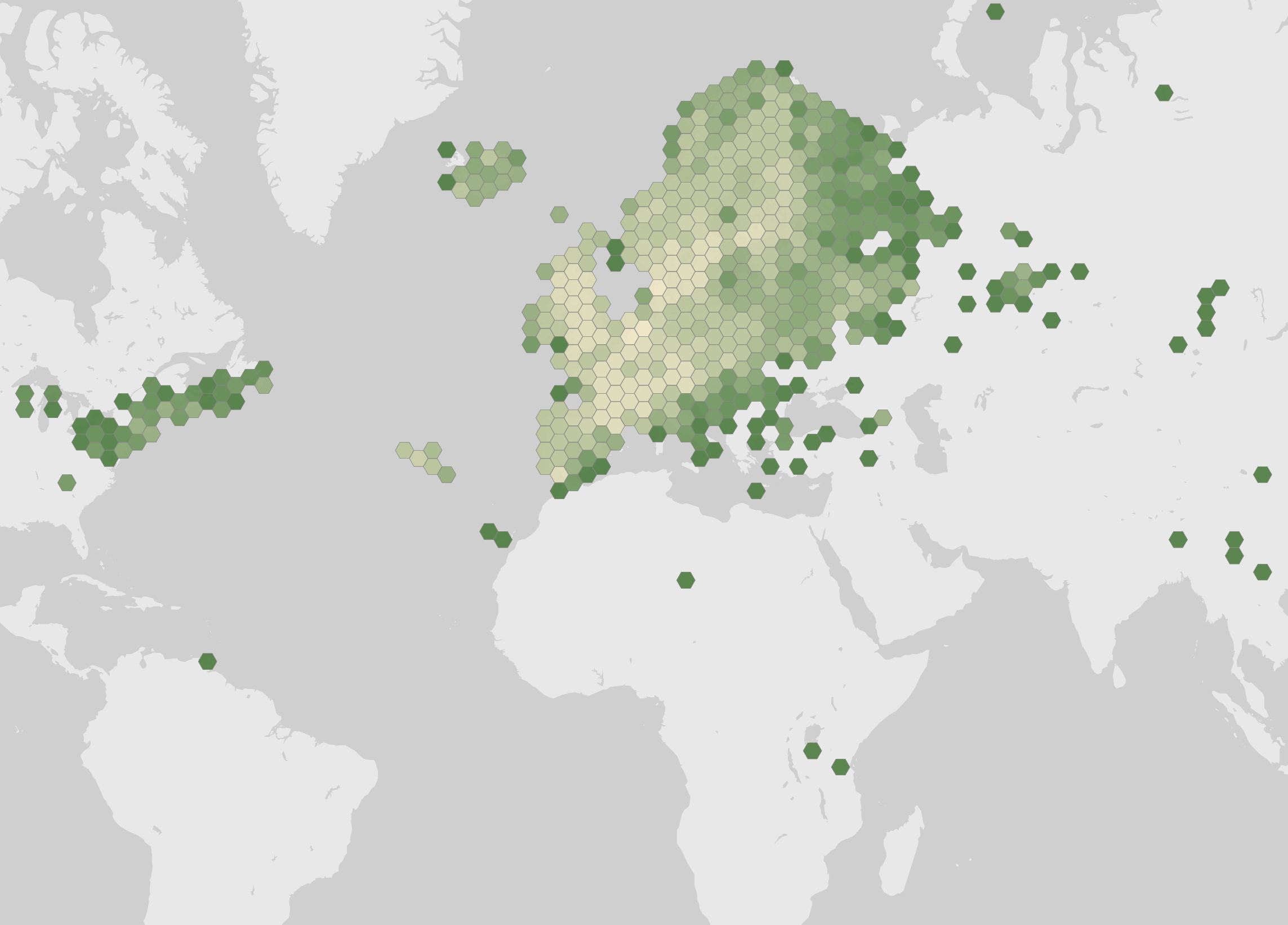
Calluna vulgaris is native to Europe, Iceland, the Faroe Islands, and the Azores, and it has been introduced to many regions with suitable climates, including North America, Australia, New Zealand, and the Falkland Islands.
It favors nutrient-poor, acidic soils in open, sunny sites, though it also tolerates moderate shade. It appears in dry fields, wet bogs, dry heathlands and moors, clearings within pine-birch forests, oak woodlands, and areas above the treeline.
The species is extremely cold-hardy, surviving severe exposure and freezing temperatures well below -20°C, which helps explain its persistence on exposed moorland and mountain slopes.
Monthly observation counts rise sharply through spring, peak in June and July, and taper off by autumn and winter. Since these figures reflect presence observations rather than abundance or a complete range, they should be read only as a rough hint of when the plant is most visibly recorded, likely tied to its flowering period.
Ecology and Relationships
Heather is an important food source for sheep and deer, which graze the tips of the plants when snow covers other low-growing vegetation. Willow grouse and red grouse feed on its young shoots and seeds, tying the plant directly into moorland game populations.
It also supports a specialized herbivore, the heather beetle (Lochmaea suturalis), whose adults and larvae feed on the plant and can cause extensive mortality where populations are heavy. Larvae of several moth species, including the small emperor moth (Saturnia pavonia), also depend on it for food.
Where introduced, the relationship can flip: in New Zealand's Tongariro National Park, Mount Ruapehu, and the Wilderness Reserve near Te Anau, heather has become invasive and overgrows native plants. Heather beetles have since been released there as a biological control, with preliminary trials showing success.
Uses and Human Relationships
Heather has served practical purposes for centuries: it was once used to dye wool yellow and to tan leather. Mixed with malt, it formed part of gruit, a flavoring blend used in heather-beer brewing before hops became standard; Thomas Pennant recorded in 1769 that on the Scottish island of Islay, ale was made from two parts heather tops to one part malt, sometimes with added hops.
Its stems have long been bundled into besoms, or brooms, a use commemorated in the old song "Buy Broom Buzzems." Heather honey is a prized product of moorland and heathland regions, with beehives moved there in late summer to collect it; the honey is thixotropic, setting into a jelly until stirred, when it turns syrupy before setting again, which makes extraction from the comb difficult enough that it is often sold as comb honey instead.
White heather is considered lucky in Scotland, a tradition popularized by Queen Victoria after she brought it from Balmoral to England, and sprigs are still sold as charms or worked into bridal bouquets. The stalks are also stripped, dyed, and compressed with resin for a small Scottish sentimental jewelry industry, and in traditional Austrian medicine the herb has been used as a tea for disorders of the kidneys and urinary tract.
Fun Facts
- Calluna vulgaris is regarded as an invasive species in British Columbia, Canada, where it has naturalized in some areas despite being the same plant celebrated in Celtic myth.
- It is the province flower of Västergötland in Sweden.
- Purple heather is one of Norway's two national flowers, chosen by a 1976 radio show popularity vote alongside Saxifraga cotyledon.
- In Irish folklore and mythology, heather is often linked to the mystical and otherworldly.
- Scottish legend holds that white heather grows only on the graves of fairies, reinforcing its reputation for luck and protection.
- The ancient physician Dioscurides dismissed heather honey as "mel improbum," or unwholesome honey, a judgment modern beekeepers who prize it would strongly dispute.
Ecology
Habitat
- Wetland
- Woodland
- Shrubland
- Mountain
Growth habit
- Shrub