A single cane toad can carry enough toxin behind its eyes to kill a full-grown dog. That defense, paired with an extraordinary capacity to spread and breed, has made Rhinella marina one of the most consequential animals ever moved by humans between continents.
Native to South and mainland Central America, this large, warty member of the family Bufonidae is classified as Least Concern by the IUCN in its home range, where it lives alongside the predators that have long kept it in check. The story changes entirely outside that range: introduced across Oceania, the Caribbean, Florida, and northern Australia to fight agricultural pests, the cane toad has instead become a byword for invasive species management gone wrong. Its combination of toxic defenses, prolific egg-laying, and tolerance for disturbed habitats explains why it is one of the most intensively studied amphibians on Earth.
Identification and Appearance
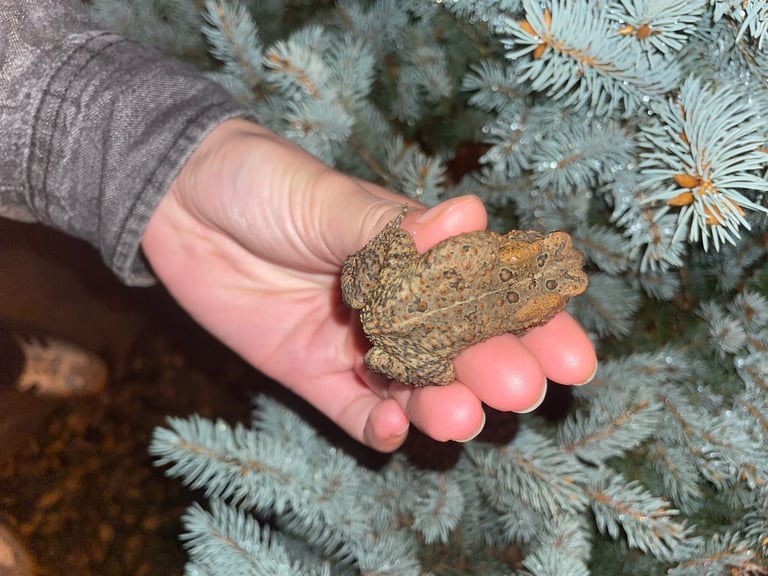
The single best way to identify a cane toad is its size paired with the large, swollen parotoid gland behind each eye — a feature no native Australian frog or toad shares. Females are markedly larger than males, typically reaching 10 to 15 centimeters in body length, with a documented maximum of 24 centimeters, making this the largest species in the family Bufonidae.
The skin is dry and covered in warts, with distinct bony ridges running from above the eyes down the snout. Coloration varies considerably between individuals, ranging from grey and yellowish to red-brown or olive-brown, often with mottled patterning, while the underside is cream-colored and may carry black or brown blotches. The eyes are distinctive up close: horizontal pupils set in golden irises. The toes carry fleshy webbing at their base, but the fingers remain unwebbed.
Juveniles look quite different from adults — smaller, smooth-skinned, and often dark or washed with red, and critically, they lack the large parotoid glands that make adults so toxic, leaving young toads far more vulnerable. In the water, cane toad tadpoles are small, uniformly black, and range from 10 to 25 millimeters long, forming dense schools along the bottom of ponds and ditches rather than swimming freely.
Distribution and Habitat
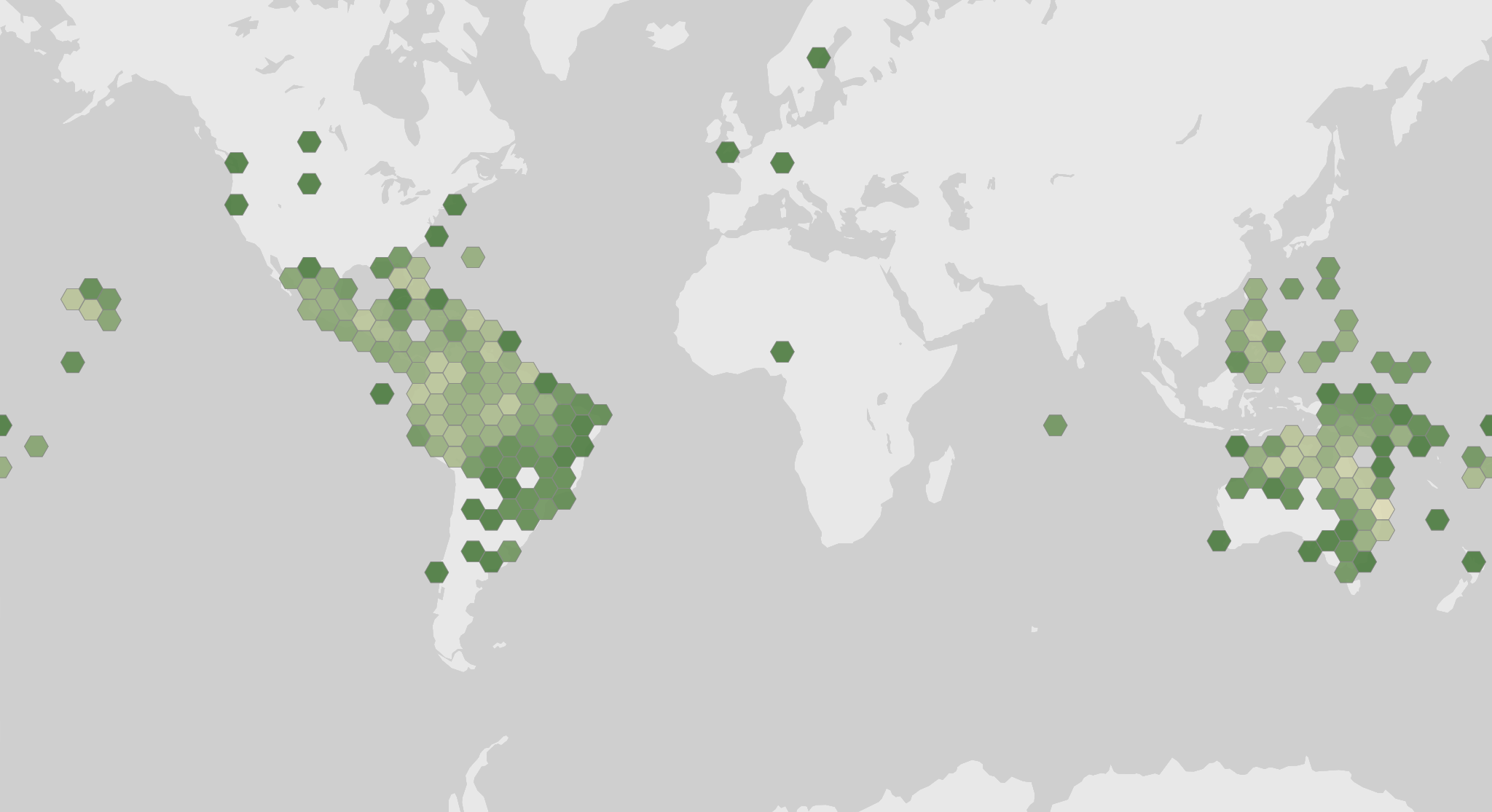
In its native range, the cane toad occurs from the Rio Grande Valley in South Texas south through Central America to the central Amazon and southeastern Peru, including continental islands near Venezuela such as Trinidad and Tobago. This span covers both tropical rainforest and semiarid environments, and the species favors forested areas near semi-permanent water, though it tolerates a surprising range of conditions — laboratory tadpoles survive salinities up to 15% of seawater, and field observations on Coiba Island in Panama found living tadpoles and toadlets at 27.5 parts per thousand salinity despite the species' non-marine lifestyle.
Density tells a striking story: in South America, cane toads occur at roughly 20 adults per 100 meters of shoreline, only 1 to 2% of the density recorded in introduced Australian populations. Beginning in the 1930s, following an apparently successful introduction to control sugarcane pests in Puerto Rico, the toad was deliberately released across the Pacific and Caribbean — Hawaii, the Philippines, Fiji, Papua New Guinea, and ultimately Australia, where 102 individuals released into Queensland cane fields in 1935 grew into a population that has since spread into the Northern Territory, New South Wales, and as far as Broome in Western Australia.
Outside forests, the species shows a clear preference for habitats altered by people, including gardens and drainage ditches, which has helped fuel its spread through disturbed and urban landscapes far from its rainforest origins.
Monthly observation counts show a rise from around 5,900 sightings early in the year to a peak near 10,600 in one month, before easing off — a pattern that likely reflects seasonal activity and breeding rather than a true population estimate, since these figures record presence, not abundance.
Behavior and Lifestyle
Cane toads move by hopping in short, quick bursts while holding an upright posture, and they are primarily nocturnal, becoming inactive during cold or dry seasons by digging into shallow excavations beneath ground cover — a form of aestivation that lets them ride out unfavorable conditions. Individuals are largely solitary outside of breeding congregations.
The species' signature behavior is chemical defense: when threatened, glands on the back and the prominent parotoid glands secrete a thick white bufotoxin. Ingestion or contact with mucous membranes can cause profuse salivation, twitching, vomiting, shallow breathing, and collapse of the hind limbs in a predator, sometimes leading to paralysis or death.
Physiologically, cane toads tolerate a critical thermal range of roughly 10–15°C at the low end to 40–42°C at the high end, and some populations can shift their cold tolerance within hours of encountering a temperature drop. This rapid physiological plasticity, combined with evidence that more northerly populations in the United States are better cold-adapted than southerly ones, has helped the species establish itself far beyond its tropical origins.
Communication
Cane toads rely on acoustic signaling during breeding, when males gather at water bodies and call in chorus to attract mates — the primary form of long-distance communication documented for the species. Tactile and chemical cues supplement these calls, both in mate location and, more broadly, in the toad's chemical defense system, where skin secretions communicate toxicity to potential predators through direct contact rather than sound or sight.
Hunting and Diet
Cane toads forage mainly at night, prowling mature forests and roadways to locate prey rather than lying in wait. In southern Florida, this nocturnal hunting concentrates on ants, beetles, and earwigs, but the species is highly opportunistic elsewhere: toads have been found with dragonflies, grasshoppers, true bugs, crustaceans, gastropods, and even dog and cat food in their stomachs, alongside occasional plant matter.
This flexibility — feeding on whatever terrestrial insects and small invertebrates are available in a given location — helps explain how the species thrives in such different environments, from native rainforest floors to suburban gardens and roadsides far outside its original range.
Reproduction and Life Cycle
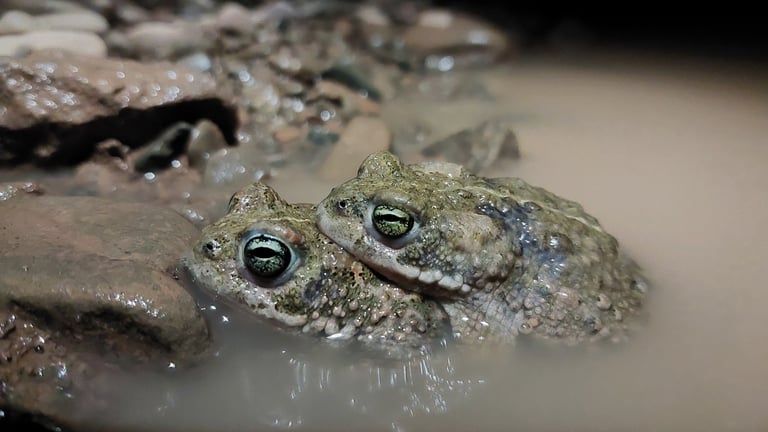
Breeding follows a promiscuous system in which males congregate at temporary or permanent still and slow-moving water to call for mates, and a single successful male may fertilize the eggs of multiple females in one season while a female's eggs may in turn be fertilized by more than one male. Courtship culminates in external fertilization as the pair spawns directly into the water.
A female lays her eggs in long jelly-like strings draped over rocks, debris, or emergent vegetation, releasing anywhere from 8,000 to over 30,000 eggs at once; these strings can stretch up to 20 meters. The black eggs, each about 1.7 to 2.0 millimeters across, hatch within 2 to 7 days depending on temperature.
Tadpoles are small, black, and form dense schools, developing into toadlets over a period that ranges from 12 to 60 days, typically around four weeks. Toadlets emerge at roughly 10 to 11 millimeters and grow rapidly, though the pace and timing of sexual maturity vary geographically — females in New Guinea mature at a snout–vent length of 70 to 80 millimeters, while those in Panama mature closer to 90 to 100 millimeters. Breeding continues nearly year-round in tropical parts of the range, while subtropical populations breed seasonally with the onset of the wet season.
Once eggs are laid and fertilized, the adults provide no further care; investment in offspring ends at the moment of spawning.
Population and Ecological Role
No overall population figures are available, but density comparisons hint at how differently this species behaves at home versus abroad: native South American shoreline densities run near 20 adults per 100 meters, a fraction of the density reached in introduced Australian populations. In its native range, a long list of predators keeps numbers in check, including the broad-snouted caiman, the banded cat-eyed snake, freshwater eels, killifish, and even bullet ants.
Where the species has been introduced, a different set of predators has learned to exploit it, often with specialized techniques. Australian water rats, or rakali, learned within two years how to flip toads over, surgically remove the toxic gallbladder and skin, and eat only the heart and other safe organs; crows and kites use a similar flipping strategy, and species such as ibis, whistling kites, kookaburras, and frogmouths also prey on the toad. Meat ants and opossums of the genus Didelphis appear largely unaffected by the toxin and can consume cane toads with little consequence.
Because the toad's normal defense is to stand still and let its toxin do the work, it is poorly equipped against attackers immune to that toxin, meaning its ecological role shifts sharply depending on which predators share its habitat — a stable prey item in South America, but a disruptive toxic novelty in places where predators have not evolved to handle it.
Conservation and Threats
The IUCN lists the cane toad as Least Concern, reflecting healthy, common populations across its native South and Central American range, where it is not considered in need of special conservation measures. It carries no special status under the US Federal List or CITES.
The conservation picture inverts entirely outside that native range: everywhere the species has been introduced, it is treated as a pest and actively targeted for extermination rather than protection, owing to its documented harm to native predators that lack tolerance for its toxin. This dual status — secure at home, persecuted abroad — makes the cane toad an unusual case in which the conservation priority is control rather than protection.
Conservation status
- LC
- NT
- VU
- EN
- CR
Least Concern
Cultural Significance
Long before its modern reputation as an invasive pest, the cane toad held spiritual significance for the Olmec, who are believed to have regarded the toad as a sacred being representing duality — its ability to live in both wet and dry worlds, in water and on land, mirrored themes of dual existence in Olmec thought. Some researchers suggest its toxins may even have been used as an entheogen in ritual contexts.
Practical use of the toad runs deep in South America: the Embera-Wounaan people traditionally "milked" the toads for their toxin to make arrow poison, and in parts of Peru the toad has been hunted as food after careful removal of the skin and parotoid glands, with the prepared meat valued as a source of omega-3 fatty acids.
In more recent history, the toad's toxins found their way into medicine and industry far from its homeland: bufotenin extracted from the toad has been used in Japan as an aphrodisiac and hair restorer and in China to slow heart rates during cardiac surgery, while for about two decades in the mid-20th century, toads were used worldwide in a rapid pregnancy test. Its skin is also turned into leather and novelty items, and stuffed, posed cane toads are sold as souvenirs in parts of Australia.
Fun Facts
- A female cane toad can lay more than 30,000 eggs in a single spawning event, strung together in jelly strands up to 20 meters long.
- Only an estimated 0.5% of cane toads survive to adulthood, partly because young toads lose the toxic protection of the egg and tadpole stage before their parotoid glands fully develop.
- In Australia's unnaturally dense invasive population, tadpoles have evolved to be far more likely to cannibalize their siblings than tadpoles in the native South American range.
- Despite the common name "marine toad" and the scientific name Rhinella marina, the species does not live in the sea, though its tadpoles can tolerate surprisingly salty water.
- While wild cane toads typically live 10 to 15 years, one captive individual reportedly survived for 35 years.
Ecology
Habitat
- Wetland
- Forest
- Woodland
- Grassland
Behavior
- Nocturnal
- Predator
- Solitary
- Hibernating
Diet
- Insectivore
Photos
SourcesGBIFiNaturalistWikidataWikipediaAnimal Diversity WebAnAge