By day the common toad all but disappears, tucked into leaf litter, burrows or damp crevices, only to emerge at dusk and spend the night hunting the invertebrates that make up its diet.
Bufo bufo is an amphibian in the family Bufonidae, order Anura, found across most of Europe, western North Asia and a small corner of Northwest Africa. The IUCN lists it as Least Concern, reflecting how common and widespread it remains through much of this range.
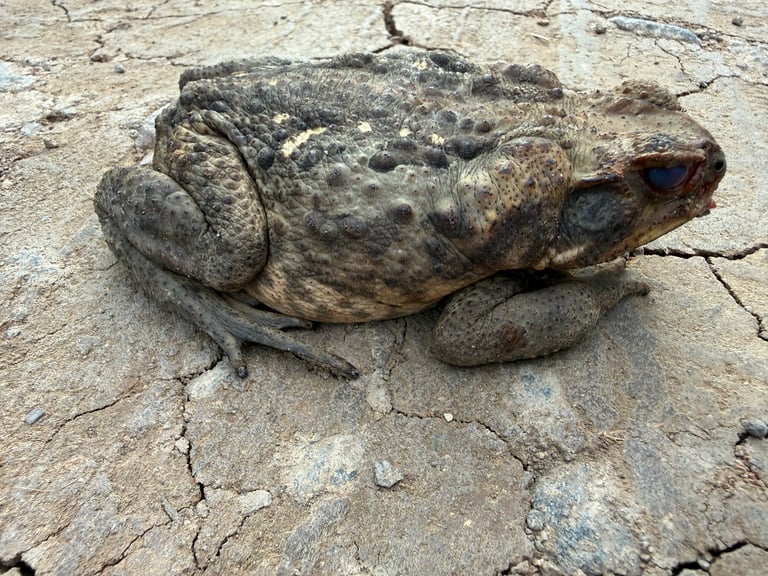
It belongs to a species complex, a group of closely related toads descended from a shared ancestral lineage, and its grayish-brown, wart-covered skin and ungainly gait make it one of the most recognizable amphibians a person is likely to encounter in a European garden or forest after dark.
Identification and Appearance
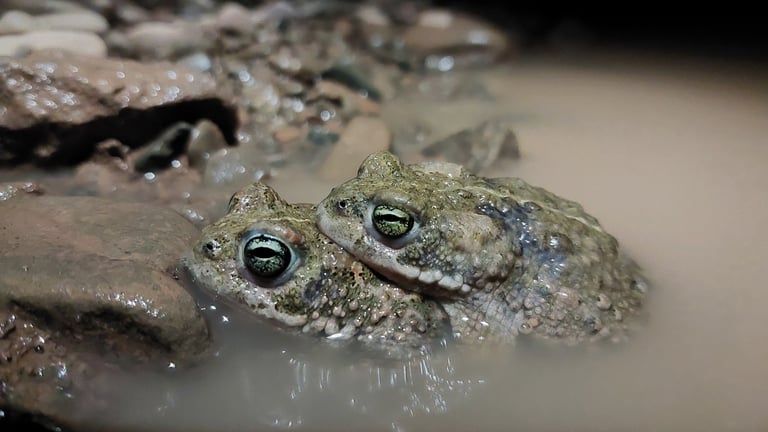
The clearest way to identify the common toad is by the pair of paratoid glands bulging just behind each eye: in Bufo bufo these sit at an oblique angle, whereas in the similar natterjack toad (Bufo calamita) and European green toad (Bufo viridis) they run parallel to one another. The glands secrete bufotoxin, a noxious substance the toad relies on to deter predators.
Adults grow to around 15 centimeters (6 inches) in length, with females typically stockier and larger than males, and toads from southern parts of the range outsizing their northern relatives. The body is broad and squat, held close to the ground, with a wide head that joins the trunk without a distinct neck. The mouth is wide and toothless, set below a terminal snout with two small nostrils, and the bulbous eyes have yellow or copper irises with horizontal, slit-shaped pupils.
Skin is dry and covered in small, wart-like lumps, colored a fairly uniform brown, olive-brown or grayish-brown, sometimes blotched or banded with darker patches. Males tend toward gray while females run browner, and the underside is dirty white speckled with gray and black. During the breeding season males develop nuptial pads on the first three fingers, used to grip females, and their hind feet carry long, unwebbed toes, while the toes on the front feet turn inward, an adaptation suited to walking rather than swimming.
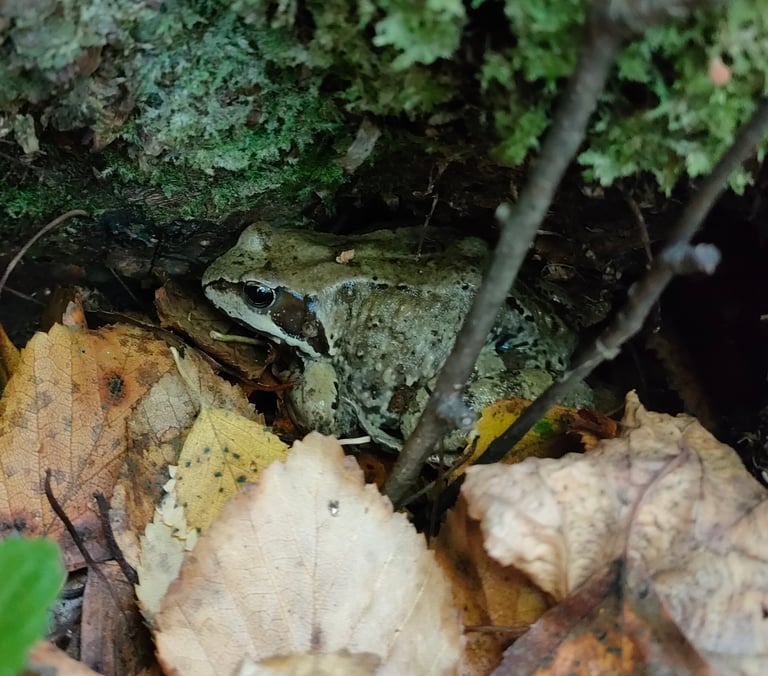
Beyond gland orientation, the natterjack toad is usually smaller and marked with a yellow stripe down its back, while the green toad shows a distinctive mottled pattern. The common frog (Rana temporaria) can also be mistaken for a toad but has a pointier snout, damp smooth skin, and moves by leaping rather than the toad's slow walk. Common toads are long-lived: individuals in the wild typically survive ten to twelve years, though captive animals have reached fifty, and their age can be read from the annual growth rings laid down in the bones of their toes.
Distribution and Habitat
The common toad ranges across nearly all of continental Europe, absent only from Iceland, the far north of Scandinavia and a handful of Mediterranean islands such as Malta, Crete, Corsica, Sardinia and the Balearic Islands. It has also been introduced to parts of Ireland, where it appears to be thriving. To the east its range extends as far as Irkutsk in Siberia, and to the south it reaches the northern mountains of Morocco, Algeria and Tunisia, with populations recorded up to 2,500 meters (8,200 feet) in the southern part of its range. After the common frog, edible frog and smooth newt, it ranks as the fourth most common amphibian in Europe.
It favors forested habitat, particularly wet stretches of coniferous, deciduous and mixed woodland, but is flexible enough to occupy open countryside, farmland, copses, parks and gardens. Despite depending on ponds for breeding, adults are often found in dry areas well away from standing water outside the breeding season.
Monthly observation records show a sharp rise from a low in January and February to a peak in March, before tapering steadily through summer into a winter low again, a pattern that lines up with toads emerging from hibernation and gathering at breeding ponds in early spring before dispersing into surrounding habitat for the rest of the year. These figures reflect how often the species has been recorded rather than its true abundance or the full extent of its range.

Reproduction and Life Cycle
Each spring the common toad leaves its hibernation site and migrates en masse to a breeding pond, and it is remarkably faithful to the same location year after year: more than 80% of males marked as juveniles have been recorded returning to spawn in the very pond where they hatched. Toads find their way back using a combination of olfactory, magnetic and visual cues, and experiments moving them more than three kilometers (two miles) from their pond found many were still able to relocate it.
Males arrive first and linger for weeks, while females stay only long enough to mate and lay their eggs. Because males typically outnumber females at the pond by four or five to one, competition is intense: some disputes are settled by the pitch of a male's croak, a reliable signal of body size, but a Swedish study of one pond found 38% of successful males won access by physically displacing or defeating rivals already in amplexus. Female mortality also runs higher than that of males, with 41% skipping a breeding season entirely in some years.
A successful male grips the female under the forelimbs in amplexus, sometimes remaining attached for several days as she lays a long, double string of 1,500 to 6,000 small black eggs, stretching 3 to 4.5 meters (10 to 15 feet) and becoming tangled among pond vegetation as the pair move through the shallows. Males in the throes of breeding are indiscriminate enough to occasionally grasp fish or other males instead of a mate.
Tadpoles hatch after about 10 days and initially cling to the remnants of the egg string, feeding on its jelly before attaching to submerged leaves and eventually swimming freely. They can be told apart from common frog tadpoles by their darker coloring and a mouth exactly as wide as the gap between their eyes. Over several weeks their legs develop and the tail is reabsorbed, and by around twelve weeks old they have become miniature toads roughly 1.5 centimeters (0.6 inches) long, ready to leave the pond.
Population and Ecological Role
The common toad occupies a role as both predator of invertebrates and prey for a wide range of animals, defending itself when threatened by inflating its body, raising its hindquarters and lowering its head while relying on bufagin, a foul-tasting toxin secreted from its paratoid and other skin glands. The defense fails against grass snakes, which appear unaffected, and crows have learned to puncture the skin and extract the liver while avoiding the toxin entirely. Hedgehogs, rats, mink and even domestic cats also take adult toads, while herons, crows and birds of prey hunt them from the air.
Tadpoles secrete their own noxious compounds to deter fish, though great crested newts are unaffected, and aquatic invertebrates such as dragonfly larvae, diving beetles and water boatmen get around the chemical defense by puncturing the tadpole's skin and sucking out its contents rather than swallowing it whole. Adult toads also face a specialized threat from the parasitic fly Lucilia bufonivora, whose larvae, once hatched from eggs laid on the toad's skin, crawl into the nostrils and consume the toad's flesh from within, usually with fatal results.
One unusual relationship benefits a small mollusk, the European fingernail clam (Sphaerium corneum), which can climb onto a toad's toe and hitch a ride to new ponds, a likely means by which this otherwise slow-moving clam disperses across the landscape.
Conservation and Threats
The IUCN Red List classifies the common toad as Least Concern, a status justified by its wide distribution and continued abundance across most of its range, along with its tolerance of many habitat types from deciduous and coniferous forest to scrubland, meadows, parks and gardens. Even so, the species faces mounting pressure in specific regions and habitats.
Its most significant threats are habitat loss, the drainage of wetlands needed for breeding, agricultural intensification, pollution and road mortality; the common toad suffers the highest roadkill rate of any amphibian in Europe, with many deaths occurring where migration routes cross roads that follow streams. Chytridiomycosis, a fungal disease of amphibians, has been detected in populations in Spain and the United Kingdom and may be affecting numbers there. In Spain increasing aridity and habitat loss have pushed the species to a Near Threatened status, and in the Sierra de Gredos mountains, expanding populations of otters and the frog Pelophylax perezi are adding new predation and competition pressure at higher elevations.
In the United Kingdom the species cannot be legally traded and has been named a Biodiversity Action Plan priority species due to a slow, ongoing decline, while parts of Russia list it as a rare species even though numbers rose in the Moscow Oblast during the 1990s. Toads confined to small, isolated urban patches show lower genetic diversity and more physical abnormalities than rural populations, a sign that habitat fragmentation is eroding long-term population viability in cities.
In several countries, including Germany, Belgium, the Netherlands, Britain, northern Italy and Poland, road tunnels have been built to let toads cross safely, and volunteer toad patrols carry them across busy roads in buckets during the spring migration.
Conservation status
- LC
- NT
- VU
- EN
- CR
Least Concern
Cultural Significance
In medieval Europe the common toad carried a heavy symbolic weight, widely associated with the Devil, who was even given a coat of arms bearing three toads, and viewed as a witch's familiar capable of poisoning people. Ordinary people made use of dried toads and their bile, feces and blood, and in the Basque Country witches were believed to keep familiars in the form of toads dressed in elegant robes; when the Spanish inquisitor Alonso de Salazar Frías searched suspected witches' houses for such dressed toads between 1610 and 1612, he found none.
The toad's supposed venom, called "sweltered venom," fed into literary depictions of it as an agent of poison and evil: John Milton cast Satan as a toad pouring poison into Eve's ear in Paradise Lost, and Shakespeare's witches in Macbeth used a toad in their spell-making, while As You Like It references the old belief in a protective "toadstone" said to lie hidden inside a toad's head. A gentler image appears in Kenneth Grahame's The Wind in the Willows, where the conceited, endearing Mr. Toad became popular enough to inspire A. A. Milne's stage adaptation, Toad of Toad Hall.
George Orwell took a very different view in his essay "Some Thoughts on the Common Toad," describing the toad's emergence from hibernation as one of the most moving signs that spring has arrived.
Fun Facts
- The genus name Bufo comes directly from the Latin word for "toad," making the common toad's full scientific name, Bufo bufo, essentially "toad toad."
- It has no teeth and no external vocal sac, a trait that sets it apart from many true frogs.
- The toes on its front feet turn inward and its hind feet carry long, unwebbed toes, features suited to walking rather than swimming.
- While wild individuals typically live ten to twelve years, common toads have survived up to fifty years in captivity.
- Biologists can estimate a toad's age by counting the annual growth rings preserved in the bones of its toes.
- During the frenzy of the breeding season, some males will attempt to grasp fish, inanimate objects or even other males instead of a female.
Ecology
Behavior
- Nocturnal
- Predator
- Migratory
- Crepuscular
Habitat
- Forest
- Woodland
- Grassland
- Urban
Diet
- Insectivore